
Shrek - An Economic Analysis
The Working Class Hero
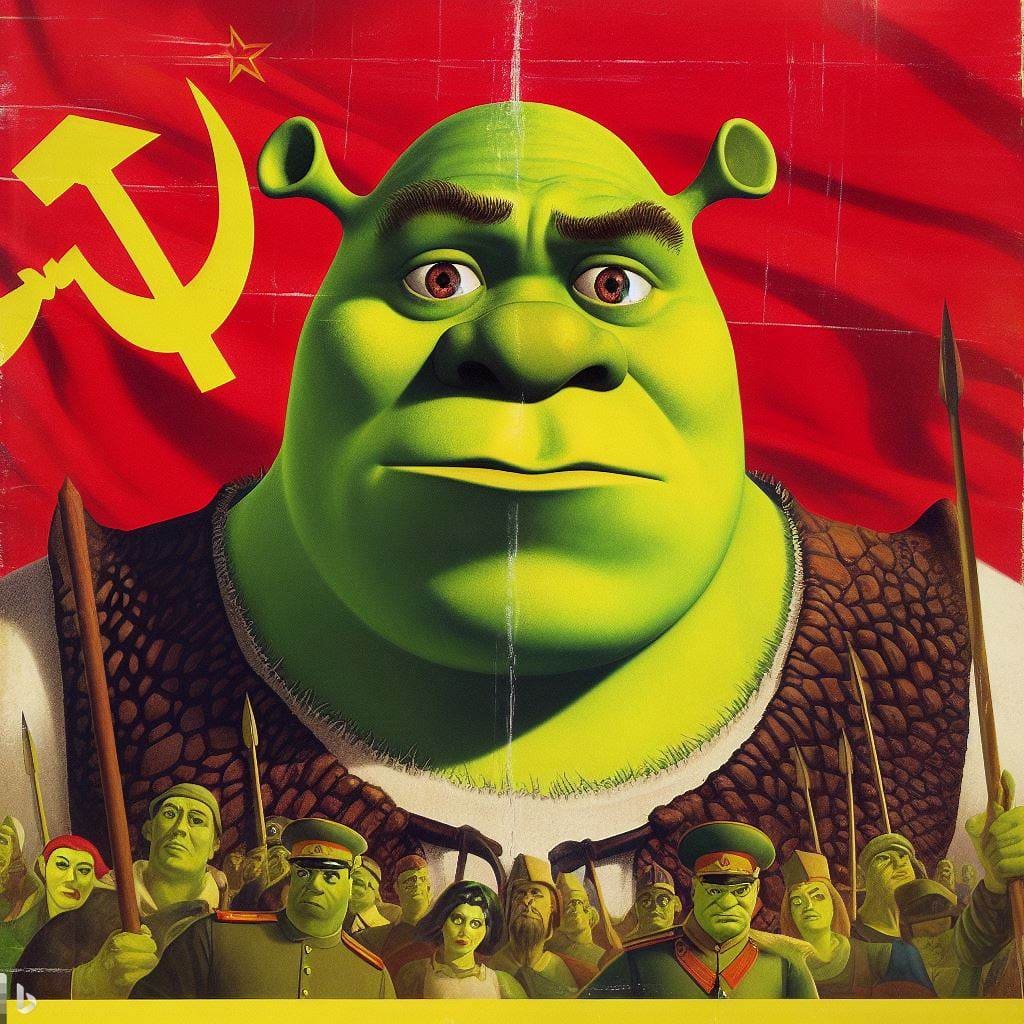
In the Shrek universe, the ogre archetype is universally perceived as a menacing and violent creature. However, a careful examination of the central character, Shrek, reveals that these conventional notions are unfounded. Shrek, in fact, espouses a pacifist disposition, preferring to sidestep confrontations and resort to nonviolent means of self-defense. This characterization hints at the broader theme of disenfranchisement and stereotyping faced by ogres within the context of the film.
Shrek also serves as a personification of the negative stereotypes often associated with the working class, embodying traits such as poor hygiene, rudeness, and an existence amidst squalor. These stereotypes are regrettably common and harmful in the portrayal of underprivileged, working-class individuals. Shrek's exaggerated embodiment of these traits underscores his role as a symbol of the proletariat, and his status as an ogre places him at the lowest rung of the societal hierarchy.
Within the society depicted in the film, a totalitarian regime appears to reign, exemplified by the subjugation of fairy tale creatures who are deprived of their rights. They are forcibly displaced to Shrek's swamp without due process, a clear indication of Shrek's limited control over his own property. Lord Farquaad's brutal interrogation of the gingerbread man, labeling fairy tale creatures as vermin poisoning his utopian vision, closely resembles the ideologies of totalitarian regimes like the Nazis, wherein external elements were vilified as threats to an ideal society.
Evidently, the Shrek universe lacks a sense of class consciousness or solidarity among the working class. Shrek, personifying the proletariat, embodies a solitary disposition, and early in the film, the working-class characters themselves partake in the persecution of fairy tale creatures for monetary gain. In contrast, Donkey emerges as a revolutionary figure, attempting to forge an alliance with Shrek to resist the ruling class. His refusal to judge Shrek based on his ogre status reflects an awareness of the importance of working-class unity and the avoidance of internal divisions. However, Shrek consistently rebuffs Donkey's overtures for collaboration and collective action, adhering to a non-violent and pacifist stance.
As the plot unfolds, Donkey, representing the revolutionary spirit, advocates for violent resistance to overthrow the bourgeoisie. When Shrek is coerced by Lord Farquaad to rescue Princess Fiona in exchange for regaining his swamp, Donkey attempts to instill class consciousness in Shrek and suggests a revolutionary course of action. Shrek, however, staunchly rejects this, emphasizing his commitment to non-violence and the desire to dispel the stereotypes that cast ogres as inherently violent.
This misplaced philosophy of non-violence and acquiescence may render Shrek susceptible to the allure of liberal reforms presented by the bourgeoisie in the form of Princess Fiona. It is not uncommon for the bourgeoisie or fascist entities to offer the working class apparent compromises to maintain control and propagate the illusion of societal improvement. However, these reforms typically bring no substantial change and uphold the existing power dynamics, resulting in continued exploitation of the lower classes.
Princess Fiona serves as the epitome of the upper class within the narrative, characterized by her beauty, eloquence, and proper demeanor, in stark contrast to Shrek's portrayal. Her personality undergoes rapid transformation throughout the film, adapting to her immediate needs. When she overhears Donkey and Shrek discussing collaboration, her sudden shift to a more ogre-like demeanor is purposeful. Shrek, influenced by her appearance and actions, begins to identify with this bourgeois figure, mirroring the way politicians present themselves to the masses through political advertisements and speeches.
Historical parallels can be drawn here, notably to Hitler's use of red in the Nazi flag to appeal to the working class, an idea derived from his attendance at a Marxist demonstration. Class collaboration, a fundamental element of fascist ideology, encourages cooperation across different class strata to uphold the social hierarchy and create the illusion of a mutually beneficial relationship between the oppressed and oppressor. Princess Fiona's transformation aims to appear relatable to Shrek, emphasizing the need for this illusion to perpetuate the status quo.
As the film progresses, Donkey, the revolutionary, is gradually left behind and overshadowed by Shrek. The attempt to halt the wedding between Lord Farquaad and Princess Fiona is a symbolic gesture towards revolution, but the disunity among the working class and the lack of a clear objective hinder its success. Donkey, after forming a connection with the dragon, enlists her support in disrupting the wedding. The dragon, like Donkey, believes in the necessity of violence to challenge the bourgeoisie, leading to the swallowing of Lord Farquaad. Nevertheless, Shrek's aversion to violence and his susceptibility to liberal reforms impede the revolution's success.
A pivotal scene arises when Princess Fiona discloses her ogre curse to Shrek, an ultimate facade that he wholly embraces. This moment represents the proletariat falling for the bourgeoisie's illusory promises of happiness, preventing the revolution from reaching fruition.
The movie's denouement illustrates how the working class, under the influence of ideology and a culture of forgetfulness, ends up celebrating individuals who have subjected them to torment
About the Creator
Keep reading
More stories from James Watson and writers in Art and other communities.
Debunking Misconceptions about the Frankfurt School: Adorno's Analysis of the Culture Industry
There exists a common misperception that the members of the Frankfurt School, most notably Theodor Adorno, harbored a disdain for Western culture and sought its obliteration. However, the actual truth is quite the contrary. Adorno, the focus of our discussion in this video, did not harbor any aversion for Western culture. Instead, he was deeply concerned about its degradation, which he believed resulted from the overpowering influence of capitalism. His trepidations centered on the cultural transformation that transpired when profit motives took precedence over all other aspects, leading to what Adorno and Max Horkheimer termed the "culture industry."
By James Watson2 years ago in Art
Jim Sloan
By Brian D’Ambrosio At 90, Jim Sloan has lived several lifetimes’ worth of work—carpenter, sign painter, excavator, sawmiller, road-builder and the go-to rattlesnake remover of Galisteo, New Mexico. Art may be the through-line, but it has never been the source of his income, nor the center of his universe. Sloan has always kept one foot in the studio and the other in the soil, without bothering to decide which world he truly belongs to. The truth is that he fits cleanly into neither, and he has long since stopped trying.
By Brian D'Ambrosio 6 days ago in Art


Comments (1)
Thank you for sharing this interesting analysis of the Shrek universe. I agree that the film offers a nuanced exploration of social themes such as classism, xenophobia, and the dangers of conformity.