
New Power: Long Strokes
Without even dipping a toe in the water, Maxwell Alexandre's work dives into the debate on contemporary art and identity.

These are days when no one should rely unduly on his competence. Strength lies in improvisation. All the decisive blows are struck left-handed.
- Walter Benjamin in One-Way Street
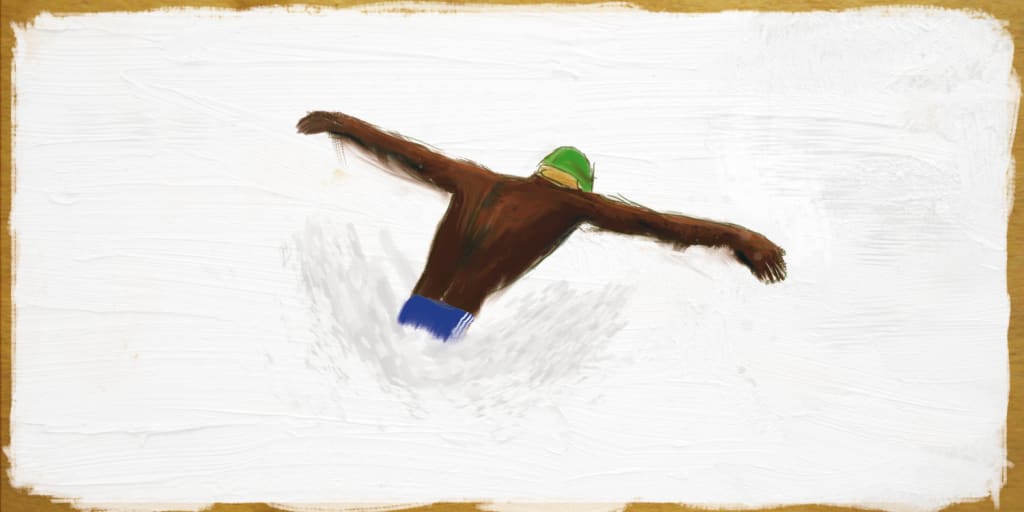
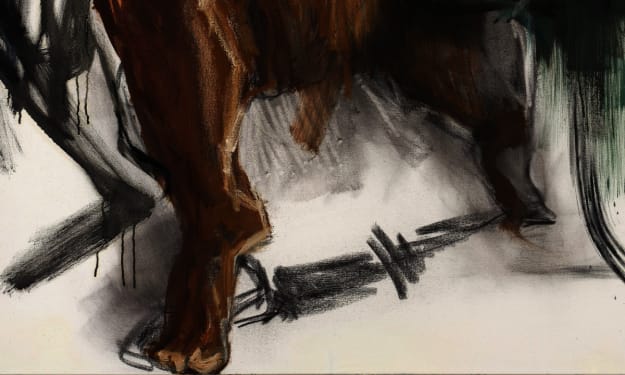
“I am not a painter,” says Maxwell Alexandre in a video promoting the first exhibition of his installation “Novo Poder: Passabilidade” in the capital of São Paulo. Even so, the artist has found success in his recent endeavor, full of examinations, inventiveness and freshness. Having already exhibited abroad, the artist, like a determined designer, used materials that he had access at the time to give substance to his idea, even though these were recognized as unconventional materials. Initially, the challenge posed by these tools enhanced the images produced, giving them a unique visual aspect, in addition to introducing questions about the art object. Along with the use of acidic brown kraft paper as a support, the artist previously used materials such as shoe polish and wall tint, addressing the preservation of his work and its value in the art market.
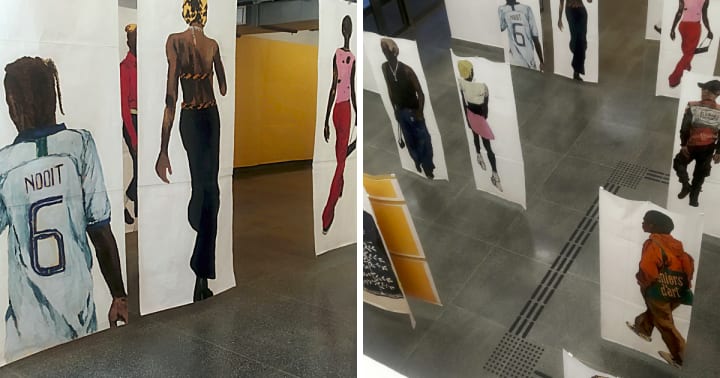
More than a series of paintings, the work is an installation where the physicality of the figures occupies the environment and the space between them is loaded with meaning; the spectators move among the figures, who in turn are mixed with the flesh-and-blood passers-by. Exhibited in a format similar to rafters, the works reveal the rawness of brown kraft paper on its reverse. From the front, the full-body representation of people in movement gives lasting materiality to the ‘rolêzinhos’, a type of manifestation that has put tension in environments that are generally hostile to the participants of this form of peaceful movement that emerged in Brazil in the last decade. In the installation, currently on display at Sesc Avenida Paulista, the figures are inserted into a uniform white background. As the creator himself pointed out, the objective was to evoke ‘the white cube’, a term that attributes to art galleries and museums the characteristic of isolating artistic work from the outside world and facilitating its appreciation, thus making the perception of these environments invariably linked to what is exclusive and exclusionary. The isolation and restricted access imposed in these places are often contested by artists, who demand it’s democratization and greater integration with the outside world.
A gallery is constructed along laws as rigorous as those for building a medieval church. The outside world must not come in, so windows are usually sealed off. Walls are painted white.
Brian O'Doherty in ArtForum Magazine, vol.24 n.9.
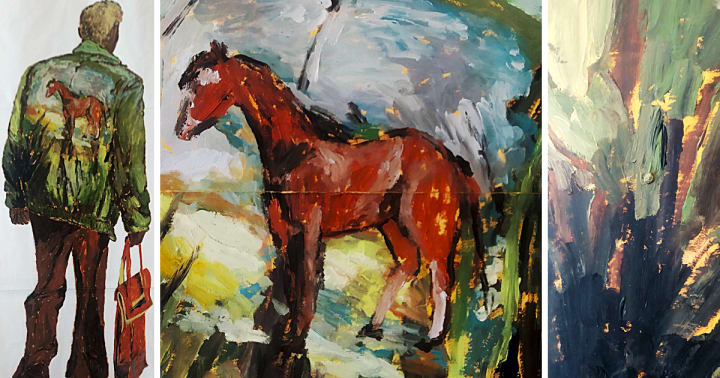
The white background is combined with the black of the skin under the brown of the paper. The relations of the colors here carries multiple and yet objective connotations, highlighting mainly its provocative character in relation to the diversity of art spaces and a critique that addresses the parameters of racial identification. In the details of most of the works presented, small portions of paper without paint are noticeable, revealing the ocher color of the support amid the figures represented, a detail that is not appreciated against the white background. This suggests a 'blackening', an intention perhaps diametrically opposed to whitening, a concept disseminated by eugenic minds who, from the last years before abolition, saw the racial miscegenation present in Brazil as a trait that was detrimental to the moral and material development of its population; ideas that unfortunately still influence the social dynamics in the country. As an inversion of the Redemption of Cam, this detail in Maxwell's work suggests that miscegenation goes beyond skin color.
Racial identification is almost a relational issue in Brazil: it varies from individual to individual, depending on the place, time and the observer. The lighter the person asking the question, the “darker” the answer can be, and vice versa.
- Lilia Schwarcz in 'Nem preto nem branco, muito pelo contrário'
Color is a physical feature that differentiates similar individuals biologically. Race encompasses more complex cultural values. The artist from Rio de Janeiro presents an aesthetic based on his own history and his investigative efforts regarding his perception of himself, a characteristic that can be widely recognized in several works within the contemporary artistic production worldwide. As if answering a census question with another question, his installation instigates a review of genetic biology, more specifically its concept of dominant and recessive genes, thus bringing new ways of approaching concepts such as color and race, for example, through fashion.
The fact is that you thought that clothes and places could protect you in some way. But that wasn’t a rule. One day, before you caught the bus to go back home, you decided to take a walk around Moinhos de Vento park, with your new shoes and your reversible jacket from Tevah stores.
- Jeferson Tenório in Dark Side of Skin
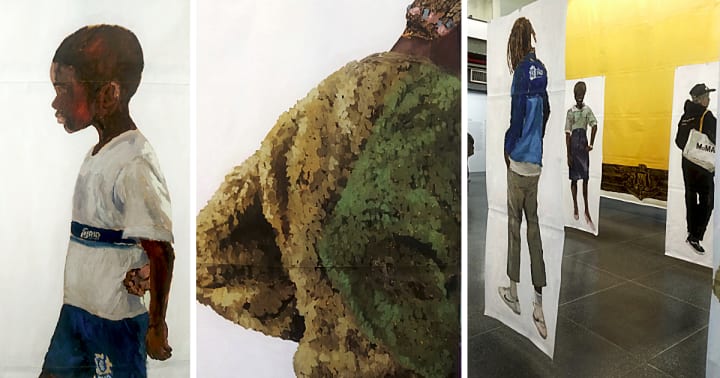
With a keen eye, based on his sensitivity and training in design, the artist strategically organizes a portfolio of clothing styles among his paper and ink passersby. Composed of a myriad of examples, from public school uniforms, work uniforms to looks composed of pieces probably found in foreign boutiques. This variety forces the viewer to flex their judgment when faced with each portrait in the series, making it difficult to generalize the perception of the individuals represented there. Working with the coveted oil paint, Maxwell gives pictorial vigor to the garments, expanding his discourse through colors and textures. He is, without a doubt, a painter.
About the Creator
Bruno Bispo
Passionate about advertising, design and art. You can read some of my writings about this subjects in English here on Vocal. If you prefer, read it in Portuguese here.
Keep reading
More stories from Bruno Bispo and writers in Art and other communities.
Transcendental Play
In a vigorous journey of symbolic broadening, Márcia Falcão achieves a distinct visual vocabulary in the series ‘Capoeira em Paleta Alta’. Relishing the evolution of her work in recent years, the painter's dedication to investigate her sign repository becomes evident and clear, accessing an accentuated and profound motivation, thus reaching new levels of expressiveness. Her sources are the suburbs and life on the hills of Rio de Janeiro, domestic life, and the identity representations of gender and race, which gain prominence in the series. The Rio native painter then undertakes a pictorial exploration unifying the human figure and capoeira, an intangible cultural heritage of humankind according to UNESCO. The series of paintings is developed simultaneously with others that address similar concepts and share pictorial affinity with each other; among these consonances is the prominence of human anatomy as the main motif. The nude, a genre present since the dawn of figurative art and which, in the timeline of art history, has been recognized as tradition and rebellion, also oscillating between the sacred and the profane. By undressing her figures on her canvases, the artist imposes her conceptions in an undeniable and objective way right in front of the observer and simultaneously investigates the body as an essential element in the construction of individuality.
By Bruno Bispo10 months ago in Art
Valentino Garavani
In the golden age of couture, when fashion was less about speed and more about soul, one name quietly rose to become synonymous with timeless elegance: Valentino Garavani. To speak of Valentino is to speak of romance, discipline, beauty, and a lifelong devotion to the art of dressing the world’s most admired women.
By S.A Charlesabout 12 hours ago in Art



Comments
There are no comments for this story
Be the first to respond and start the conversation.