
Journalism As Art and Theory As Art: Some Initial Similarities, Distinctions, And Comparisons To Text-Based Art
The increasingly-recognized Art of Journalism suggests both an Art of Theory as well as Plain-Text Writing fall within the category of Text-Based Art.
Introduction: An Art of Journalism and Theory Art
If it is true that there exists an Art of Journalism—a discipline recognized for its blend of meticulous research, written expression, and impactful factual narratives—then it seems to follow that both Theory Art and Post-Theory Art may also be considered in a similar light—as art. Consider, for example, the practice of both—both forms require degrees of solitude, focus, and a deep engagement with the subject matter in order to produce works that are comprehensive within a framework and that resonate with audiences both objectively and as to additional subjective interpretation.
Just as an art of journalism seeks to present facts and narratives in a compelling manner, within a traditional framework, so too theory art, which may be said to document, propose, comment on, critique, and communicate theories, and about ideas and relationships through theories, including about facts, like journalism, in an objective reality-based world, observable by anyone in the world, from any country, culture, or time. Do the similarities rest on both? – The framework and the practicing artist’s approach? Whether through words (the art of journalism) or visuals (the art of theory) (or, of course, musical composition, or theatre, or performance or any of the traditional arts), both an art of journalism and an art of theory seem similar in their artistic nature, including, possibly, as to their aesthetics, not just their utility.
Possible Similarities of Journalism and Theory as Art.
Because the essence of both journalism and theory art demand rigorous research and an ability to distill complex ideas into accessible forms and formulations, it seems that both an art of journalism and an art of theory may have an inherent aesthetic, even if not seen as a traditional aesthetic. The similarity seems most clear when one considers the visual formatting, headings, headlines, sentence structures, and clear language that is necessary in the art of journalism to present information effectively and accurately. Consider, in relation to this, theory art when the artist employs oral, spoken word, and/or plain text sentence and paragraph elements into pieces to propose, document, or critique how things may relate or connect—that is, theories.
Observable Distinctions Between Journalism as Art and Theory as Art: Some Differences Between Facts And Theories
That said, there also appear to be distinctions that show that an art of journalism is different than an art of theory, including that neither one is a subset of the other. Here are some of the distinctions between journalism art and theory art: First, it may be argued that theory art is primarily concerned with the exploration and presentation of theories, which means it is often engaging at a level above facts, such as in the context of engaging with abstract concepts, or philosophical inquiries, or relationships or connections that we don’t have that many facts about yet. In other words, it need not be fact-based or empirical.
In contrast, the art of journalism seems, at least traditionally, focused on investigating, uncovering, reporting, and contextualizing facts, emphasizing truth and objectivity—this is what we know so far, as distinct from, given what we know so far, let’s theorize about what it might mean. It’s a big difference, and any blending of the two, at least in the artist context, raises interesting formulations of journalism-theory-art and how it might relate to existing forms of art such as documentary art. Historically, across all cultures and times, these elements have been invaluable in human communication and the evolution of human thought—from spoken word traditions to the latest investigative report by a newspaper or news station. It is interesting that they might both be art, might both have this purpose and ability, and be different on the basis of the theory-fact distinction. Perhaps two different artistic and aesthetic methodologies towards the same thing: one through the lens of theory, the other through the lens of factual reporting?
Which raises an interesting question—do other well-established disciplines in human art across cultures and times show any evidence of journalism as art, theory as art, or both? If so, in what ways? The following is the briefest and most initial examination of these questions.
Can Film and Video Arts Be a Form of Both Journalism Art and Theory Art?
Film/Video Arts, encompassing animators, documentary makers, experimental filmmakers, feature filmmakers, and screenwriters, may be powerful vehicles for conveying complex narratives and theories. Here are just two of dozens if not hundreds of examples: Dziga Vertov's Man with a Movie Camera uses the camera as a tool to explore urban life and social dynamics, capturing the essence of the city as a living organism. Bong Joon-ho's Parasite provides a contemporary exploration of class structures and economic theories, using cinematic storytelling to dissect societal divides and aspirations. If these mediums are effective at conveying intricate narratives, it seems to follow that they are equally capable of proposing, critiquing, and discussing theories. And one can picture that if a film is particularly factual—not just the documentary but also a particularly rigorous ‘based on true facts’ film it seems clear that film and video can be a form of expression not just for theory art but also for journalism as art.
Can Interdisciplinary Arts Be a Form of Both Journalism Art and Theory Art?
Interdisciplinary Arts, which include performance art, sound art, movement, choreography, and new media installation, encompass a fusion of performance, sound, and new media, allowing for the convergence of diverse ideas and forms. Because interdisciplinary arts enable the blending of multiple artistic elements, Marina Abramović's performance piece, The Artist Is Present, challenges viewers to engage with theories of presence and human interaction through silent encounters. Laurie Anderson's sound installations, such as United States Live, merge music, storytelling, and multimedia, creating immersive experiences that question the nature of reality. It follows that if these forms can address complex narratives, they are also adept at engaging with and discussing theories.
Can Literature Be a Form of Both Journalism Art and Visual Theory Art?
Literature, including novels, short stories, graphic writing, journalism, essays, biographies, creative nonfiction, memoir, poetry, and translations, offers a profound platform for theoretical exploration. James Baldwin's The Fire Next Time delves into racial and societal theories, using personal narrative to expose the complexities of identity and prejudice. Baldwin's essays resonate with the urgency of social change, akin to the critiques found in Arundhati Roy's essays, where she examines globalization and environmental policies. In her works, such as The God of Small Things, Roy challenges readers to confront uncomfortable truths about power and oppression. If literature is effective in narrating human experiences, it may be argued that it is equally powerful in conveying, discussing, and critiquing theories.
Can Journalism as Art Be Distinguished From Other Plain-Text Documents That Are Recognized As Conceptual Art and Text-Based Art?
It seems that here is where the question of conceptual text-based art and what is and is not considered to be conceptual text-based art comes most clearly into focus. While it is beyond the scope of this paper, an initial observation is that there is no principled or logical means by which to say the following is conceptual text-based art but journalism is not. Consider:
Jenny Holzer's Truisms As Plain-Text Art With An Aesthetic Not Unlike Journalism
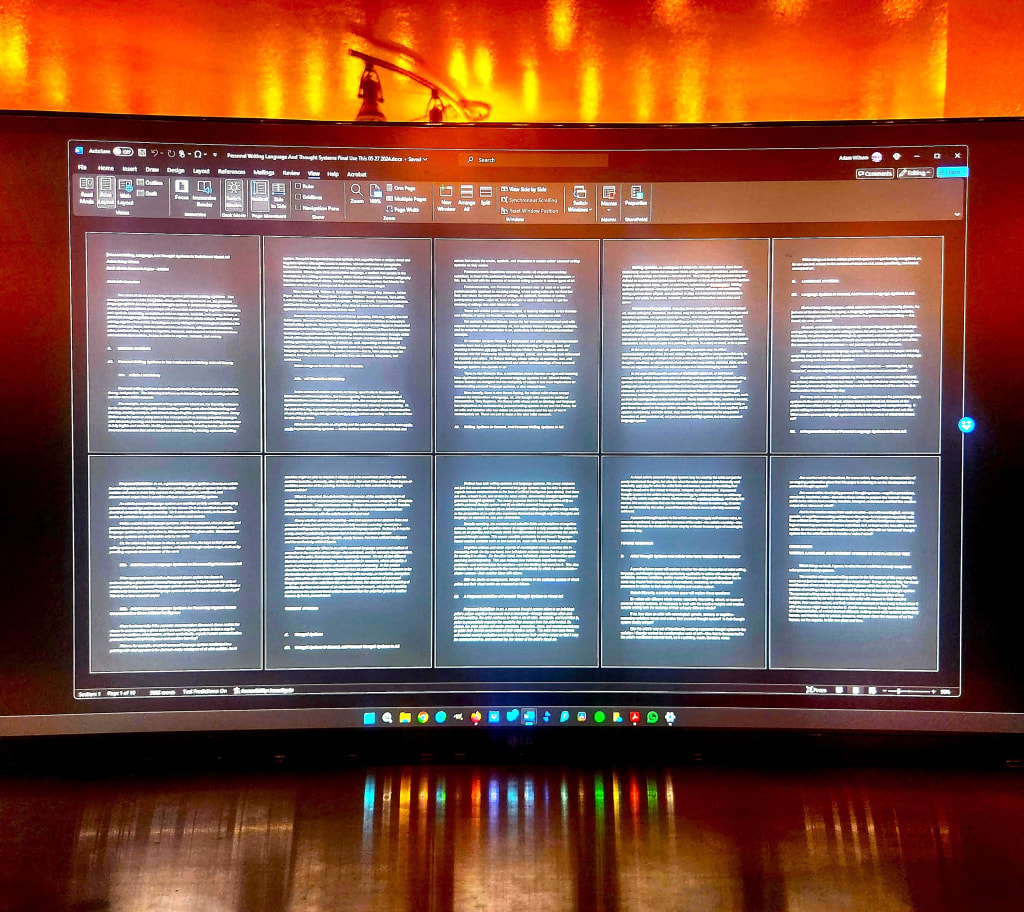
The Truisms series by American conceptual artist Jenny Holzer exemplifies text alone as conceptual art, post-conceptual art, and text-based art. Holzer's works, often manifested as plain text on paper, have no visual image, yet they have a recognized aesthetic: They establish a distinct visual aesthetic rooted in the stark presentation in the lines and curves of language-symbols themselves. Holzer's approach underscores how plain text, much like a journalist's document, can embody artistic expression through its content and presentation alone, as text, without an image needed in order to be 'art.' In particular, Holzer's Truisms series, which began in 1977, aligns with the core proposition of conceptual art by prioritizing ideas—just as plain text on paper—over traditional artistic skills.
Journalism, Plain-Text Art, Content, And An Aesthetic of Language Lines and Curves
Others do this too, in ways that cannot reasonably be distinguished from the work of a journalist. For example, see the work of Lawrence Weiner as well as the work of Joseph Kosuth. Moreover, see the writings of Joseph Kosuth, on the intellectual foundations of conceptual art; such as Kosuth's 1969 essay Art After Philosophy and his One and Three Chairs (1965), which particularly underscore the conceptual focus on language itself as art.
Glenn Ligon and Other Text-Based Artists: Plain-Text Aesthetics Not Dissimilar To Journalism
Similarly, the work of Glenn Ligon, another prominent American conceptual artist, explores the aesthetics of text through pieces that often resemble typewritten documents and which have no imagery, just text on paper or text on canvas. For example, one of the collections of his work, titled Work Work Work Work Work (2005) emphasizes the repetitive labor of writing text to be an art discipline and an art practice in and of itself.
Like journalists who construct text pieces through factual documentation and language, Holzer's, Weiner's, Kosuth's, and Ligon's works, in particular, among the text-based conceptual artists of the past century, all highlight how text alone, be it by journalist or traditional 'artist,' can have a practice, a content, and an aesthetic that falls within theories and understandings of what art is. These conceptual text-based artists' works seem to show a clear path for journalism to be art, as well as a clear path for other fact-based and theory-based writing, documentation, and text practices to be art, demonstrating that even a plain-text, fact-based document crafted by a journalist—whether a professional or an amateur—can possess inherent artistic value.
An Initial View of Art Theory In Relation to Plain Text Art as Applied To Journalism as Art
Just as Holzer and Ligon's text-based artworks invite reflection and interpretation of the objective fact-based realities reported, journalistic writings shape narratives and influence public discourse, suggesting that, just as language can be a powerful tool in art, it can also be a powerful tool in journalism, and at that point it seems illogical to say that somehow journalism is still somehow not 'art.' At least some art theorists seem to agree, although this topic, too, requires a paper of its own. The writings of theorists like Roland Barthes, particularly The Death of the Author (1967), and the insights from W.J.T. Mitchell's Picture Theory (University of Chicago Press, 1994), provide a theoretical framework for understanding how text—the lines and curves of our languages—functions within art, further suggesting that journalism fits within the intersection of art, language, and aesthetics. Such theoretical perspectives square with what the text-based artists have been doing. They have been making plain-text non-visual works; the works are considered art; and this suggests that, at least in theory, the creation of art through text is not limited to those traditionally labeled as artists. It is for another paper, but it seems to be that journalists, as both a conceptual matter, are engaged in the practice of a form of text-based art.
Having said all this, let's return to considering Journalism as Art within other mediums that do not involve written text, but which still involve language, such as music.
Can Music Composition Be a Form of Both Journalism Art and Visual Theory Art?
Music Composition, which includes all types of composition in all musical styles, from hip-hop to classical and from post-modern jazz to electronica, can convey theoretical ideas and narratives. John Cage's 4'33" challenges the definition of music and silence, proposing a theory of auditory perception where ambient noise becomes the canvas. Kendrick Lamar's To Pimp a Butterfly addresses social justice and identity through lyrical narratives, blending jazz, funk, and spoken word to explore the African American experience. Given that music can narrate complex experiences, it seems to follow that it can also propose, critique, and engage with theories.
Can Theatre Be a Form of Both Journalism Art and Visual Theory Art?
Theatre, including playwrights, librettists, devised theatre artists, performance artists, composers of musical theatre, as well as directors generating original material, provides a space for challenging societal norms and enacting theoretical concepts. Bertolt Brecht's Mother Courage and Her Children critiques war and capitalism, employing the alienation effect to encourage critical reflection. Caryl Churchill's plays, such as Top Girls, explore feminist theories and power dynamics, using non-linear narratives and overlapping dialogues to disrupt traditional storytelling. If theatre can effectively convey complex narratives, it is possible that it is equally adept at engaging with and discussing theories.
Conclusion
This article has been an initial examination of whether the Art of Journalism, which may be seen as similar to Text-Based Art, Theory Art and Post-Theory Art, operates within traditional artistic boundaries while simultaneously challenging and expanding them. The paper's initial conclusion is yes to this question. Journalism as an art, like Theory Art, appears to be further support of a broader potential for all forms of plain writing and theoretical expressions to be regarded as art, not just in formal literature or poetry.
This recognition includes appreciating their unique aesthetic qualities of journalism as plain text art and understanding how they align with and contribute to our evolving definitions of art, portions of which are increasingly documentation-based, traditionally in film (the documentary) but now across many disciplines and mediums of artistic expression. This perspective highlights that journalism, like other forms of text-based art, including plain text art on paper such as Holzer's Truisms, fits well within our contemporary and historical conceptions of what art is, and, so far, there appears to be no principled basis upon which to distinguish journalism and say that it is not art.
References
1. Susan Sontag, Against Interpretation (USA, 1966).
2. Rem Koolhaas, Delirious New York (Netherlands, 1978).
3. Zaha Hadid, architectural works (Iraq, UK, various years).
4. Dziga Vertov, Man with a Movie Camera (Soviet Union, 1929).
5. Bong Joon-ho, Parasite (South Korea, 2019).
6. Marina Abramović, The Artist Is Present (Serbia, 2010).
7. Laurie Anderson, sound installations (USA, various years).
8. James Baldwin, The Fire Next Time (USA, 1963).
9. Arundhati Roy, essays (India, various years).
10. John Cage, 4'33" (USA, 1952).
11. Kendrick Lamar, To Pimp a Butterfly (USA, 2015).
12. Caryl Churchill, plays (UK, various years).
13. Ai Weiwei, visual artworks (China, various years).
14. Jenny Holzer, text-based installations (USA, various years).
15. Ta-Nehisi Coates, Between the World and Me (USA, 2015).
16. Michel Foucault, Discipline and Punish (France, 1975).
17. Judith Butler, Gender Trouble (USA, 1990).
18. Homi K. Bhabha, The Location of Culture (India, UK, 1994).
19. Gabriel García Márquez, One Hundred Years of Solitude (Colombia, 1967).
About the Creator
Adam Daley Wilson - Conceptual Artist + Appellate Lawyer
Adam Daley Wilson is an American conceptual artist and painter represented by Engage Projects Gallery Chicago. He is also an appellate lawyer from Stanford Law who briefs issues from artist's rights to the First Amendment. Portland, Maine.
Reader insights
Nice work
Very well written. Keep up the good work!
Top insights
Easy to read and follow
Well-structured & engaging content
Excellent storytelling
Original narrative & well developed characters
Eye opening
Niche topic & fresh perspectives
On-point and relevant
Writing reflected the title & theme
Keep reading
More stories from Adam Daley Wilson - Conceptual Artist + Appellate Lawyer and writers in Art and other communities.
What Is Text-Based Art? Better Definitions Reflecting Art Histories, Plural, of a Truly Worldwide Form of Art
This Artist's Studio Research Paper Is A First Attempt To Answer Some of These Questions From A World-Wide Perspective: What Are Better Definitions of Text-Based Art?
By Adam Daley Wilson - Conceptual Artist + Appellate Lawyerabout a year ago in Art
The Best Philosophy in the World Is the One You Can Live
Ask ten philosophers what the best philosophy in the world is, and you will receive at least ten different answers—possibly delivered with footnotes, counterarguments, and mild contempt for the other nine. This disagreement is not a flaw of philosophy; it is its essence. Philosophy was never meant to be a universal prescription handed down like a rulebook. It exists to help human beings live better lives. By that standard, the best philosophy in the world is not the most elegant or complex—it is the one that can be lived.
By Fred Bradford4 days ago in Art


Comments