
British sculptor Henry Spencer Moore is best known for his large-scale bronze and marble sculptures. These have made him a prominent figure in modernist art.

The Arch is a monumental bronze sculpture that characterizes open and curvaceous shapes. It is an abstract and colossal artwork that highlights Moore’s ability to create harmonious forms.

Butterfly was created by Moore in 1985 and is located in the UK. The sculpture was created from bronze and highlights abstract art. It reflects the artist’s interpretation of organic forms featuring smooth, curvilinear shapes. The sculpture’s polished surface captures and reflects light, making it harmonious with art, nature, and the constructed world.

Draped Seated Woman is a bronze sculpture from when the sculptor was exploring draped figures. It depicts a seated female form covered by flowing drapery, thus creating both mystery and monumentality.
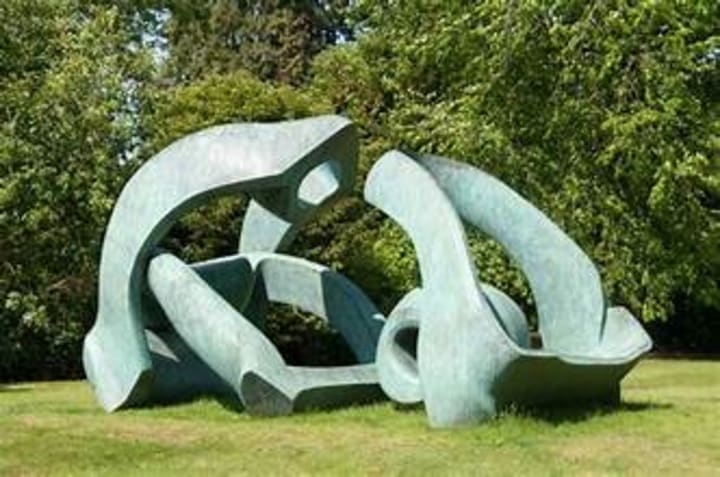
Hill Arches is a bronze sculpture created in 1973. The artwork is notable for its abstract forms, which consist of four separate parts – three stirrup-shaped elements and a large sphere. This is part of Moore’s late monumental bronzes and reflects his exploration of form and space.

Large Interior Form is a bronze sculpture originally created as part of a larger artwork in the 1950s and has only been cast as separate pieces since 1981. This sculpture has three holes; the middle part is protruding and resembles a figure 8.

Mother and Child is an abstract sculpture that depicts a mother bending down to hold her child in her arms. One of the mother’s hands is lifting up on her leg; the other hand has become one with her body and the child.
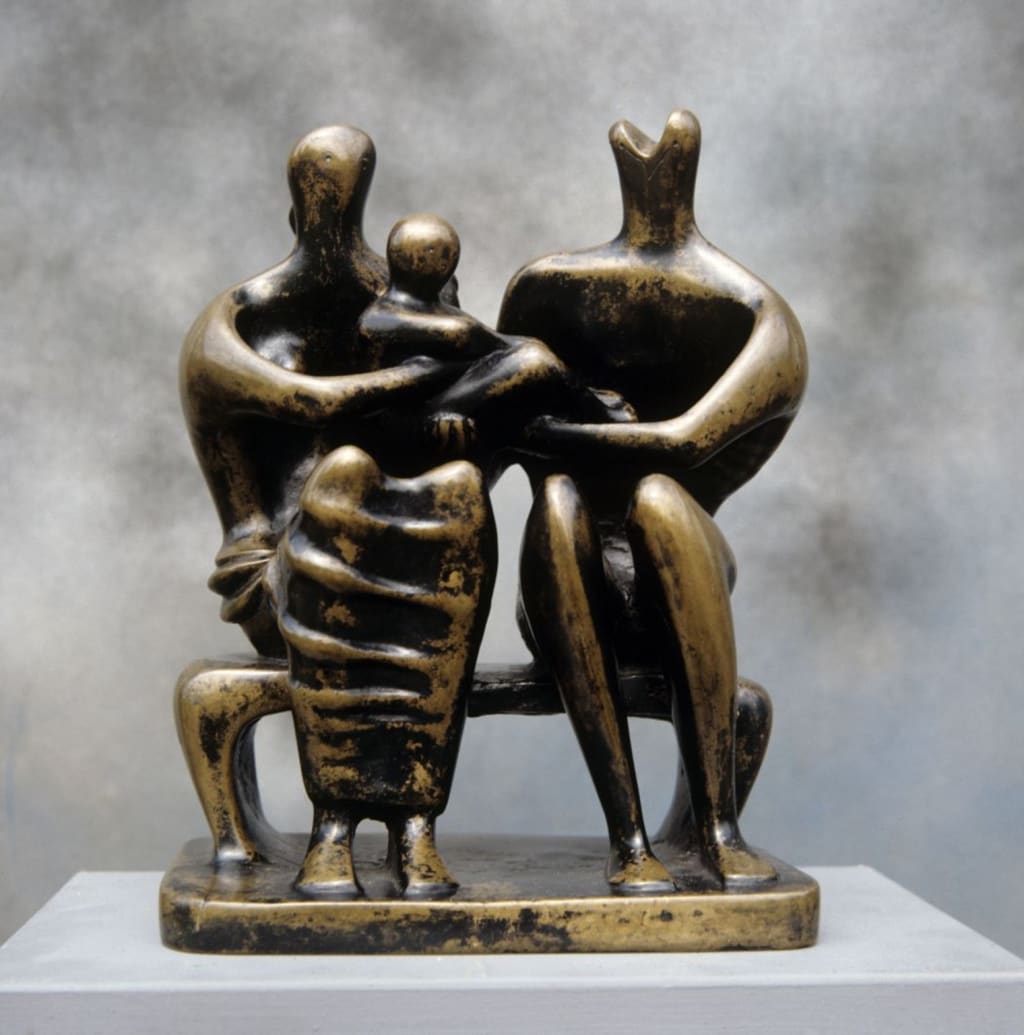
Nuclear Family Sculpture was created by Moore for the Barclay School in Stevenage. It depicts a family of three figures—a man, a woman, and a child. (pictured above) The woman is on the right side of the bench, her hair in a bun, and her dress draped over her legs. She holds the child in her hands. The man on the left side of the bench holds the child with his left hand.

Oval with Points is a series of enigmatic abstract sculptures. The sculpture has a flat oval ring with two holes in the middle. It has two protrusions inside the edge of the hole that narrow into sharp points almost meeting in the center of the hole. These are bronze sculptures divided into upper and lower points. They are on display in various places, with one in Perry Green, Hertfordshire, England.

The Past is a sculpture that was created in 1961. The artwork falls under the Expressionism art movement, highlighting the use of dramatic and emotional expression. It depicts a reclining human figure cast in bronze. The figure is positioned in a relaxed pose, with one arm propped up while the other drapes across the body, legs extended.

Reclining Figure No. 2 – Bridge Prop is a bronze sculpture that explores the body through the interconnection of its various bifurcated parts. It was inspired by the Waterloo Bridge in London, where the sculptor saw one part of the bridge resting on another; therefore, the title is “Bridge Prop.”
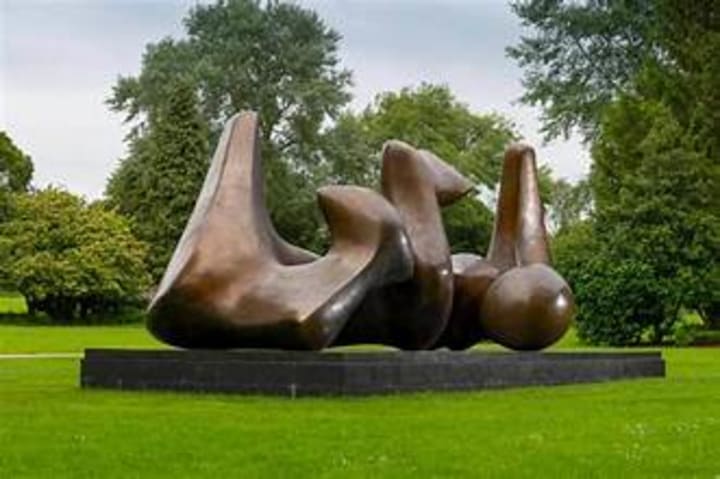
Three-Piece Sculpture Vertebrae depicts the head, neck, chest, arms, and hips in discrete forms. It is made of bronze. This sculpture follows Moore’s two and three piece reclining figures of 1959-63, but has more in common with his abstract multi-part sculptures from the 1930s.
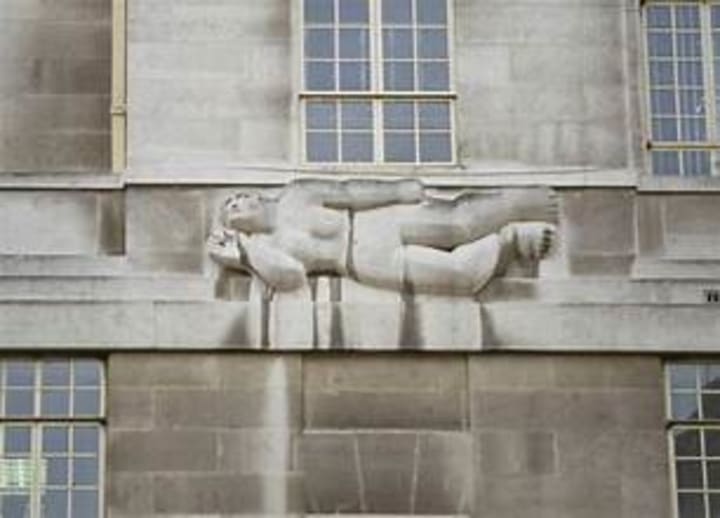
West Wind is a sculpture that was carved from Portland stone in 1928 and was Moore’s first public commission. The relief is placed high on the walls of 55 Broadway, London Underground Ltd. Headquarters.

Working Model for Sheep Piece is a sculpture created in 1971. It is an abstract sculpture that explores the forms of animals. The sculpture was made in bronze and is part of the artworks that include Moore’s fascination with nature and organic shapes.
About the Creator
Rasma Raisters
My passions are writing and creating poetry. I write for several sites online and have four themed blogs on Wordpress. Please follow me on Twitter.
Keep reading
More stories from Rasma Raisters and writers in Art and other communities.
'Till Death We Do Art
There would be nothing divine in this world without art. Nature may surpass the divine to all intents and purposes, but like everything it absorbs and is absorbed by, it remains here, stuck on the surface of this world, ever-present, physically bound to the universe.
By Avocado Nunzella BSc (Psych) -- M.A.P 17 days ago in Art
5 Ways to Trust Your Creative Ideas
When I go through creative dry spells, I tend to think that generating more ideas is what is going to get me through it. However, I've learned the hard way that this isn't the case. But, having more ideas doesn't make us more creative. In fact, it can have the opposite effect.
By Kathy Tsoukalas6 days ago in Art



Comments
There are no comments for this story
Be the first to respond and start the conversation.