
Impressive Artwork of Edouard Manet
Realism artist

French realism artist Edouard Manet created some of the most controversial paintings of the 19th century. The artist traveled across Europe during the 1850s and studied the artworks of some of the most renowned artists in history. He developed a style that formed the bridge between realism art and impressionist art.

A Bar at the Folies-Bergère is the most famous of all the cafe scenes that Manet created. This artwork was completed in 1882, making it one of the final major artworks created by Manet before he succumbed to syphilis and rheumatism the following year. The painting depicts a scene at the Folies Bergere in Paris, an opera venue transformed into a popular nightclub. The woman in the bar was named Suzon, who worked at the nightclub in the early 1880s.

The Balcony is a painting depicting four people standing on a balcony. The woman sitting in the painting is Berthe Morisot, and next to her is Fanny Claus, a violinist. The man standing is Jean Baptiste Antoine Guillemet, a French painter, and the obscured figure in the background is Leon Leenhoff, the artist’s son.

The Cafe Concert is one of several scenes that Manet captured taking place in a cafe. The artist painted people as they were, depicting men and women drinking beer and other beverages. In the background, a waitress can be seen drinking beer from a mug. The cafe is the Brasserie Reichshoffen on Boulevard Rouchechouart at the foot of Montmartre Hill in the northern part of Paris.
The Execution of Emperor Maximilian is the title of several paintings on the same subject completed by Manet in the late 1860s. (pictured above) The artwork depicts the execution of Emperor Maximilian I, who was the ruler of the Second Mexican Empire, a client state of France. The artist completed three large oil paintings, a sketch, and a lithograph on the same subject.
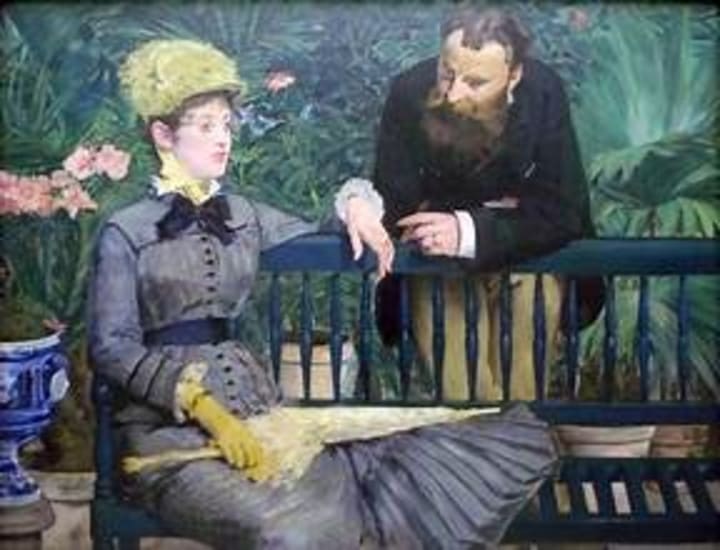
In the Conservatory is a painting Manet created in a conservatory in the Rue d’Amsterdam in Paris. The place was owned by Swedish painter Georg von Rosen, and Manet temporarily used it as a studio during the late 1870s. The artwork depicts a couple of married friends of the artist named Guillemets, who owned a clothing shop.

Luncheon on the Grass is an artwork that was originally referred to as The Bath. The painting depicts two finely dressed gentlemen picnicking and a completely nude woman sitting with them. In the background, a semi-nude woman can be seen taking a bath in a small pond.

Music in the Tuileries is among the first paintings that depict an outdoor scene with Parisians having a good time. In the painting, a large number of people have gathered in the Tuileries Garden near the Louvre to enjoy a concert. This painting had a profound impact on the following Impressionist art movement, as Realism artists only painted what they observed. The content of this artwork, in combination with Manet’s typical painting style, transforms it into a work that closely resembles the ideals of the Impressionists.
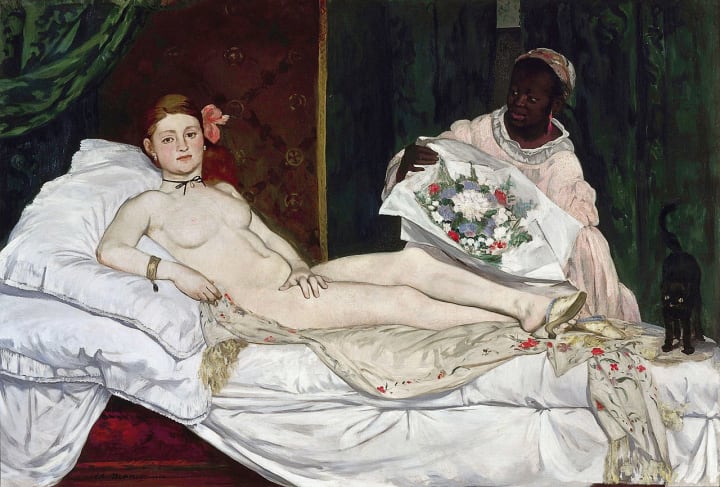
Olympia is among the best-known artworks by Manet. The painting depicts a nude woman reclining, accompanied by a servant who appears to be bringing her flowers. Both of these women were professional art models—Victorine Meurent and the servant, Laure. The artwork was exhibited at the Paris Salon of 1865. The painting was inspired by the artwork of Titian titled Venus of Urbino. The French government acquired the painting in 1890 after a public subscription organized by French artist Claude Monet. Today it can be seen in the Musée d’Orsay in Paris.
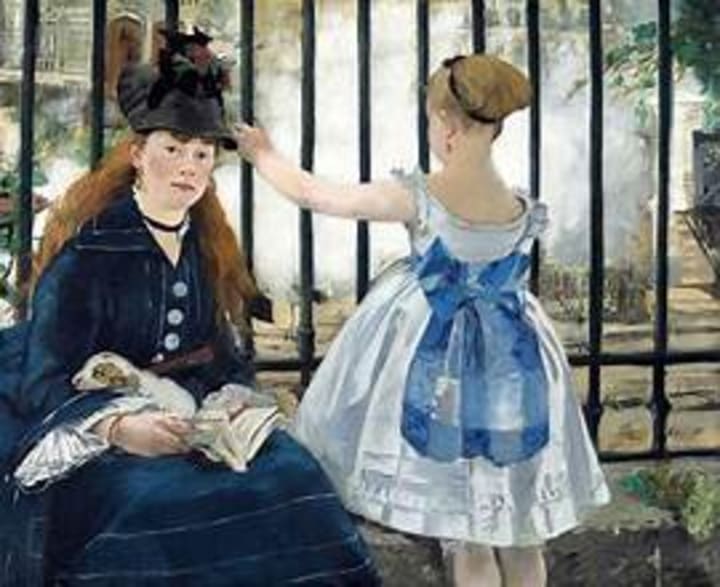
The Railway is a painting depicting Victorine Meurent, the artist’s model. This artwork is also referred to as Gare Saint-Lazare, which is a train station in Paris. Beyond the iron fence steam trains can be seen. A little girl by the fence looks interested in the trains.

The Spanish Singer was one of the earliest paintings created by Manet. It depicts a Spanish singer playing the guitar. This artwork was accepted at the Paris Salon of 1861 along with a painting that depicted the artist’s parents. This artwork clearly shows the influence of one of Manet’s idols during this period, Diego Velazquez. The acceptance of this painting launched Manet’s art career.
About the Creator
Rasma Raisters
My passions are writing and creating poetry. I write for several sites online and have four themed blogs on Wordpress. Please follow me on Twitter.
Keep reading
More stories from Rasma Raisters and writers in Art and other communities.
'Till Death We Do Art
There would be nothing divine in this world without art. Nature may surpass the divine to all intents and purposes, but like everything it absorbs and is absorbed by, it remains here, stuck on the surface of this world, ever-present, physically bound to the universe.
By Avocado Nunzella BSc (Psych) -- M.A.P 19 days ago in Art
Sahara Desert of Merzouga: The Complete Travel Blog Guide
Sahara Desert of Merzouga is one of the top places, you should not miss when visiting Morocco. It's place where golden dunes stretch endlessly, camels walk across the horizon, and nights sparkle with a sky full of stars. Located near the Algerian border, Merzouga is the gateway to the spectacular Erg Chebbi dunes, the most lovely sand dunes in Morocco. Merzouga desert is highly recommended among travelers due to its lovely high, clean and golden dunes offering visitors the chance to enjoy their vacation. Morocco Tours Company
By Othmane Anaam6 days ago in Art
The Piggy Project
I’ve had so many names in this life I lose track of which ones were ever really mine and which ones I wore because someone needed me to. Some were handed to me before I had words to refuse them, before I knew what they meant, before I knew I could say no. Most weren’t meant to hurt. That doesn’t mean they didn’t leave marks. Marks that told me who I belong to, who I am by way of who claims me, recognizes me in the good and bad, who walks beside me.
By Fatal Serendipity3 days ago in Confessions




Comments
There are no comments for this story
Be the first to respond and start the conversation.