
Impressive Artwork Jean Honore Frangonard
Rococo artist


Artist Jean Honore Frangonard was among the most prolific Rococo artists of the 18th century. He is best known for his ornamental artworks commissioned by King Louis XV. The artist won the Grand Prix of Rome in 1752 with a history painting. Frangonard learned the Rococo art style from Francois Boucher, one of the greatest artists of his time.
Blind Man’s Bluff is a fascinating artwork that depicts young people playing the children’s game. The painting is full of deceptions, such as the girl looking out from under her blindfold. It appears that the game might lead to seduction. The two figures are in pastoral costume, and in the background is a wood. It seems to abolish the boundary between the truth and lies, reality and fiction.

Coresus Scarificing Himself to Save Callirhoe is a large oil-on-canvas created in 1765. The painting depicts a dramatic scene from “Description of Greece” by Pausanias. In the myth, Coresus, a priest of Dionysus in Calydon, is absorbed with unrequited love for the maiden Callirhoe. To punish her rejection, the god sends a plague upon the city, and the oracle decrees that only her sacrifice can end it. Fragonard portrays the climactic moment when Coresus, serving as the sacrificial priest, chooses to plunge the knife into his own heart rather than kill the woman he loves. Callirhoe has collapsed beside him, unconscious, while attendants recoil in horror.

Jeroboam Sacrificing to Idols is a historic painting with which Fragonard won the prestigious Grand Prix de Rome. It was a prize hat earned him a scholarship to Rome at the age of 20. This painting depicts the Biblical scene with King Jeroboam, who led the northern tribes of Israel into idolatry, as he sacrifices to golden calves. Fragonard's work is characterized by its vibrant colors and dynamic composition, typical of the Rococo style. The scene captures the tension between divine command and human folly, emphasizing the consequences of turning away from God.

The Lock is a painting that appears to depict a couple inside a private room while the man is locking the door. This is one of the ultimate representations of the libertine spirit in France of the 18th century. This could especially be said of the court of King Louis XV, a man who had countless mistresses, such as Madame de Pompadour, a fervent admirer of Rococo art.

The Love Letter is a painting depicting another popular subject in 18th-century France, the love letter. The woman is elegantly dressed with a powdered face the fashion in France at the time. Sunlight highlights the central part of the painting, which is another example of the ideals of the Rococo art movement. The dog on the chair just makes the viewer smile.
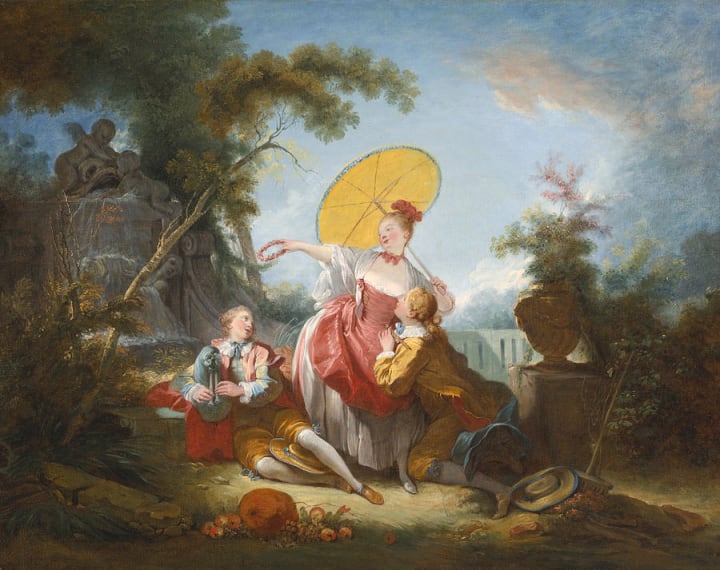
The Musical Contest was created early in Fragonard’s art career. The painting depicts a “pastoral,” or an idealized version of country life. The painting depicts a female figure standing, holding a bright yellow parasol. She is dressed in a pink and white dress with matching accessories. The woman has heavy makeup on being the fashion in parts of Europe at this time. There are two male figures staring at her with desire. The gentleman on the left is playing a traditional type of musical instrument as they frolic in a lovely garden.

The See-Saw is a painting that depicts young children playing with a seesaw in a forest grove.

The Stolen Kiss is an artwork inspired by the Dutch Golden Age painter a century earlier. The painting depicts a young couple having a secret romance, enjoying a kiss between two lovers, showing a young lady in a cream-colored silk gown who appears to have left her company for a secret meeting with a young man. The painting originally belonged to the King of Poland, Stanislaw August Poniatowski. Later it came into the possession of Tsar Alexander I in the 19th century.

The Swing is one of the most famous painting created by Fragonard. It is considered to be a masterpiece of the Rococo era. The painting depicts a woman on a swing pushed by an old man behind her. A young man can be seen in the bottom left corner, situated so that he can see up her dress. As the woman swings, she kicks her left foot and her shoe flies off.
About the Creator
Rasma Raisters
My passions are writing and creating poetry. I write for several sites online and have four themed blogs on Wordpress. Please follow me on Twitter.
Keep reading
More stories from Rasma Raisters and writers in Art and other communities.
Remembering Rembrandt
Artist Rembrandt Van Rijn, best known as Rembrandt, was a Dutch painter in the 17th century. The Baroque style came shortly after the Renaissance, and Rembrandt was influenced by some of the most prolific Italian artists who had arrived in the Netherlands a century before.
By Rasma Raisters2 months ago in Art
The Crossroads of Becoming
I found it by accident. Tucked between a laundromat and a shuttered bookstore, half-hidden by ivy and time, stood a rusted phone booth. Not the sleek glass kind from movies, but an old metal one—peeling paint, cracked receiver, a dial so stiff it groaned when turned. No one had used it in years. Probably decades.
By KAMRAN AHMAD5 days ago in Art
Catherine: The Unshakable Heart of the Monarchy
The House of Windsor is facing a subtle but undeniable shift. Tension runs high, and the once-clear lines of loyalty and influence are now blurred. At the center of it all stands Catherine, Princess of Wales—a figure who has long been admired for her grace, calm, and unwavering dignity. But recent events have brought a storm to the palace doors, one that threatens to test the very foundation of royal stability. For years, Catherine served as the quiet anchor of the monarchy. She carried her role with elegance, weathering constant scrutiny from the public and press alike. Then came a serious health challenge, a period of uncertainty and silence that left many wondering if she would step back permanently. But she did not. Instead, she returned stronger, her poise and presence commanding renewed attention and respect. Public admiration for her soared, culminating in headlines that celebrated her as more than a royal figure—they crowned her a symbol of strength. This rising public affection, however, has created ripples behind palace walls. Reports suggest that King Charles feels overshadowed, and Queen Camilla may be aligning with palace traditionalists in response to Catherine’s prominence. What was once a harmonious center of royal life now shows signs of friction. Influences are shifting, whispers and press narratives become tools of subtle power struggles, and Catherine, the stabilizing force, is suddenly cast as a threat. This isn’t about Catherine versus Meghan Markle, though the comparison is inevitable. Meghan, once seen as the disruptor, now observes the palace from outside. Her era of controversy shaped her influence, but today’s narrative highlights endurance over disruption. Catherine doesn’t need confrontation to command attention—her consistency, humility, and resilience naturally draw public support. This quiet power is precisely what unsettles those who rely on control and manipulation. Catherine’s return demonstrates a fundamental truth: legacy outlasts noise. She embodies a rare combination of grace under pressure, emotional intelligence, and unshakable composure. Her strength is evident not in headlines or controversy but in her ability to maintain dignity amid chaos. People don’t just admire her; they trust her. They feel her presence, and in her, they see continuity, reliability, and hope for the monarchy’s future. The palace may attempt to manage narratives, deploy commentators, or subtly influence the media, but they cannot manufacture the connection Catherine shares with the public. Her influence is organic. It is the result of years of consistent, visible dedication, and it resonates far beyond the confines of Buckingham Palace. While power struggles may unfold within, the world watches, and the audience has already chosen a champion. Meanwhile, Meghan’s story, once loud and all-encompassing, fades into the background. Her brand of influence—rooted in challenge and controversy—cannot compete with Catherine’s enduring presence. The public craves stability, someone who embodies calm, resilience, and authenticity. Catherine provides that in abundance, and the contrast is unmistakable. Enduring legacy outshines transient disruption. Ultimately, Catherine’s rise is not a threat to the monarchy—it is its lifeline. She is the bridge between tradition and relevance, connecting generations with quiet confidence. The very qualities that some may perceive as challenging palace control—her popularity, her grace, her resilience—are precisely what sustain public trust. This isn’t a story of rivalry; it’s a lesson in the power of character, the influence of consistency, and the enduring appeal of authenticity. History has a way of remembering who strengthens institutions and who allows petty conflicts to erode them. Catherine stands as a testament to steadfast leadership, quiet courage, and the enduring bond between a royal and her people. Those who underestimate her do so at their peril, for her strength is both visible and deeply felt. The narrative is clear: Catherine isn’t merely surviving; she is thriving. She faces pressure, criticism, and palace politics with unflinching dignity, reinforcing her role as an indispensable figure in the monarchy’s future. Her story reminds the world that true influence is built on resilience, authenticity, and the unwavering commitment to serve, rather than to command attention. As the palace navigates shifting alliances and personal insecurities, the public stands with Catherine. Her legacy, already forming, will outlast the temporary noise of gossip and speculation. She is the embodiment of stability, grace, and leadership—a woman whose presence strengthens the monarchy and whose endurance inspires the world. The House of Windsor may grapple with internal tension, but Catherine has already secured her place in the hearts of those she serves. In a world of fleeting attention and manufactured drama, Catherine proves that true influence is quiet, steady, and lasting. She faces life’s storms not with theatrics, but with poise and resilience, leaving a legacy that no palace intrigue can diminish. The world watches, admiration grows, and history quietly notes who stood firm, who served with dignity, and who became a true icon of endurance. Image Creation Format for This Story: Subject: Catherine, Princess of Wales, standing gracefully in a sunlit palace courtyard, with subtle shadows representing tension behind palace doors. Mood: Elegant, dignified, serene, yet powerful—contrast of calm versus tension. Style: Realistic digital painting, slightly cinematic, focus on light and expression.
By Behind the Curtain3 days ago in Art



Comments
There are no comments for this story
Be the first to respond and start the conversation.