
Impressive Artwork Jacques Louis David
Neoclassical artist
Artist Jacques Louis David was among the leading neoclassical painters of his time. His initial mentor was Francois Boucher, who was the court painter of Louis XV and a leading Rococo artist. This French artist joined the revolutionaries and supported Napoleon Bonaparte, eventually becoming his painter.

The Coronation of Napoleon is a painting created by the artist at the time he was already Napoleon Bonaparte’s personal painter. The painting depicts the moment when Napoleon is crowned as the French Emperor at Notre-Dame de Paris in December 1804. David attended this event and was able to finish the painting a year after the event, adding finishing touches in January 1808.
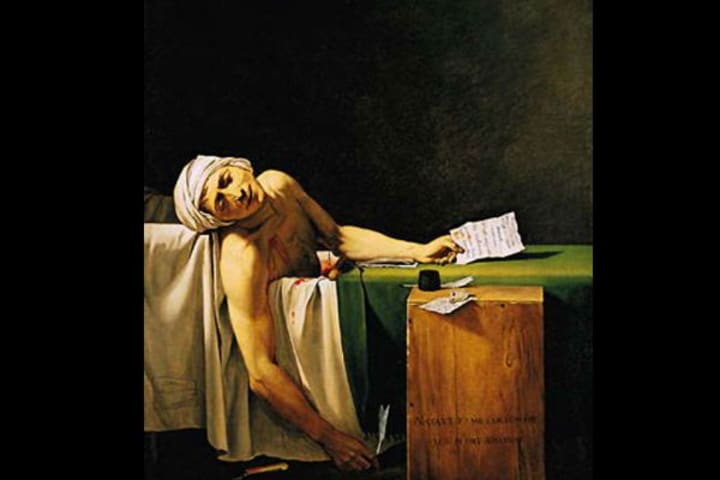
The Death of Marat is a painting with a classical theme created during the 1780s. It depicts the assassination of Jean-Paul Marat during the French Revolution. Marat was one of the revolutionary leaders of the Jacobin group. He was killed while taking a medicinal bath by a supporter of the Girondins, a young woman named Charlotte Corday.
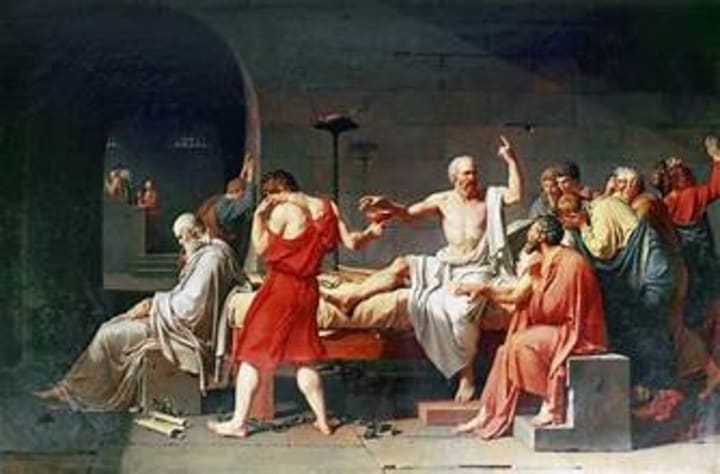
The Death of Socrates is among the many of the artist’s paintings with a popular classical theme created during the 1780s. This painting depicts the moment just before Socrates, the 5th-century BCE Greek philosopher, is to be executed by having to drink poison, as told in a story in “Phaedo” (a Platonic dialogue that is set in the last hours of Socrates' life) by Plato, the 4th-century BCE Greek philosopher. Socrates was condemned to die by drinking hemlock because he brainwashed the youth of Athens with his philosophical stories, which people in power in ancient Greece didn’t agree with. He can be seen telling his final story as he calmly accepts his fate.

Emperor Napoleon in His Study at the Tuileries is a painting depicting Napoleon Bonaparte dressed in full uniform in his private office at the Tuileries Palace in Paris, France. The artwork was commissioned by the 10th Duke of Hamilton, Alexander Hamilton, an admirer of the French Emperor.

The Intervention of the Sabine Women is a painting that depicts an episode that occurred around the foundation of Rome. Romans kidnapped young women from nearby towns and cities in the mid-8th century BC. In the painting Hersilia, the wife of Romulus Augustulus, the last emperor of the Western Roman Empire, rushes between her husband and her father, Titus Tatius, the leader of the Sabines, placing her babies between them. A vigorous Romulus prepares to strike a half-retreating Tatius with his spear but hesitates.

The Lictors Bring to Brutus the Bodies of His Sons is another painting depicting a classical story that allegedly took place in Ancient Rome. It depicts Lucius Junius Brutus, the man who founded the Roman Republic and maintained it at a great cost. The First Consul of the Roman Republic ordered the execution of his sons because they were involved in a plot to overthrow him and restore the monarchy. This means that he sacrificed his family to retain the Roman Republic in the 6th century B.C. The artwork's themes of virtue, sacrifice, and devotion to the nation sparked much controversy when it was unveiled in the politically charged era of the French Revolution . The style of painting is in the neoclassical manner. Brutus sits on a klismos on the left, alone and brooding; to the right, his wife holds their two horrified daughters, the elder of whom is about to faint, while a servant on the far right quakes in anguish.
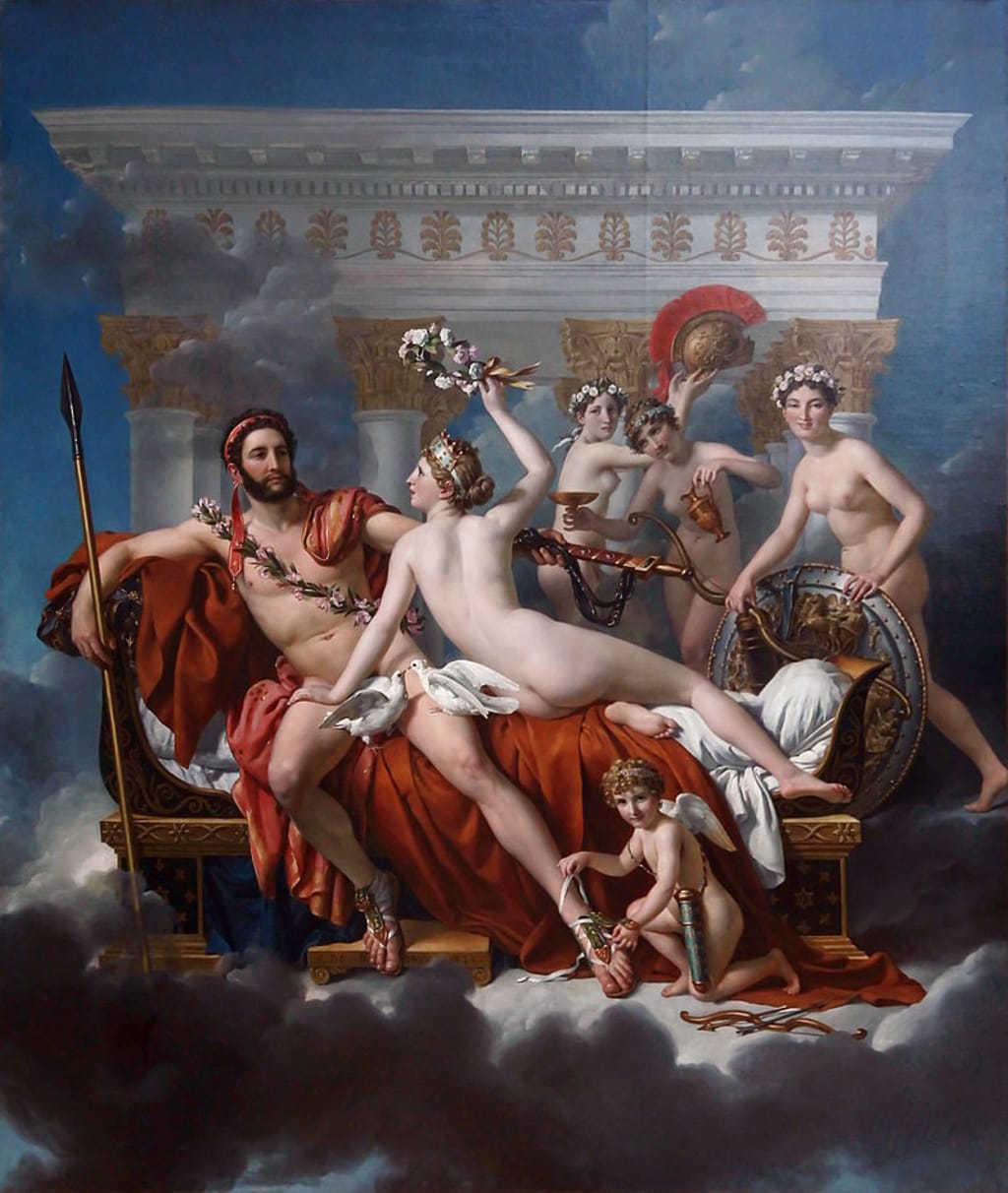
Mars Being Disarmed by Venus is the final piece of art that Jacques Louis David created in his lifetime. (pictured above) He began creating the painting at the age of 73 in 1822 and completed it the last year of his life during his exile to Brussels in 1824. The artwork depicts the Roman god Mars and the goddess Venus with Cupid and the Three Graces. They are shown in front of a floating temple that appears in the clouds. The viewer can see the moment that Mars removes his armor and gives in to the charm of Venus.
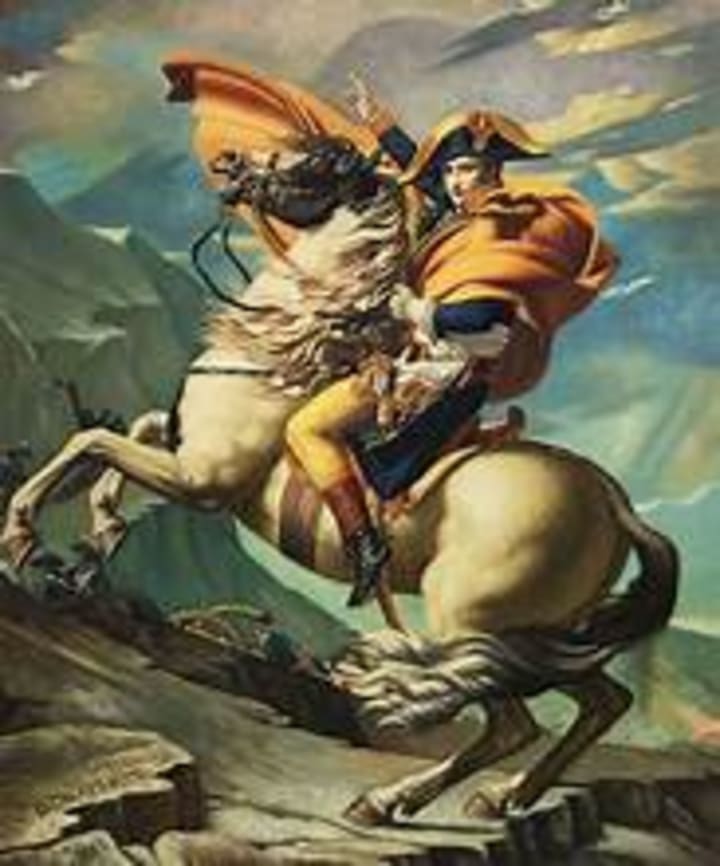
Napoleon Crossing the Alps is also known as Napoleon at the Saint-Bernard Pass and is one of five similar paintings in an equestrian portrait series of Bonaparte. All of the paintings were created between 1801 and 1805, at the time of the Napoleonic Wars. The scene in the painting depicts the moment in May 1800 when Bonaparte and his army crossed the Saint Bernard Pass, the highest road in the Swiss Alps.
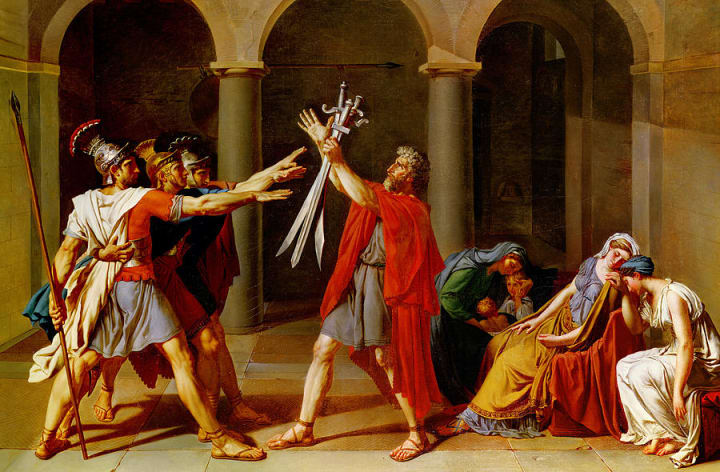
The Oath of the Horatii is one of the best-known neoclassical paintings. The painting depicts a legend that dates back to the 7th century BC. Three sons salute their father before going off to fight. The fight between Rome and Alba Longa (an ancient city of Latium in central Italy ) was decided by a battle of three soldiers of each party. The three Roman brothers of the Horatii family prepare to fight the three brothers of the Curiati family belonging to Alba Longa. Legend has it that only one of the three brothers survived the battle. David uses a limited color palette and sharp contrasts to enhance the emotional intensity of the scene.

The Portrait of Madame Recamier depicts a Parisian socialite named Juliette Recamier. This is a neoclassical portrait depicting her in a reclining pose, wearing classical clothing.
About the Creator
Rasma Raisters
My passions are writing and creating poetry. I write for several sites online and have four themed blogs on Wordpress. Please follow me on Twitter.
Keep reading
More stories from Rasma Raisters and writers in Art and other communities.
Impressive European Statues
Angry Boy, in Oslo, Norway, is located in Vigeland Sculpture Park. It’s the creation of the Norwegian sculptor Gustav Vigeland. This sculpture stands out among others, depicting a young boy in distress, capturing the intensity of his emotions as he throws a tantrum. He is frozen in motion with one foot lifted and his fists clenched and appears in an intense moment of rage.
By Rasma Raisters4 months ago in Art
'Till Death We Do Art
There would be nothing divine in this world without art. Nature may surpass the divine to all intents and purposes, but like everything it absorbs and is absorbed by, it remains here, stuck on the surface of this world, ever-present, physically bound to the universe.
By Avocado Nunzella BSc (Psych) -- M.A.P 22 days ago in Art
The Taylor Swift Paradox: Breaking Down the Critiques Behind the World's Biggest Pop Star
The Taylor Swift Paradox: Breaking Down the Critiques Behind the World's Biggest Pop Star Introduction Taylor Swift is undeniably the defining pop culture icon of our era. With her record-breaking Eras Tour, massive economic influence, and fiercely loyal fanbase, she has achieved a level of superstardom rarely seen in modern history. However, with unprecedented fame comes intense scrutiny. Despite her monumental success, Swift faces a growing wave of criticism regarding her artistic choices, public persona, environmental impact, and business practices. For some, these factors have led to "Swift Fatigue," causing them to distance themselves from her work. Here is a comprehensive breakdown of the most prominent critiques leveled against the pop phenomenon.
By Nivard Anna7 days ago in Art
Early March 2026: 4 Goals Accomplished
It's early March and I've now accomplished my 4th writing goal for the year of 2026. Before diving into the behind-the-scenes of it... why not tell you up front what that accomplishment was? I was published in a 2nd publication for this year. Published in Helix Literary Magazine out of Central Connecticut State University. You can read it for free right now!
By Stephen Kramer Avitabile5 days ago in Writers



Comments
There are no comments for this story
Be the first to respond and start the conversation.