

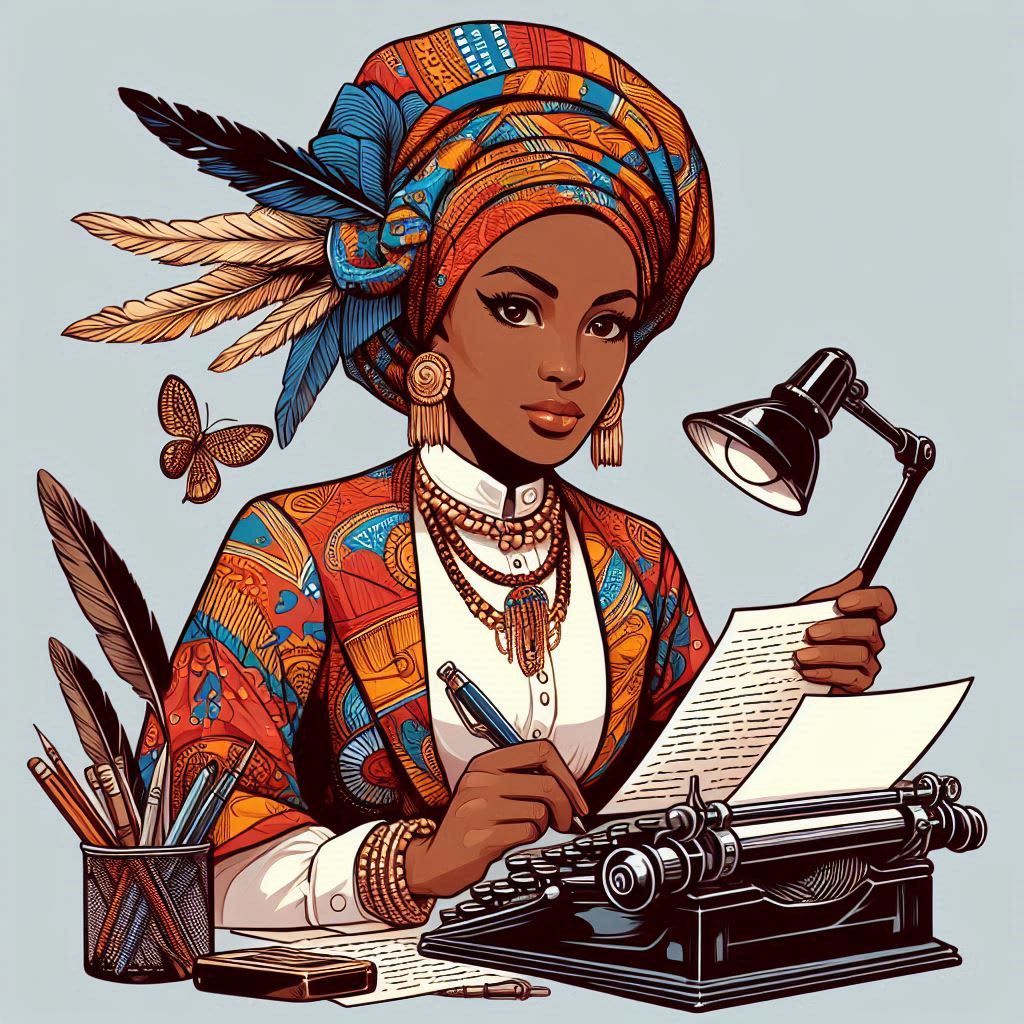
In the pantheon of Nigerian literary giants, one name stands out for her trailblazing achievements and enduring legacy: Flora Nwapa. As Nigeria's first internationally acclaimed female novelist, Flora shattered the glass ceiling for women writers, paving the way for generations of female authors to follow in her footsteps. With a writing career spanning over three decades, Flora left an indelible mark on Nigerian literature, exploring themes of love, family, culture, and identity in her works. This is the story of Flora Nwapa, a true icon of Nigerian literature, whose life and legacy continue to inspire and captivate readers around the world.
Flora Nwapa, a name synonymous with literary excellence, was a trailblazer in every sense of the word. As Nigeria's first internationally acclaimed female novelist, she paved the way for generations of women writers, challenging societal norms and stereotypes along the way. Born on January 13, 1931, in Oguta, Imo State, Nigeria, Flora's life was a testament to her unwavering passion for storytelling and her unrelenting pursuit of excellence.
Growing up in a society where women's roles were largely relegated to the domestic sphere, Flora's early life was marked by a desire to break free from the constraints of tradition. Her parents, Christopher and Martha Nwapa, encouraged her love for learning, and she attended the prestigious Oguta Girls' High School. It was during this period that Flora developed a deep appreciation for literature, particularly the works of William Shakespeare and Jane Austen.
After completing her secondary education, Flora proceeded to the University College, Ibadan, where she studied English, History, and Geography. Her time at university was marked by a growing interest in creative writing, and she began to write short stories and poetry. However, it was not until she moved to the United Kingdom to pursue a degree in Education at the University of Edinburgh that Flora's writing career truly took off.
In 1962, Flora published her debut novel, "Efuru," which tells the story of a young Igbo woman's struggles with marriage, motherhood, and identity. The novel was a groundbreaking work, offering a unique perspective on the experiences of women in traditional Igbo society. "Efuru" was an instant success, earning Flora critical acclaim and establishing her as a major literary voice in Nigeria.
Over the next several decades, Flora continued to write prolifically, publishing numerous novels, short stories, and children's books. Her works include "Idu" (1970), "Never Again" (1975), "One is Enough" (1981), and "Women are Different" (1986). Through her writing, Flora explored themes of love, family, culture, and identity, offering a nuanced and multifaceted portrayal of Nigerian society.
Flora's contributions to Nigerian literature extend far beyond her own writing. She was a pioneering publisher, establishing the Tana Press in 1977, which became a leading publisher of African literature. Through Tana Press, Flora provided a platform for emerging writers, helping to promote and celebrate the rich literary heritage of Nigeria.
Throughout her life, Flora received numerous awards and honors for her contributions to literature. She was awarded the Nigerian National Merit Award in 1982 and was appointed an Officer of the Order of the Niger (OON) in 1989. Flora's legacy extends beyond Nigeria, with her works translated into several languages and studied in universities around the world.
Flora Nwapa passed away on October 16, 1993, but her impact on Nigerian literature and culture remains indelible. As a pioneering novelist, publisher, and advocate for women's rights, Flora paved the way for future generations of writers and intellectuals. Her life and work serve as a testament to the power of storytelling and the importance of amplifying the voices of marginalized communities. Today, Flora Nwapa is remembered as a trailblazer, a true icon of Nigerian literature, and a shining example of the transformative power of the written word
About the Creator
Henry Lucy
Thanks for reading my story,I am the type that love's penning down words rather than speaking it out and I believe you will enjoy every bit of what I will pen down feel free to check out other stories because I love writing different topic
Keep reading
More stories from Henry Lucy and writers in Art and other communities.
Lady Kwali
In the quiet village of Kwali, nestled in the heart of northern Nigeria, a young girl sat beside her grandmother, watching with wide-eyed wonder as nimble fingers shaped the wet clay into a magnificent pot. The earth was alive beneath their hands, whispering ancient stories through the molding clay. That girl was Hadiza Ladi Kwali, a name that would one day resonate across the world as Nigeria’s most celebrated potter.
By Henry Lucy11 months ago in Art
A Modern African Tarot
The fourteenth card in A Modern African Tarot marks a profound turning point. Where XII HANGED MAN invites surrender and new perspective, XIII DEATH brings closure, transformation, and the sacred necessity of letting go. This card reimagines the traditional Death archetype through African mourning rituals, ancestral reverence, and the cyclical nature of life.
By Vongani Bandi6 days ago in Art
Why do all sports balls have their own shape, size, and material?
Why do all sports balls have their own distinct shapes, sizes, and materials? At first glance, this might seem like a simple matter of tradition or aesthetic preference. Yet beneath the surface lies a fascinating interplay of physics, history, human physiology, and the very essence of each sport’s gameplay. The ball is not merely an object to be kicked, thrown, or hit — it is the central actor in a carefully choreographed dance between rules, players, and environment.
By Aizanat Alimova-Umalatova6 days ago in Art



Comments
There are no comments for this story
Be the first to respond and start the conversation.