
Why do all sports balls have their own shape, size, and material?
The ball is not merely an object to be kicked, thrown, or hit — it is the central actor in a carefully choreographed dance between rules, players, and environment.

Why do all sports balls have their own distinct shapes, sizes, and materials? At first glance, this might seem like a simple matter of tradition or aesthetic preference. Yet beneath the surface lies a fascinating interplay of physics, history, human physiology, and the very essence of each sport’s gameplay. The ball is not merely an object to be kicked, thrown, or hit — it is the central actor in a carefully choreographed dance between rules, players, and environment.
Consider the spherical football (or soccer ball), whose near‑perfect roundness is no accident. A sphere rolls predictably, bounces uniformly, and responds consistently to the foot’s touch. This symmetry allows for precise passing, dribbling, and shooting — skills that define the sport. Early footballs were made from pig bladders, which naturally varied in shape and size, leading to erratic behaviour. As the game formalised in the 19th century, standardisation became essential. Today’s football must have a circumference between $68{,}6$ and $71{,}1\ \text{cm}$, weigh $410{-}450\ \text{g}$, and maintain a pressure of $0{,}6{-}1{,}1$ atmosphere. These specifications ensure that every match, from a local pitch to a World Cup final, unfolds with the same fundamental physics. The material — now synthetic leather or polyurethane — balances durability, water resistance, and tactile feedback, while the iconic pentagon‑hexagon panel design enhances aerodynamic stability.
Contrast this with the oval rugby ball, whose elongated form tells a different story. Rugby’s origins in 19th‑century England involved handling and running, not just kicking. The oval shape fits snugly against a player’s body, making it easier to carry during a tackle or pass under pressure. When kicked, its asymmetry creates an unpredictable bounce, adding a layer of tactical complexity. Early rugby balls, like their football counterparts, were crafted from inflated pig bladders covered in leather. Over time, the shape was refined to optimise grip and control, with modern iterations using synthetic rubbers and textured surfaces to enhance handling in wet conditions. The rules of rugby — emphasising forward passes, scrums, and mauls — are intrinsically tied to this design. A spherical ball would roll away too easily during a scrum, disrupting the sport’s core dynamics.
Basketball presents another evolutionary path. Its large, bouncy sphere is tailored for dribbling, a skill central to the game. The surface features deep channels that improve grip, while the internal rubber bladder and leather or composite cover create a responsive bounce. Men’s basketballs have a circumference of $75\ \text{cm}$ ($29{,}5$ inches), women’s $72\ \text{cm}$ ($28{,}5$ inches), with a weight of $567{-}624\ \text{g}$. These dimensions allow players to control the ball with one hand, enabling the rapid, rhythmic dribbles that define the sport. The orange colour, now iconic, was originally chosen for visibility under early indoor lighting. Here, the ball’s design reflects not just physics but also the human hand’s anatomy — a size too large would hinder control, too small would reduce shooting accuracy.
Cricket balls, by contrast, are hard and dense, built for high‑speed bowling and powerful batting. Made of cork wound with twine and encased in leather, they weigh $155{,}9{-}163\ \text{g}$ and have a circumference of $22{,}4{-}22{,}9\ \text{cm}$. The prominent seam running around the ball is critical: bowlers use it to generate swing and spin, exploiting aerodynamic principles to deceive batsmen. The hardness ensures the ball can withstand repeated impacts with wooden bats at speeds exceeding $140\ \text{km/h}$. Unlike football or basketball, where consistency is paramount, cricket balls are designed to *vary* in behaviour — a worn ball behaves differently from a new one, adding strategic depth.
Even subtle differences in materials reveal deeper design logic. Beach soccer balls, for instance, are lighter than standard footballs (around $14{-}15{,}5\ \text{oz}$) and use softer leather to minimise discomfort when played barefoot on sand. Futsal balls, used in indoor court games, contain foam to reduce bounce on hard surfaces, prioritising control over aerial play. American footballs, descendants of rugby balls, are more pointed to aid spiral throws over long distances — a necessity in a sport where precision passing across a $100{-}\text{yard}$ field is key.
The interplay of culture and environment also shapes ball design. In England, where football emerged in urban areas with flat surfaces, a round ball suited foot‑based play. Rugby, often played in rural, muddy fields, favoured an oval shape for easier hand‑holding. In Brazil, the samba‑infused style of football thrived with a ball that rewarded dribbling and close control, while in the United States, the elongated American football mirrored a culture valuing strategic, long‑range plays.
Ultimately, the diversity of sports balls is a testament to human ingenuity. Each ball is a microcosm of its sport’s soul — a fusion of historical accident, scientific precision, and the endless quest to balance challenge and fairness. From the unpredictable wobble of a rugby ball to the silky spin of a cricket delivery, these objects are not just tools but silent architects of the games we love. Their shapes, sizes, and materials are not arbitrary; they are the silent rules that guide every pass, kick, and shot, ensuring that each sport remains uniquely itself.
About the Creator
Keep reading
More stories from Aizanat Alimova-Umalatova and writers in Art and other communities.
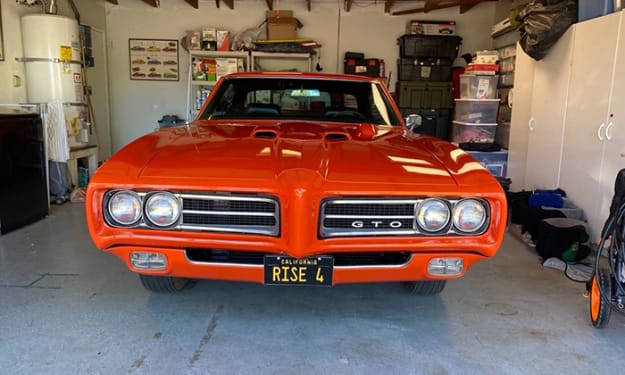
Why do americans love old cars even though they are extremely uncomfortable and impractical?
On the streets of American cities, you can often see vintage cars from the 1950s–1970s — massive vehicles with chrome details and flowing body lines. Compared to modern compact and technologically advanced cars, they look archaic. However, Americans are not rushing to give them up, and there are deep reasons for this phenomenon rooted in the country’s culture and history.
By Aizanat Alimova-Umalatova2 months ago in History
'Till Death We Do Art
There would be nothing divine in this world without art. Nature may surpass the divine to all intents and purposes, but like everything it absorbs and is absorbed by, it remains here, stuck on the surface of this world, ever-present, physically bound to the universe.
By Avocado Nunzella BSc (Psych) -- M.A.P 27 days ago in Art



Comments
There are no comments for this story
Be the first to respond and start the conversation.