

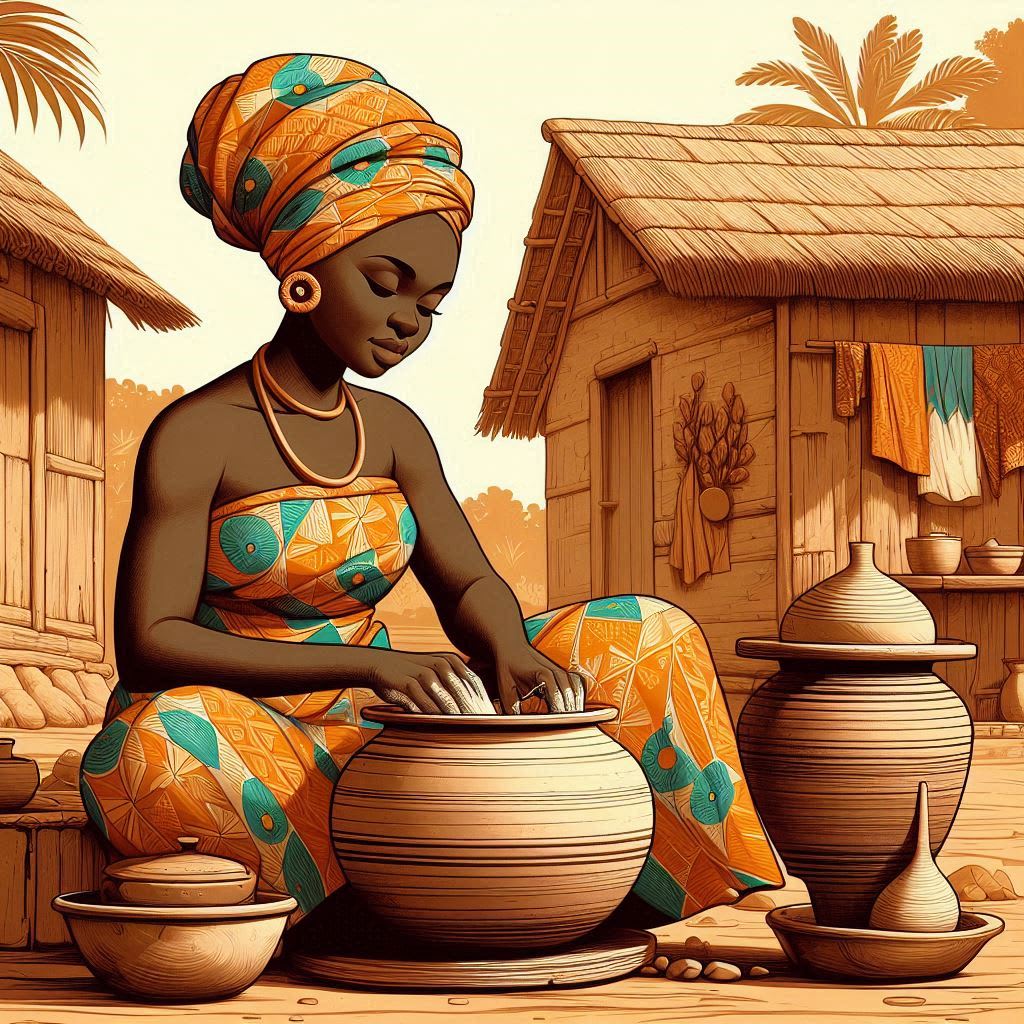
In the quiet village of Kwali, nestled in the heart of northern Nigeria, a young girl sat beside her grandmother, watching with wide-eyed wonder as nimble fingers shaped the wet clay into a magnificent pot. The earth was alive beneath their hands, whispering ancient stories through the molding clay. That girl was Hadiza Ladi Kwali, a name that would one day resonate across the world as Nigeria’s most celebrated potter.
Born in the early 1920s in Gwari land (now in modern-day Niger State), Ladi Kwali grew up in a society where pottery was a woman’s craft, passed down from generation to generation. It was more than just an art—it was a lifeline, a tradition deeply woven into the fabric of the community. Her family, like many in the region, created pottery not only for domestic use but also for trade.
From an early age, Ladi demonstrated an exceptional gift. While most potters followed traditional designs, she introduced intricate patterns inspired by nature—flowing rivers, curling leaves, and animals she had seen in the wild. Her pots, bowls, and water jugs carried a distinct elegance, each piece a silent ode to her ingenuity. Her work stood out, and soon, her reputation grew beyond her small village.
The breakthrough moment in Ladi Kwali’s life came in the 1950s when Michael Cardew, a British studio potter and the founder of the Pottery Training Centre in Abuja, noticed her exquisite craftsmanship. He was fascinated by her ability to mold clay with such precision and artistic flair. Unlike the mass-produced pottery of the Western world, Ladi Kwali’s work bore the essence of her people, their history, and their spirit.
Cardew invited her to join the Abuja Pottery Centre, a place where traditional African pottery techniques merged with modern studio practices. There, she learned to work with a potter’s wheel, a tool unfamiliar to her before, as she had always shaped her creations by hand. But true to her nature, she adapted quickly, merging ancient Gwari traditions with new techniques.
Through Cardew’s influence, Ladi Kwali’s work gained international recognition. Her pots were displayed in exhibitions across Europe and America, dazzling audiences who had never seen such masterful African pottery. She demonstrated her skills before royalty and dignitaries, including Queen Elizabeth II, leaving an indelible mark wherever she went.
Despite her global success, Ladi Kwali remained deeply connected to her roots. She continued to teach young Nigerian potters, passing down her knowledge and ensuring that the craft did not fade into obscurity. She believed that pottery was not just about shaping clay; it was about preserving history, culture, and identity.
In recognition of her immense contributions to Nigerian art, the government honored her with several accolades. She was awarded the Member of the Order of the British Empire (MBE) in 1963 and later, the Nigerian National Order of Merit Award in 1980. The Nigerian government even immortalized her by featuring her image on the twenty Naira note—a rare honor, marking her as an enduring symbol of artistic excellence.
Ladi Kwali’s legacy is not just in the pots she made, but in the countless artists she inspired. Today, her work continues to be celebrated in museums and cultural centers, reminding the world of the power of traditional craftsmanship.
As the sun sets over Abuja, where her hands once shaped the earth into breathtaking forms, the echoes of her artistry remain, whispering through the clay, telling stories of resilience, beauty, and a woman who turned the simple act of pottery into a masterpiece of history.
And any one who here's of her loved her for the strength, wisdom and the courageous woman she was, she bears the character and the virtuous hard work of an African mother
About the Creator
Henry Lucy
Thanks for reading my story,I am the type that love's penning down words rather than speaking it out and I believe you will enjoy every bit of what I will pen down feel free to check out other stories because I love writing different topic
Keep reading
More stories from Henry Lucy and writers in Art and other communities.
The EndSARS Protests (2020)
In October 2020, Nigeria witnessed a historic uprising as youths took to the streets to demand an end to police brutality and the notorious Special Anti-Robbery Squad (SARS). The #EndSARS protests sparked a national conversation on governance, accountability and human rights.
By Henry Lucy11 months ago in Art
Why Nietzsche Belongs in 2026
As the world moves toward 2026, it does not feel like a calm progression into the future—it feels like a collision. Rapid technological acceleration, cultural fragmentation, economic uncertainty, and a deep crisis of meaning define the modern condition. Traditional authorities are distrusted, ideologies compete aggressively, and individuals feel both empowered and exhausted by choice. In such a landscape, Friedrich Nietzsche’s philosophy emerges not as a comfortable guide, but as a necessary one. Unsettling, demanding, and brutally honest, Nietzsche may offer the most fitting philosophical framework for the year ahead.
By Fred Bradford4 days ago in Art


Comments
There are no comments for this story
Be the first to respond and start the conversation.