
Famous Artworks by Raphael
The artwork of a Renaissance artist

Raffaello Sanzio da Urbino, known simply as Raphael, was one of the most accomplished artists of the High Renaissance period in Italy.
The Disputation of the Most Holy Sacrament is a fresco corresponding to theology. Raphael created it between 1508 and 1511. The artwork depicts a scene that spans both Heaven and Earth. The Virgin Mary stands to the left of Christ with clasped hands. Below her, on the terrestrial plane, there is a person with the same look just near the table. Saint John the Baptist stands to the right of Christ with a hand outstretched. Below him is Julius II with his arm raised the same.

Expulsion of Heliodorus is a painting created between 1511 and 1512. It was part of the contract for Raphael to decorate the chambers of the Apostolic Palace in the Vatican. The artwork depicts a Biblical scene from 2 Maccabees (3:21-28). Seleucus IV Philopator, King of Syria, orders Heliodorus to take the wealth kept in the Temple in Jerusalem. In response to the high priest Onias III’s prayers, God sends a horseman aided by two youths to drive Heliodorus away. Raphael added a self-portrait at the far left of the painting.

The Marriage of the Virgin is also known as Lo Sposalizio. This is an oil painting completed in 1504 for the Franciscan Church of San Francesco. It depicts a marriage ceremony between Mary and Joseph. Raphael created this artwork when he was 21 and had finished his apprenticeship at the studio of Perugino and was heading for Florence.

The School of Athens is among the artist’s most famous paintings. Raphael created this artwork at the Apostolic Palace in the Vatican between 1509 and 1511. Today it hangs in the North Wing of the Vatican Palace. This is one of four frescoes that he painted in that chamber, each symbolizing a different area of human knowledge: Justice, Philosophy, Poetry, and the School of Athens. In the painting, you see fifty individuals. The philosophers on the left symbolize the theories of Plato, while those on the right represent the theories of Aristotle.

The Sistine Madonna is an oil painting on canvas of the Virgin Mary with Jesus Christ. The painting was commissioned by Pope Julius II for the church of Santa Maria del Popolo in Rome. It depicts the Virgin Mary holding baby Jesus. She is flanked by Saint Sixtus and Saint Barbara. Two angels can be seen at the bottom of the painting. This artwork was created for the Benedictine monks of San Sisto Monastery in Piacenza and placed near the altar. In 1754, the painting was given to King Augustus III of Saxony and, after WWII, sent to Moscow and later returned to Germany in 1955.

The Triumph of Galatea is a fresco that was painted at the Villa Farnesina in Rome about 1512. In Ovid’s Metamorphoses is the tale of Acis, a mortal peasant shepherd who falls in love with Galatea, a Nereid, or water nymph, in his Metamorphoses. Raphael didn’t depict the pivotal events of this story but focused on the later life of Galatea. She is depicted surrounded by marine creatures whose shapes were influenced by paintings created by Michelangelo. Ancient Roman art was the influence for the brilliant colors and ornamentation. A Triton (half man, part fish) kidnaps a sea nymph on the left, while another Triton uses a shell as a trumpet behind them. Galatea is drawn by two dolphins in a shell-chariot.
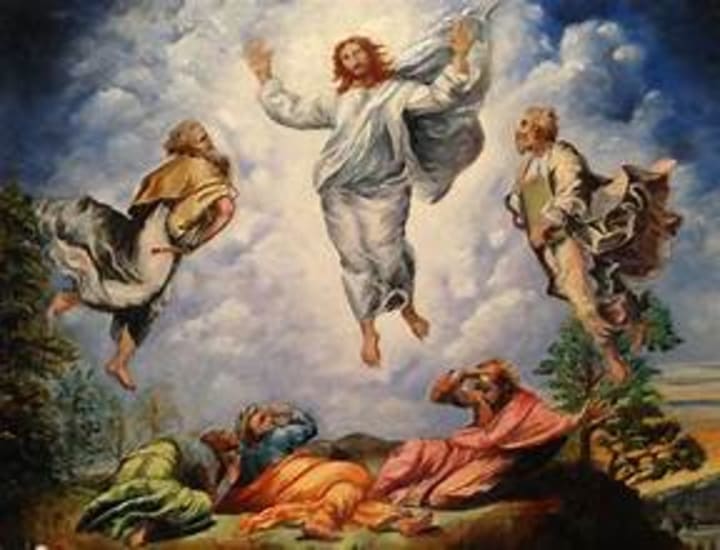
Transfiguration is the last artwork created by Raphael. It is considered a masterpiece of the Italian High Renaissance. It was created as an altarpiece for the Narbonne Cathedral in France. The painting illustrates how the life and teachings of Christ changed people. The artist created this artwork using the classic fresco method.
About the Creator
Rasma Raisters
My passions are writing and creating poetry. I write for several sites online and have four themed blogs on Wordpress. Please follow me on Twitter.
Keep reading
More stories from Rasma Raisters and writers in Art and other communities.
Best Known Paintings by Leonardo Da Vinci
Leonardo da Vinci was a famous Renaissance artist who created many paintings, sculptures, and inventions. I have been writing about the best-known artworks of various artists according to the art styles through the centuries. I believe that da Vinci is the one artist that most people knew about, and he worked with many types of media, among them paint, bronze, wax modeling, and sculpting marble.
By Rasma Raisters5 months ago in Art
'Till Death We Do Art
There would be nothing divine in this world without art. Nature may surpass the divine to all intents and purposes, but like everything it absorbs and is absorbed by, it remains here, stuck on the surface of this world, ever-present, physically bound to the universe.
By Avocado Nunzella BSc (Psych) -- M.A.P 24 days ago in Art
Wander the World
In a not-so-distant future, the world had changed in many ways. Cities floated in the sky, and robots helped people with their daily tasks. Among these wonders lived a curious girl named Elara. She was sixteen years old and always dreamed of exploring the world beyond her floating city called Skyhaven. Elara had long, wavy hair, bright green eyes, and a heart full of adventure. She spent her days in her small room, gazing at the stars through her window, imagining the places she would go.
By Hamad Afridi 7 days ago in Art
From ad men to mad men
It's after 2am in the morning when a local police patrol vehicle in Northern New Jersey spots a figure costumed as Quasimodo, The Hunchback of Notre Dame, proceeding southbound on the sidewalk along Lydecker Street. Though the hunchback’s costume stuffing offers added insulation, it's January, and friggin’ freezing. Carefully, the officers slow down, gently question the subject, and offer him a ride home.
By David W. Maury7 days ago in Humor


Comments
There are no comments for this story
Be the first to respond and start the conversation.