
Famous Artwork by Francisco Goya
Romanticism artist
Spanish Romantic artist Francisco Goya was regarded as the most significant Spanish painter of the late 18th and early 19th centuries. Goya was known as the last of the Old Masters and the first of the moderns. The artist was appointed as a court painter to the Spanish crown in 1786. His early artwork was defined by portraits of Spanish nobility and Rococo-style tapestry cartoons created for the royal palace.
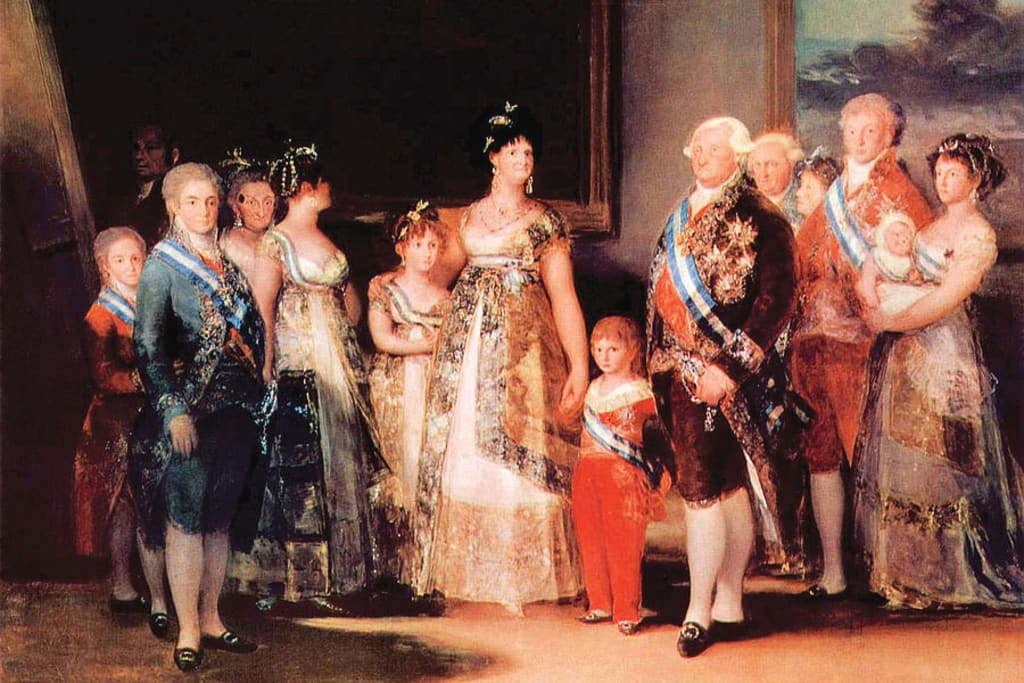
Charles IV of Spain and His Family is an artwork painted by Goya as an oil-on-canvas. The artist began working on the portrait in 1800, soon after becoming the First Chamber Painter for the royal family, and completed it in the summer of 1801. The painting depicts Charles IV of Spain with his wife, Maria Luisa of Parma, and their children and relations. The painting was inspired by Louis-Michel van Loo’s 1743 Portrait of Felipe V and his family and Velázquez’s Las Meninas, with the royal subjects posing for the artist, who is seen at his easel to the left of the panel. The group portrait was finished the year after Goya was appointed first court painter, the highest post attainable to a Spanish artist and previously held by Diego Velázquez.
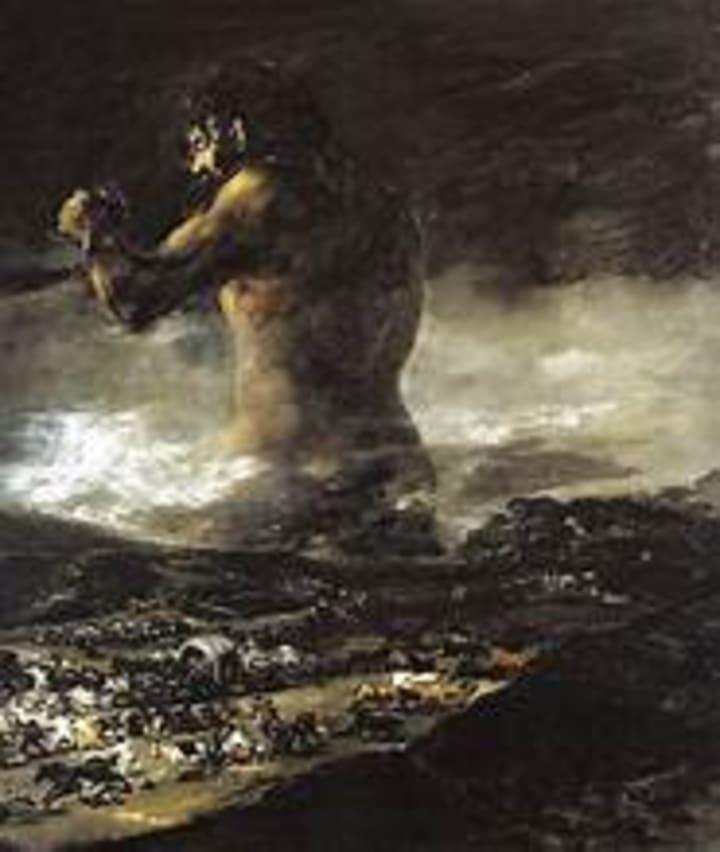
The Colossus, or The Giant, is a painting depicting a giant in the middle of the canvas walking towards the left-hand side of the image. Mountain hides his legs up to his thighs, and clouds envelop his torso. The giant appears to be taking an aggressive stance with one fist raised to shoulder height. The bottom third of the painting shows a gloomy valley filled with humans and herds of livestock escaping in all directions.

The Nude Maja is a painting that depicts a naked lady lying on a bed of pillows. It was commissioned by Manuel de Godoy to display in his private collection in a cabinet dedicated to paintings of nudes. Goya also produced a pendant of the same figure, but dressed, known now as La maja vestida (The Clothed Maja), which is generally displayed next to La maja desnuda at the Prado. The figure in La maja vestida is recognized as a maja based on her attire. Maja is a Spanish feminine noun that typically refers to a woman who is charming, attractive, or stylish.

Saturn Devouring His Son is a painting that illustrates the Greek tale of the Titan Cronus, who feared that one of his offspring might overthrow him and therefore ate each of his children when they were born. This artwork is one of fourteen Black Paintings Goya created directly on the walls of his dwelling between 1819 and 1823. After the artist died, it was converted to canvas and can be viewed at Museo del Prado in Madrid, Spain.

The Second of May 1808 was originally titled The Charge of the Mamelukes. It is set in the Calle de Alcala near Puerta del Sol in Madrid, Spain, during the Dos de Mayo Uprising. The artwork represents one of the numerous popular uprisings against France’s conquest of Spain igniting the Peninsular War. Goya experienced the French conquest of Spain firsthand in 1808, when Napoleon used the pretense of replenishing his troops in Portugal to capture the Spanish monarchy, leaving his brother Joseph in authority.

The Third of May 1808 was created by Goya in 1814. It was commissioned by the provincial government of Spain. The painting depicts the early hours of the morning following the uprising and centers on two masses of men. One is a rigidly poised firing squad, and the other is a disorganized group of captives held at gunpoint. A square lantern situated on the ground between the two groups throws a dramatic light on the scene. The brightest illumination falls on the huddled victims to the left, whose numbers include a monk or friar in prayer. To the immediate right and at the center of the canvas, other condemned figures stand next in line to be shot. The Third of May 1808 influenced a number of great paintings, including a series by Édouard Manet and Pablo Picasso’s Massacre in Korea and Guernica.
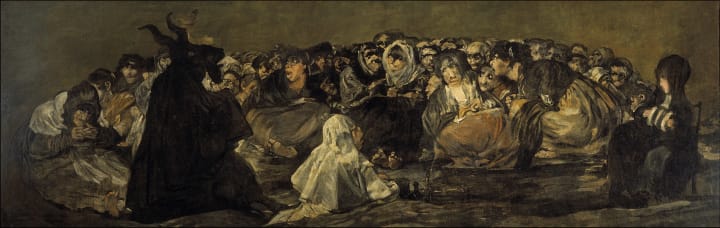
Witches’ Sabbath and the Great He-Goat is an oil mural painted between 1821 and 1823. In moonlight shadow, Satan hulks in the guise of a goat over a coven of fearful witches. This artwork is among the fourteen Black Paintings Goya created in oil on the walls of his home. This one was the largest of the paintings.
About the Creator
Rasma Raisters
My passions are writing and creating poetry. I write for several sites online and have four themed blogs on Wordpress. Please follow me on Twitter.
Keep reading
More stories from Rasma Raisters and writers in Art and other communities.
Famous Artwork by Eugene Delacroix
French Romantic artist Eugene Delacroix was a trailblazer of the Romantic art movement. His paintings are a testament to his mastery of color, emotion, and storytelling. Delacroix's artworks, not only influenced the Impressionists but also inspired the Symbolist movement, making him a pivotal figure in art history.
By Rasma Raisters2 months ago in Art
Standing While Falling
Quotation from Friedrich Nietzsche "He who wrestles long with monsters should beware lest he himself become a monster. And if you gaze long into an abyss, the abyss also gazes into you. Man is not destroyed by suffering, but by the meaning he makes of it."
By LUCCIAN LAYTH5 days ago in Critique




Comments
There are no comments for this story
Be the first to respond and start the conversation.