
Famous Artwork by Eugene Delacroix
Romanticism artist
French Romantic artist Eugene Delacroix was a trailblazer of the Romantic art movement. His paintings are a testament to his mastery of color, emotion, and storytelling. Delacroix's artworks, not only influenced the Impressionists but also inspired the Symbolist movement, making him a pivotal figure in art history.

The Barque of Dante is the first major painting by Delacroix and is an artwork showing the shift in the character of narrative painting from neoclassicism towards romanticism. The artwork depicts events narrated in canto eight of the Inferno by Dante. A smoky mist and the blazing City of Dis form the backdrop against which the poet Dante endures his crossing of the River Styx. The barque flows through waters with tormented souls and Dante is steadied by Virgil, the learned poet of classical antiquity. It can be viewed at the Louvre.

The Death of Sardanapalus is a painting created as an oil on canvas in 1827. The painting is a Romanticism artwork based on the tale of Sardanapalus, a king of Assyria, from Greek historian Diodorus Saiculus’ library. It was inspired by the play “Sardanapalus” by Lord Byron, by the Hector Berlioz cantata “Sardanapale,” and by an unfinished Franz Liszt opera, “Sardanapalo.” The artist used rich, vivid, and warm colors and broad brushstrokes.

Liberty Leading the People was created by Delacroix during the Romantic era. It commemorates the July Revolution of 1830 that toppled King Charles X. The painting depicts a bare-breasted “woman of the people” with a Phrygian cap personifying the concept and goddess of Liberty. With her is a young boy brandishing a pistol in each hand. They lead a group of people forward over a barricade and the bodies of the fallen while holding aloft the flag of the French Revolution. The painting can be viewed at the Louvre in Paris, France.

The Lion Hunt is a series of oil-on-canvas paintings created by Delacroix in the mid-1800s. The artist often painted hunting scenes and animals fighting. He was fascinated by the oriental and exotic locales. The artist took a trip to Morocco in 1832 to get inspiration for his artwork. In this painting the dramatism, which is so typical of Romanticism, was created by energetic brushstrokes and the contrast of the complementary colors of red and green and blue and orange with dark and bright patches.

The Massacre at Chios is the second major oil painting created by Delacroix. This artwork is over four meters tall and depicts the horror of the wartime destruction visited on the northern Aegean Sea island of Chios during the Chios massacre in 1822. The painting depicts different suffering characters, military might, ornate and colorful costumes, and death. The painting was completed and displayed at the Salon of 1824 and hangs at the Louvre.

The Raft of Medusa was originally titled Scene de Naufrage/Shipwreck Scene. It is an oil painting completed by the artist at the age of 27. This artwork has become an icon of French Romanticism. The painting depicts a moment from the aftermath of the wreck of the French naval frigate Meduse, which ran aground off the coast of what today is Mauritania on July 2, 1816. On July 5, at least 150 people were set adrift on a quickly constructed raft; all but 15 died in the 13 days before their rescue.

Tiger and Snake is an artwork that represents the struggle between two opposing forces: the wild strength of the tiger and the cunning of the snake. In this painting, Delacroix manages to capture the tension and drama of this deadly encounter.
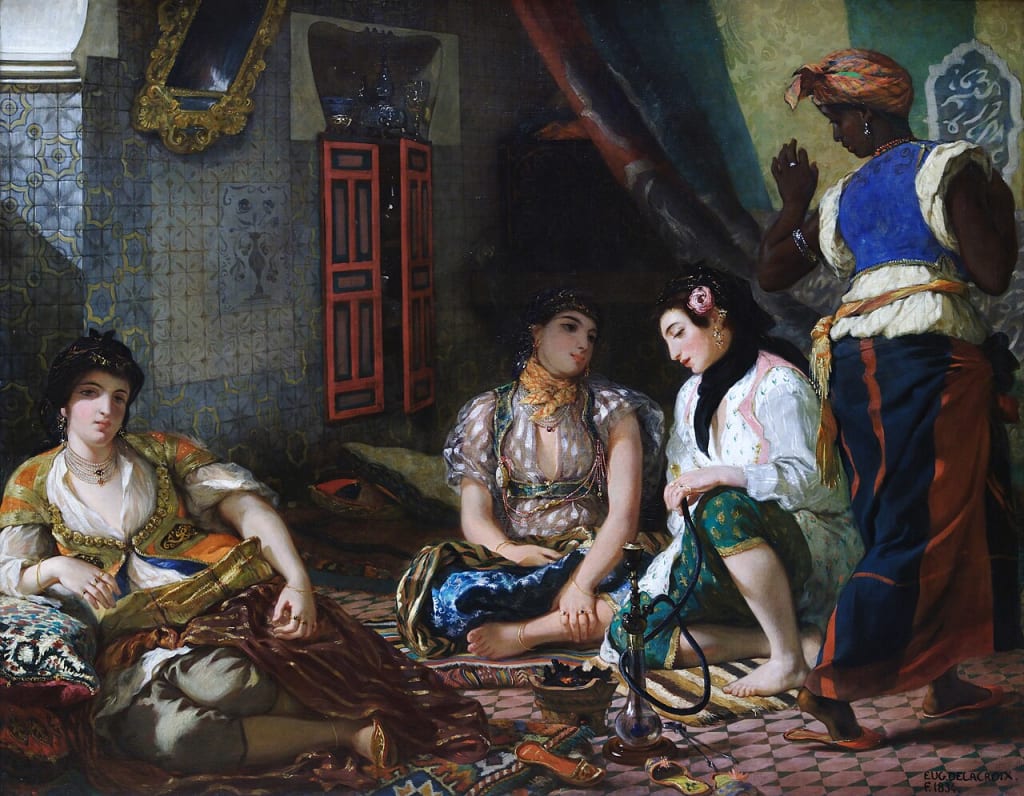
The Women of Algiers in Their Apartment is the title of two oil-on-canvas paintings created by the artist. (pictured above) The first artwork is at the Louvre, and the second artwork was painted fifteen years later and is at the Musée Fabre in Montpellier, France. The two paintings depict four women together in an enclosed room. This painting, along with Delacroix’s other Orientalist paintings, has inspired many artists of later generations. In 1888 both Vincent van Gogh and Paul Gauguin went to Montpellier to view Delacroix’s 1849 version of Women of Algiers.
About the Creator
Rasma Raisters
My passions are writing and creating poetry. I write for several sites online and have four themed blogs on Wordpress. Please follow me on Twitter.
Keep reading
More stories from Rasma Raisters and writers in Art and other communities.
'Till Death We Do Art
There would be nothing divine in this world without art. Nature may surpass the divine to all intents and purposes, but like everything it absorbs and is absorbed by, it remains here, stuck on the surface of this world, ever-present, physically bound to the universe.
By Avocado Nunzella BSc (Psych) -- M.A.P 22 days ago in Art
The Bruno Mars Enigma: The Untouchable King of Pop and the Critiques Behind the Curtain
The Bruno Mars Enigma: The Untouchable King of Pop and the Critiques Behind the Curtain Introduction By March 2026, Bruno Mars has solidified a reality that the music industry can no longer ignore: he is the undisputed number-one male artist in the world. Smashing streaming records with over 128 million monthly listeners on Spotify, Mars has orchestrated a flawless year fueled by massive, chart-topping collaborations and his highly anticipated solo project, The Romantic. His latest blockbuster single, "Risk It All," proves that his hit-making alchemy remains entirely intact.
By Nivard Anna7 days ago in Art




Comments
There are no comments for this story
Be the first to respond and start the conversation.