
Classic & Poetic
The Wanderer Above the Sea of Fog Subtitle: A Soul’s Search for Meaning in the Silence of the Mountains

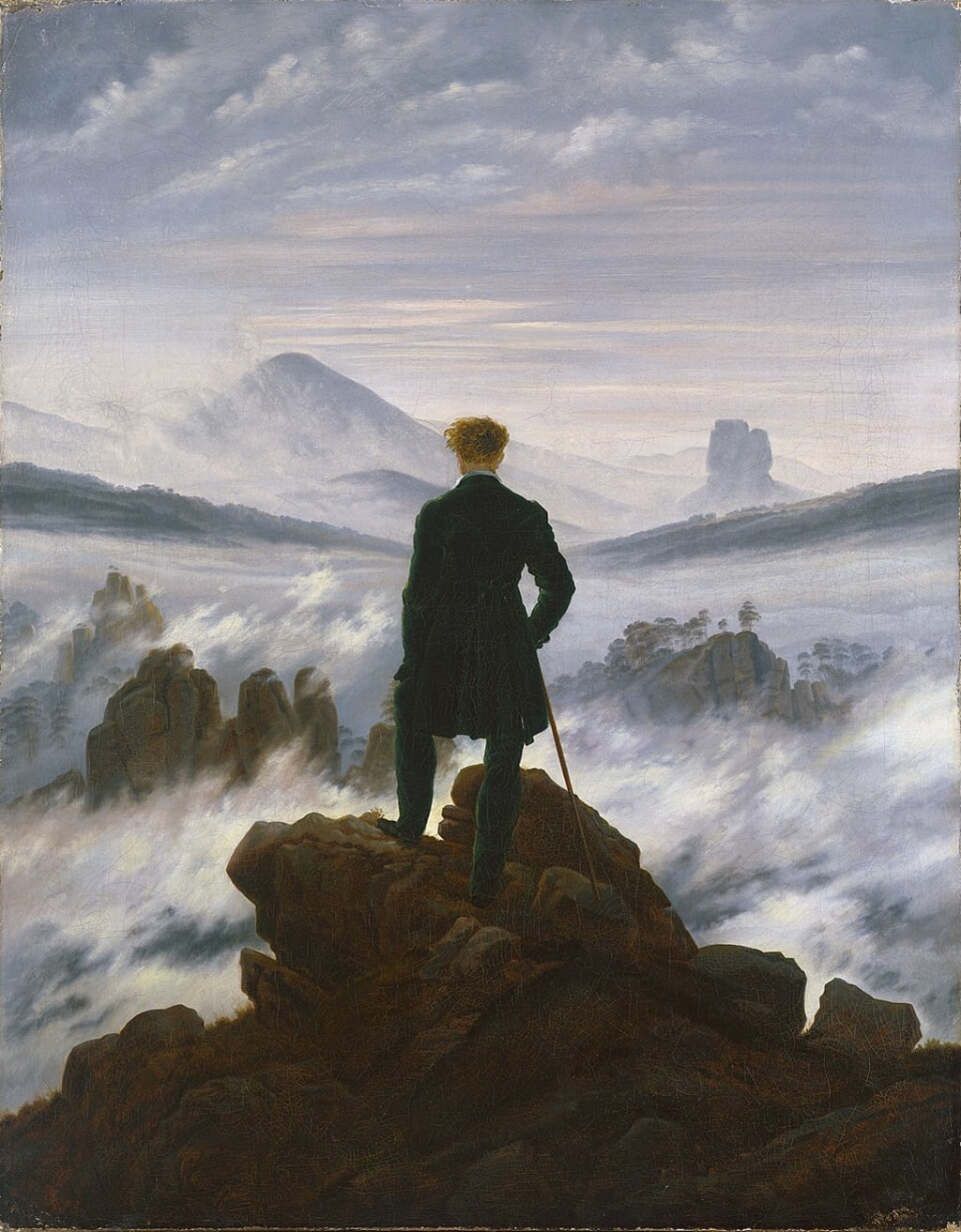
The Wanderer Above the Sea of Fog: A Story of Solitude and Soul
The fog curled around the mountain peaks like a living thing, soft and silent, veiling the world below in mystery. From the jagged precipice where he stood, the wanderer could see only hints of what lay beneath—black ridges cutting through the pale, sea-like mist, like islands afloat in a spectral ocean.
He had climbed since dawn. Now, as the wind curled his coat and tugged gently at his unkempt hair, he stood alone at the edge of the world, and time itself seemed to pause.
He had no name anymore. Names were for towns, for people who lived among roads and roofs and reasons. Up here, among the rocks and clouds, he was simply a presence—a figure. The world had called him many things before: soldier, scholar, lover, son. Each of those labels had been shed along the way, dropped like stones in a river until the currents of time smoothed them out and carried them from memory.
What remained was the journey.
He had taken to the mountains years ago. At first, it had been an escape—from war, from heartbreak, from the sharp disappointments that come with living among men. Later, it became a search. For what, he hadn’t known. Still didn’t. Only that something called him forward, from ridge to ridge, from one lonely path to the next.
The journey had changed him. Where once he had feared silence, he now found comfort. Where once he sought answers, he now embraced the questions. The mountains taught him to listen—not just to the howling wind or the crunch of boots on gravel, but to the quiet voice within. The one that whispers truths you cannot hear amid the noise of cities.
And now he stood here, above the sea of fog, on a summit he'd chased for weeks. The sky above was iron-gray, vast and indifferent. No sun broke through. No birds called. Only the whisper of wind through the rocks.
Yet the moment was not empty.
It was everything.
He thought of the countless souls below, caught in their cities, their days structured by clocks and debts and dreams not their own. He had once been one of them—working for a future written by other hands, walking streets that led to nowhere he wanted to be. But out here, with no audience but the sky, he had found a new freedom. A terrifying, beautiful kind.
He closed his eyes.
He remembered a woman once—soft-voiced, strong-eyed. She had loved him once, or at least tried to. But he had always looked beyond her, toward some invisible horizon. She had said he was always somewhere else, even when he was with her. Maybe she was right. Maybe he had always been chasing this very moment—the stillness, the view, the feeling of being nowhere and everywhere at once.
He opened his eyes. The fog below shifted, revealing for a moment the shadow of a forest. Then it closed again. Like memory. Like time.
He knew he would leave again. Climb down. Move forward. The journey was not over; perhaps it never would be. But for now, he allowed himself this one moment to simply be—a silhouette carved against the mist, a question without an answer.
The world had become too full of noise, too full of certainty. Everyone shouted, everyone knew. But up here, the silence spoke truer than a thousand books. It said: You are small, and that is not a tragedy. It said: The world does not need to make sense to be beautiful. It said: You, too, are fog and stone, here and gone.
He smiled faintly. The wind bit colder, reminding him he was still flesh. Still breathing. Still climbing.
One day, perhaps, someone would find a painting of this moment—him, standing above the sea of fog—and wonder who he was. Some might call him a Romantic, a dreamer, a lost soul. Others might project meanings onto his stillness: rebellion, melancholy, transcendence.
But he would not be there to confirm or deny. His truth was not in stories or labels. It was in the wind that tugged at his coat. In the ache in his legs. In the beauty of the unspoken.
He turned away from the cliff’s edge, not because he had found what he was looking for—but because the journey was calling again. The path ahead, half-shrouded in mist, promised no answers, only more mystery.
And that, he had learned, was enough.
Author’s Note:
Inspired by Caspar David Friedrich’s iconic painting “The Wanderer above the Sea of Fog,” this story imagines the life behind the silhouette—the soul who climbs not just mountains, but the invisible terrain of human longing. In a world obsessed with certainty and speed, sometimes it’s the wanderers—those who pause, question, and walk alone—who see most clearly.
About the Creator
Soul Drafts
Storyteller of quiet moments and deep emotions. I write to explore love, loss, memory, and the magic hidden in everyday lives. ✉️
Reader insights
Nice work
Very well written. Keep up the good work!
Top insights
Easy to read and follow
Well-structured & engaging content
Excellent storytelling
Original narrative & well developed characters
Keep reading
More stories from Soul Drafts and writers in Art and other communities.
The Triple Gaze: Charles I in Three Positions
The Triple Gaze: The Story Behind “Charles I in Three Positions” In the hushed halls of Windsor Castle, a curious painting hangs with regal stillness—three versions of the same man, staring in slightly different directions. He is solemn. He is proud. He is haunted. His name? Charles I of England. The painting? “Charles I in Three Positions”, a masterpiece by the Flemish court painter Sir Anthony van Dyck.
By Soul Drafts8 months ago in Art
'Till Death We Do Art
There would be nothing divine in this world without art. Nature may surpass the divine to all intents and purposes, but like everything it absorbs and is absorbed by, it remains here, stuck on the surface of this world, ever-present, physically bound to the universe.
By Avocado Nunzella BSc (Psych) -- M.A.P 13 days ago in Art
Best Artwork by Piet Mondrian
Dutch artist Piet Mondrian was a pioneer in the field of abstract art. His modern artwork was characterized by geometric shapes and primary colors. The artist is renowned for his distinctive style; his oeuvre reflects an amazing exploration of harmony, balance, and the essence of form. Mondrian not only revolutionized the visual arts but also laid the groundwork for the development of abstract expressionism and minimalist aesthetics in the 20th century.
By Rasma Raisters5 days ago in Art



Comments
There are no comments for this story
Be the first to respond and start the conversation.