
The Triple Gaze: Charles I in Three Positions
How a single painting captured the soul of a king—and foreshadowed the fall of a monarchy.

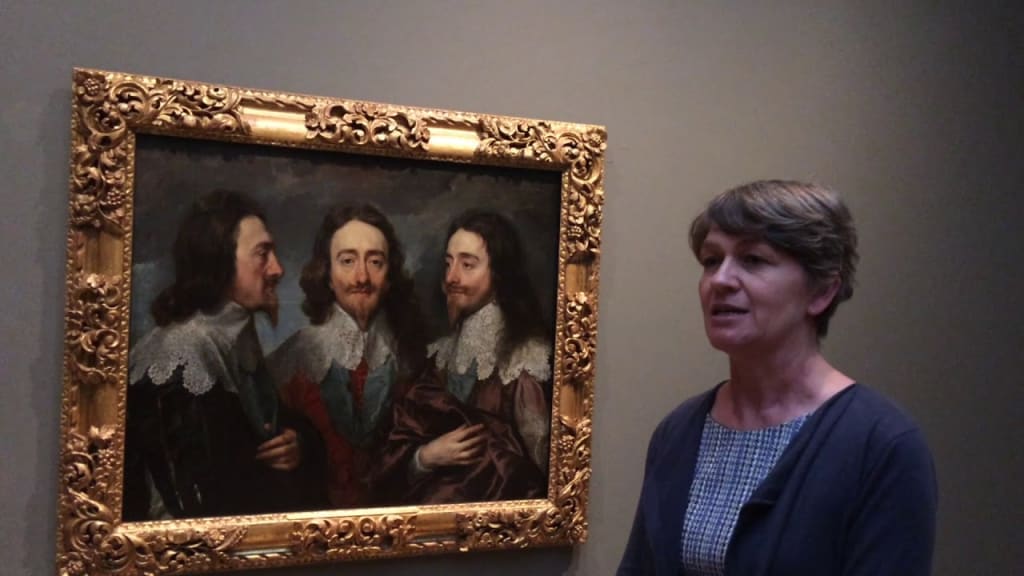
The Triple Gaze: The Story Behind “Charles I in Three Positions”
In the hushed halls of Windsor Castle, a curious painting hangs with regal stillness—three versions of the same man, staring in slightly different directions. He is solemn. He is proud. He is haunted. His name? Charles I of England. The painting? “Charles I in Three Positions”, a masterpiece by the Flemish court painter Sir Anthony van Dyck.
But this is no ordinary portrait. This is a painting born not from vanity, but diplomacy, divine image-making, and the anxious dance of power.
A Royal Image Projected
It is the 1630s. Charles I, King of England, Scotland, and Ireland, reigns during a time of great unrest. Though his court is filled with elegance and ritual, trouble stirs in Parliament and among his people. But for now, his mind is focused elsewhere—on Rome. Specifically, on one of its most famous sons: Gian Lorenzo Bernini, sculptor to popes, designer of fountains, and master of marble.
Charles, ever conscious of image and legacy, desires a bust—one that will capture his kingly presence for all eternity. But how do you send your likeness to an artist an ocean away? The answer lies in paint.
Enter Van Dyck, Charles's beloved court painter. A man of charm, style, and keen insight, Van Dyck was more than a mere artist. He was a craftsman of illusions, a conjurer of royal myth. His brush flattered but never lied outright. He painted kings not as they were, but as they should be.
And so he created a portrait like none before: a single canvas, three views—left profile, frontal, and right three-quarter. The result was both pragmatic and poetic: a reference tool for Bernini, and a meditation on kingship, identity, and fate.
A King in Fragments
The triple portrait shows Charles adorned in variations of lace collars and luxurious robes, each subtly different. His hair, auburn and flowing, is styled with courtly precision. A faint sadness touches the corners of his eyes, a shadow that perhaps only Van Dyck could see—and that history would later confirm.
The front-facing view commands attention. It is the most formal of the three, the closest to what we might call an “official portrait.” Here Charles is not a man but a monarch, distant and immaculate.
To the left, he appears younger, more delicate, almost wistful. The gaze is sidelong, as if recalling a memory or sensing a future out of reach.
On the right, the angle is more assertive, almost confrontational. Here Charles seems to meet us head-on, with the conviction of someone who believes in the absolute right of kings.
Together, these three faces compose a symphony of contradictions: power and vulnerability, confidence and doubt, the eternal and the ephemeral.
Sculpting Kings, Shaping Alliances
Once complete, the portrait was shipped to Rome, where Bernini studied it with great care. The bust he created from it was considered a triumph, capturing Charles’s likeness with uncanny accuracy. So impressed was Pope Urban VIII that he is said to have declared the English king “the handsomest ruler in all of Europe.”
But there was politics at play too. The Pope hoped the gift might warm relations between Catholic Rome and Protestant England, perhaps even nudge Charles toward religious reconciliation. That hope, like so many of Charles’s dreams, would ultimately wither.
Art in the Face of Collapse
Only a decade after the painting’s creation, Charles’s world would come crashing down. His belief in the divine right of kings, his refusal to bend to Parliament, and his aloof detachment from the common people would spark the English Civil War.
By 1649, the king whose face had been immortalized in brush and marble stood trial for treason. He was sentenced to death and beheaded outside the Banqueting House in Whitehall—a place he had once adorned with grandeur and ceremony.
As the blade fell, his triple gaze was shattered. The bust, created by Bernini from Van Dyck’s reference painting, was later destroyed in a fire at Whitehall Palace. Only the painting remains.
A Legacy in Oil and Silence
Today, “Charles I in Three Positions” is more than an artistic curiosity. It is a relic of a lost world—a portrait of power composed just as power was slipping away.
It has influenced countless artists over the centuries. Salvador Dalí, with his obsession with multiple perspectives and disjointed realities, drew inspiration from it. Filmmakers and photographers have used its form to explore themes of identity and perception. Even in psychological studies, the triple image format has become a metaphor for how we see ourselves, and how others see us.
But beyond all that, it remains a ghost story of sorts. A ghost of a king who believed in his divine right, of a court that reveled in appearances, of an artist who painted a man and glimpsed his fall.
Conclusion: The Face of a Nation, Split in Three
“Charles I in Three Positions” is not just a royal portrait—it’s a meditation on power, mortality, and the illusion of control. Each angle captures not just a face, but a moment, a mindset, a monarchy on the verge of crisis.
As viewers, we are left to wonder: which face was the real Charles? The confident ruler? The cautious observer? The haunted soul?
Or perhaps the truth, like the portrait itself, lies in the space between the angles—in the fragments of a man destined to become more myth than monarch.
About the Creator
Soul Drafts
Storyteller of quiet moments and deep emotions. I write to explore love, loss, memory, and the magic hidden in everyday lives. ✉️
Reader insights
Nice work
Very well written. Keep up the good work!
Top insight
Eye opening
Niche topic & fresh perspectives
Keep reading
More stories from Soul Drafts and writers in Art and other communities.
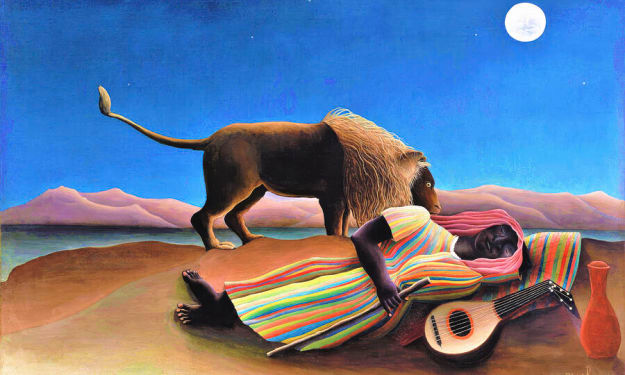
The Sleeping Gypsy
Title: The Sleep Beneath the Moon The desert had no name. It stretched in silence beyond the memory of maps, a vast ocean of sand lit only by the indigo breath of night. Wind moved softly across the dunes, lifting small whirls of dust like whispers from the past. Beneath the silver eye of the moon, there was no time—only stillness.
By Soul Drafts8 months ago in Art
'Till Death We Do Art
There would be nothing divine in this world without art. Nature may surpass the divine to all intents and purposes, but like everything it absorbs and is absorbed by, it remains here, stuck on the surface of this world, ever-present, physically bound to the universe.
By Avocado Nunzella BSc (Psych) -- M.A.P 20 days ago in Art
Creation
The actual picture is from the 'The Biggest Story Coloring Book' from Crossway. This is the 'Creation' story. Starting on the left the "Big Bang' like some say. I used purple and black crayon for the area area the sun, planets, and the comets. Then, came the fruits of the land and the fishes of the sea and beasts of the land. Using black for the beasts' fur and shades of blue for sky and a green for the grasses, as well as the water for the fishes. This is the first and the next In the Garden. Please comment.
By Mark Grahamabout 17 hours ago in Art
The Politics of Playing Dress-Up
Well, to start off I'd like to say a happy world book day to all who celebrate. I know I haven't really posted anything on my socials about it but I'm not a jubilant kind of person. I lay low most of the time. Let's start off with a popular anecdote from the vaults...
By Annie Kapur4 days ago in Geeks



Comments
There are no comments for this story
Be the first to respond and start the conversation.