
China built the world's largest sea bridge of 55 in just 30 minutes
China has built the world's largest sea bridge of 55 km connecting Hong Kong, Zhuhai, and Macau in just 30 minutes

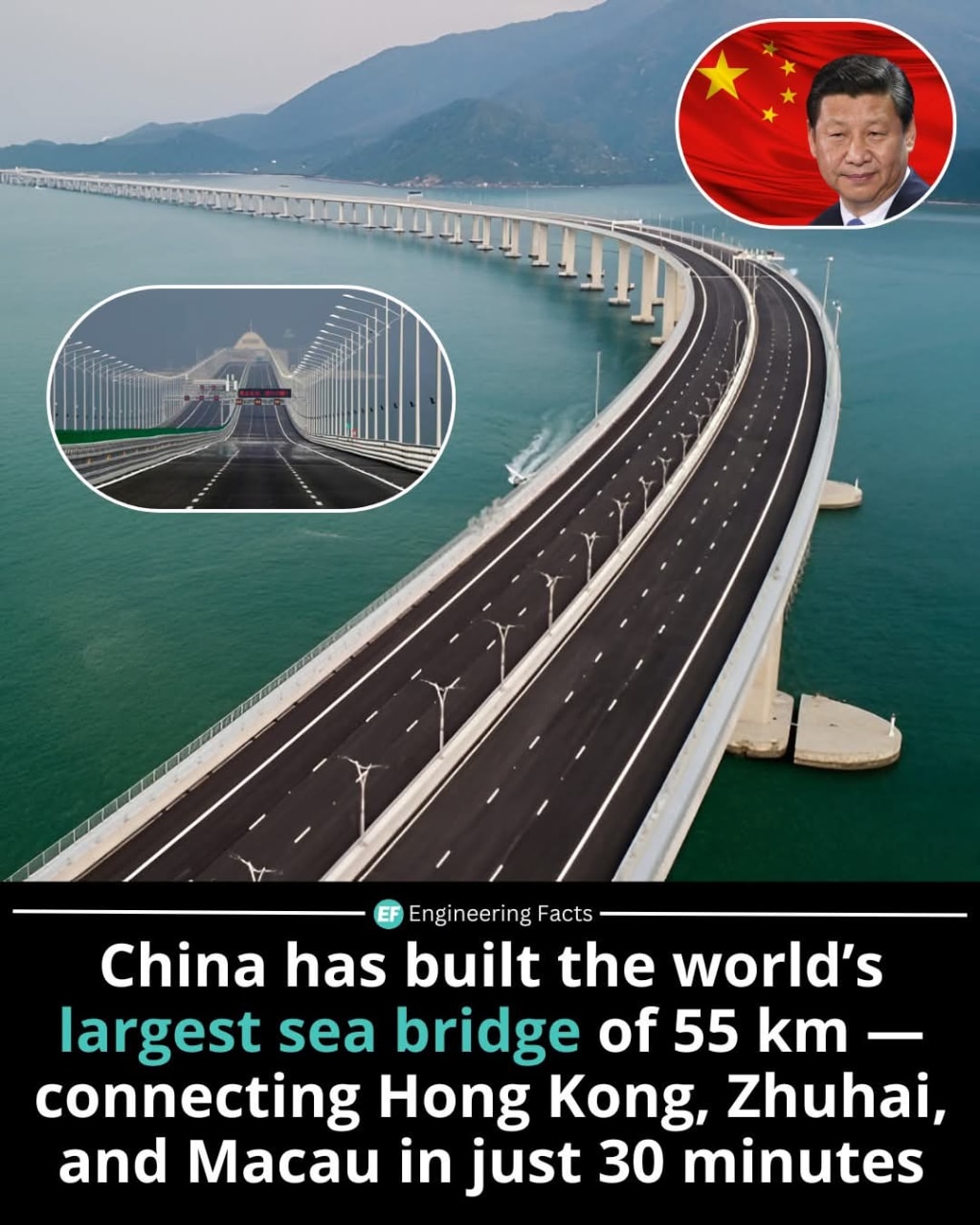
When China set out to build the world's longest sea-crossing bridge, many believed the project was simply too ambitious to succeed. Yet today, the Hong Kong–Zhuhai–Macau Bridge (HZMB) stands as one of the greatest engineering achievements of the 21st century — a 55-kilometer megastructure stretching across the mouth of the Pearl River Delta. More than just a bridge, it is a symbol of innovation, determination, and the bold developmental vision driving modern China.
Completed and opened to the public after years of complex construction, the HZMB dramatically shortens travel time between three of the region’s most dynamic cities: Hong Kong, Zhuhai, and Macau. What once required hours by land or ferry can now be done in just 30 minutes, thanks to a seamless mix of bridges, tunnels, and artificial islands built above and beneath the sea.
A Megaproject Unlike Any Other
At 55 kilometers, the Hong Kong–Zhuhai–Macau Bridge is the longest sea bridge in the world — longer than the length of Manhattan fifty times over. The megastructure is not just a single bridge but an integrated transportation system comprising:
A 22.9 km viaduct bridge
A 6.7 km undersea tunnel
Two large artificial islands
Multiple approach roads on all three sides
This combination of sea bridge and undersea tunnel makes the HZMB one of the most complex transport projects ever attempted.
The bridge spans the Lingdingyang channel, an area known for strong tides, heavy marine traffic, and challenging geological conditions. Engineers had to design the structure to endure super typhoons, powerful ocean currents, and potential ship collisions, all while ensuring a service lifespan of 120 years.
Cutting Travel Time From Hours to Minutes
Before the HZMB existed, traveling between Hong Kong and Zhuhai or Macau involved long ferry rides or road routes that took up to three to four hours, depending on weather and traffic.
Today, the same journey takes approximately 30 minutes by car or shuttle bus. This time reduction has had several immediate impacts:
Faster movement of goods and services
Easier cross-border business activities
More tourism flow between the three major cities
A deeper level of integration in the Greater Bay Area economy
This new connectivity brings together Hong Kong’s financial powerhouse, Macau’s tourism and entertainment hub, and Zhuhai’s rapidly growing manufacturing and high-tech industries.
Engineering Challenges and Groundbreaking Solutions
Building the world’s largest sea bridge required overcoming massive engineering challenges:
1. Constructing Artificial Islands
Two man-made islands were built to connect the undersea tunnel to the main bridge. Engineers used a unique immersed tube tunnel technique, lowering massive tunnel segments into a dredged trench beneath the seabed.
2. Designing for Typhoons
The structure had to withstand winds exceeding 200 km/h. Special expansion joints, deep pilings, and shock-absorbing materials were used to prevent damage during extreme weather.
3. Protecting Marine Ecosystems
Environmental protections were put in place to safeguard Chinese white dolphins living in the region. Ship routes and construction zones were carefully managed to minimize ecological disruption.
4. Maintaining 24-Hour Traffic Flow
The bridge includes advanced monitoring systems, weather sensors, and safety technologies that allow authorities to respond to emergencies instantly.
A Symbol of Economic Integration
China views the HZMB not just as an engineering success but as a vital infrastructure piece in building the Greater Bay Area (GBA) — a regional economic zone meant to rival global hubs like Silicon Valley and Tokyo Bay.
By linking the economies of Hong Kong, Macau, and mainland China more tightly, the bridge accelerates:
Business collaboration
Tourism growth
Industrial diversification
Labor mobility
Long-term urban planning
It is a physical expression of China’s strategy to unify the GBA into a world-leading center for innovation, finance, and technology.
Global Impact and Recognition
The Hong Kong–Zhuhai–Macau Bridge has captured worldwide attention for its scale and ingenuity. It broke multiple world records:
Longest sea-crossing bridge
Longest steel bridge deck
Longest immersed tube tunnel for vehicular traffic
International engineers have praised its structural safety, construction techniques, and long-term durability.
A Monument to Modern Engineering
The 55 km HZMB is far more than a transportation route — it is a testament to human ingenuity. By linking three major cities across the sea in just 30 minutes, China has shown the world what is possible when ambition, resources, and engineering mastery collide.
This bridge does not simply connect places — it connects economies, cultures, and futures. It stands as one of the greatest infrastructural achievements of our time, reshaping the geography and destiny of an entire region.
About the Creator
Best Artwork by Gustave Moreau
French Symbolist artist Gustave Moreau was known for his brilliant depictions of mythological and religious themes. He studied at the Ecole des Beaux-Arts and took private art courses with artist Theodore Chasseriau. In 1857 Moreau went to Italy and studied the paintings of Leonardo da Vinci, Michelangelo, and Giovanni Bellini. He became the professor of the artists Henri Matisse and Georges Rouault at the Ecole des Beaux Arts. The Musée National Gustave Moreau is in Paris.
By Rasma Raisters2 days ago in Art
The Crossroads of Becoming
I found it by accident. Tucked between a laundromat and a shuttered bookstore, half-hidden by ivy and time, stood a rusted phone booth. Not the sleek glass kind from movies, but an old metal one—peeling paint, cracked receiver, a dial so stiff it groaned when turned. No one had used it in years. Probably decades.
By KAMRAN AHMAD4 days ago in Art
The Ritual of Winter Challenge Winners
Welcome to the Winners Announcement for The Ritual of Winter challenge. This prompt focused on winter rituals and the meaning that settles into them over time. The top pieces stay grounded in ordinary acts and repeated routines, letting winter shape the work through pace, attention, and restraint.
By Vocal Curation Team2 days ago in Resources


Comments
There are no comments for this story
Be the first to respond and start the conversation.