
Australian scientists develop eye capable of restoring human vision
Australian scientists develop first fully functional bionic eye capable of restoring human vision

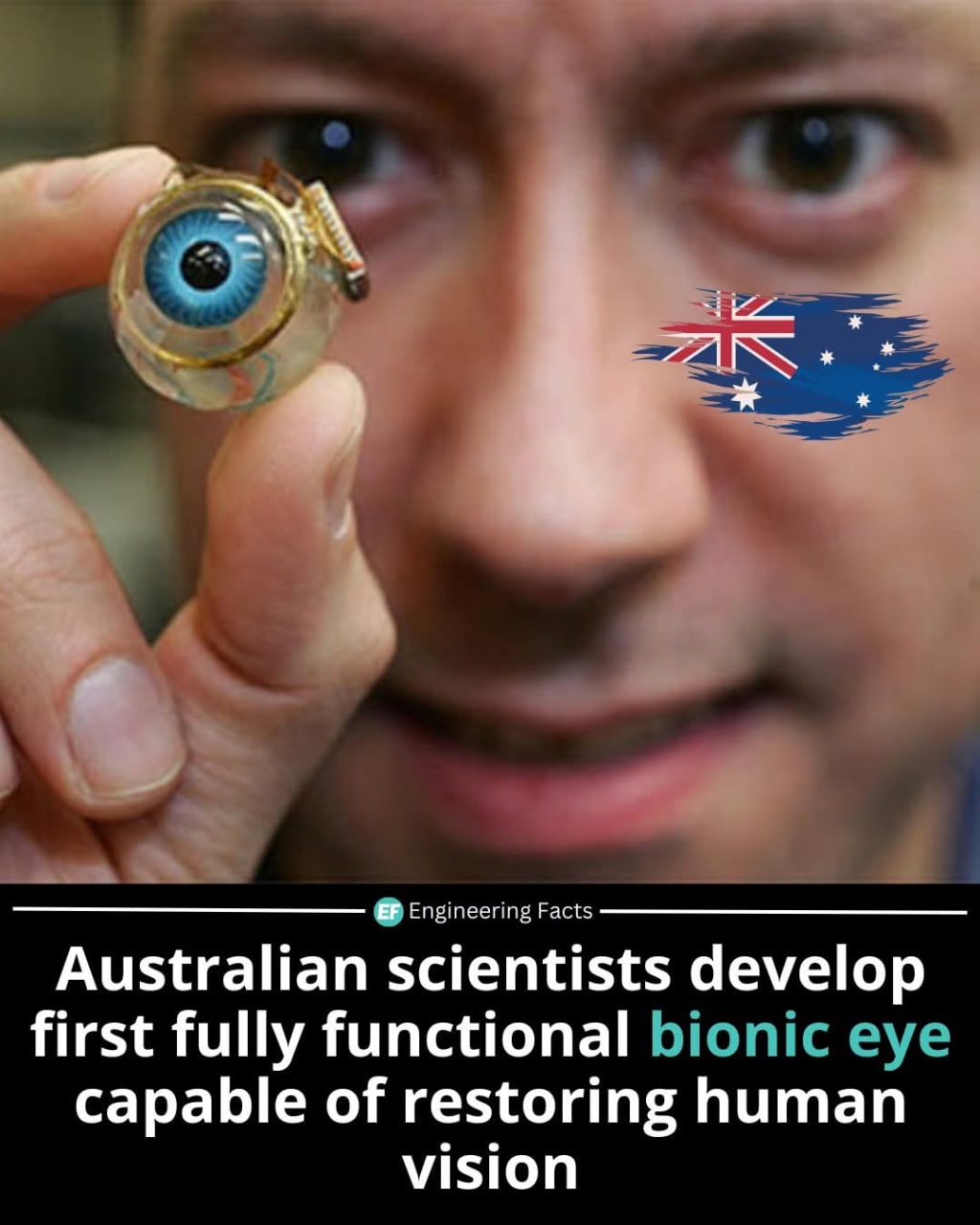
For decades, the idea of restoring sight to the blind using an artificial visual system has lived somewhere between science fiction and ambitious medical research. Today, that dream is moving closer to reality. Australian scientists have successfully completed a long-term clinical trial of a next-generation fully functional bionic eye, delivering measurable visual improvements to people living with profound blindness.
This achievement, developed in Melbourne through collaboration between the Bionics Institute, Bionic Vision Technologies, and several Australian research partners, represents one of the most advanced and promising breakthroughs in restorative vision technology.
What Exactly Is a Bionic Eye?
A bionic eye is not a biological replacement for a damaged retina. Instead, it is an electronic prosthesis that creates artificial vision by stimulating surviving retinal cells with electrical signals.
The Australian system—known as the second-generation suprachoroidal retinal implant—includes:
A small 44-electrode array surgically placed behind the retina
A camera mounted on a pair of glasses
A processing unit that converts visual scenes into electrical pulses
A wireless link that sends these signals to the implant
When the electrodes stimulate the retina, the user perceives phosphenes—tiny flashes of light—that form abstract patterns, edges, shapes, and movement. While not comparable to natural sight, these light patterns can dramatically improve independence and orientation.
The Clinical Trial: 2.5 Years of Real-World Testing
The trial involved four participants with complete or near-complete blindness caused by retinitis pigmentosa, a degenerative retinal disease with no cure.
Key findings from the study:
1. Significant improvement in functional vision
Participants were able to:
Detect obstacles
Identify doorways
Locate household objects
Recognize contrasting shapes
Navigate streets and new environments more safely
These weren’t just lab-based improvements—the benefits translated into daily life, increasing confidence and autonomy.
2. Long-term safety and stability
After nearly three years, an impressive 97% of electrodes were still functioning, showing the implant’s durability. The suprachoroidal position (behind the retina) also minimizes surgical risk compared to other types of retinal implants.
3. Genuine quality-of-life enhancement
Participants reported:
Improved mobility
Reduced reliance on guide dogs
Greater ability to explore unfamiliar spaces
Emotional benefits, including increased confidence andindependence
The research team described the improvements as “substantial and meaningful.”
Why This Technology Is So Important
Retinal diseases like retinitis pigmentosa and age-related macular degeneration affect millions worldwide. For these individuals, conventional treatments cannot restore lost photoreceptors.
But the Australian bionic eye bypasses damaged cells and directly stimulates the retina, offering a completely new pathway to perception.
This technology is especially promising because:
It is minimally invasive compared to other bionic eye systems
The electrode array is long-lasting and stable
The system is scalable, meaning future versions can expand to higher resolution
Researchers are already planning a third-generation implant, which may feature more electrodes, improved image processing, and enhanced contrast detection.
Challenges and Limitations
Despite its promise, the bionic eye is not a cure for blindness. Current limitations include:
Low resolution due to fewer electrodes compared to natural photoreceptors
Artificial vision that appears as light patterns, not detailed images
The need for extensive training to interpret visual signals
High research and manufacturing costs
However, even this level of vision—detecting edges, movements, and objects—can transform a person’s independence.
Global Significance
While multiple countries have attempted retinal prostheses, including the now-discontinued Argus II in the United States, the Australian system stands out because of:
Its stability across multiple years
Consistently functioning electrodes
Real-world usability outside the clinic
Strong institutional support and scientific transparency
The peer-reviewed publication in Ophthalmology Science has strengthened the project’s credibility and opened pathways toward regulatory approval.
A New Era for Vision Restoration
The Australian bionic eye is not the end of the journey, but it is a major milestone. It demonstrates that artificial vision is no longer a distant hope—it is an achievable reality that will continue improving.
As researchers move toward global trials and more advanced generations of the device, millions of people living with blindness may one day gain access to a technology that restores functional, meaningful sight.
This breakthrough leaves the world with a powerful message:
Vision loss may not remain permanent forever. Science is building a future where blindness can be challenged—one electrode at a time.
About the Creator
About Binding Prometheus
I want to start actively advocating on behalf of my own work, and the most valuable part of my canon is, without a doubt, Binding Prometheus, the play I have been working on since 2019 and only finished in 2023 as part of my MA. The play itself is an amalgamation of a million different inspirations. On one end, it evokes the Ancient Greek myth-play, deriving its own title from the earliest extant work of Western drama we have, Aeschylus’s Prometheus Bound. On the other end, it borrows significantly from the sci-fi bulwarks from over the years, namely Mary Shelley’s Frankenstein and Karel Capek’s Rossum’s Universal Robots. The play could be an episode of Black Mirror, I fear. I don’t know. I’ve only ever seen one episode of Black Mirror.
By Steven Christopher McKnight13 days ago in Futurism
Global Sea Freight Forwarding Market Size & Forecast 2025–2033
Introduction The Global Sea Freight Forwarding Market is entering a period of sustained expansion, supported by rising global trade volumes, increasing cross-border e-commerce, and continued investment in maritime infrastructure. According to Renub Research, the market is expected to grow from US$ 75.56 Billion in 2024 to US$ 123.60 Billion by 2033, registering a Compound Annual Growth Rate (CAGR) of 5.62% during 2025–2033.
By Marthan Sir7 days ago in Futurism


Comments
There are no comments for this story
Be the first to respond and start the conversation.