
French Symbolist artist Gustave Moreau was known for his brilliant depictions of mythological and religious themes. He studied at the Ecole des Beaux-Arts and took private art courses with artist Theodore Chasseriau. In 1857 Moreau went to Italy and studied the paintings of Leonardo da Vinci, Michelangelo, and Giovanni Bellini. He became the professor of the artists Henri Matisse and Georges Rouault at the Ecole des Beaux Arts. The Musée National Gustave Moreau is in Paris.

The Angels of Sodom was created in 1890. The story comes from the Bible, Genesis 19, where two angels disguised as men are sent by God to save Lot and his family from the city of Sodom. During the night the angels sleep in Lot’s house; men from the city surround the home, demanding that Lot let them rape his distinguished guests. Later, during a drunken stupor Lot sleeps with both of his daughters, each becoming pregnant. In the artwork, you see the angels hovering in the air.

The Apparition was created in 1876. It is a provocative painting depicting the story of Salome from the Bible. In the story, King Herod Antipas receives criticism from John the Baptist about marrying his half-brother’s former wife, Herodias. In anger the king throws John the Baptist into prison but hesitates to execute him due to his popularity. In the Book of Matthew, “On Herod’s birthday, the daughter of Herodias, Salome, danced for the guests and pleased Herod so much that he promised with an oath to give her whatever she asked.” She asked for the head of John the Baptist on a platter. King Herod grants her the wish. In the painting, the artist depicts Salome nude and bedecked in jewelry. She is pointing at the horrifying apparition of the disembodied head of John the Baptist.

The Dream of an Inhabitant of Mongolia was created in 1881. It is one of many watercolor illustrations by the artist that he created for the “Fables” series written by French writer Jean de la Fontaine. The writer was famous for collecting traditional Aesop's and Asian fables and rewriting them in French verse. In this artwork, you can see an intricate, gold-and-jewel-toned style making the painting bright.

Created in 1880 Galatea is a painting Moreau created, taking inspiration from Homer’s Odyssey in Greek mythology. The artwork depicts Galatea, a sea nymph who is lusted after by Polyphemus, a cyclops and son of Poseidon. In the myth, Polyphemus crushes the lover of Galatea to death and in turn she creates a river out of her lover’s blood, allowing his spirit to live on. In the painting, Polyphemus watches Galatea in her grotto. Moreau has painted him with three eyes instead of one. She sits prettily in her grotto, unaware of being watched, while among the coral are other sea nymphs.
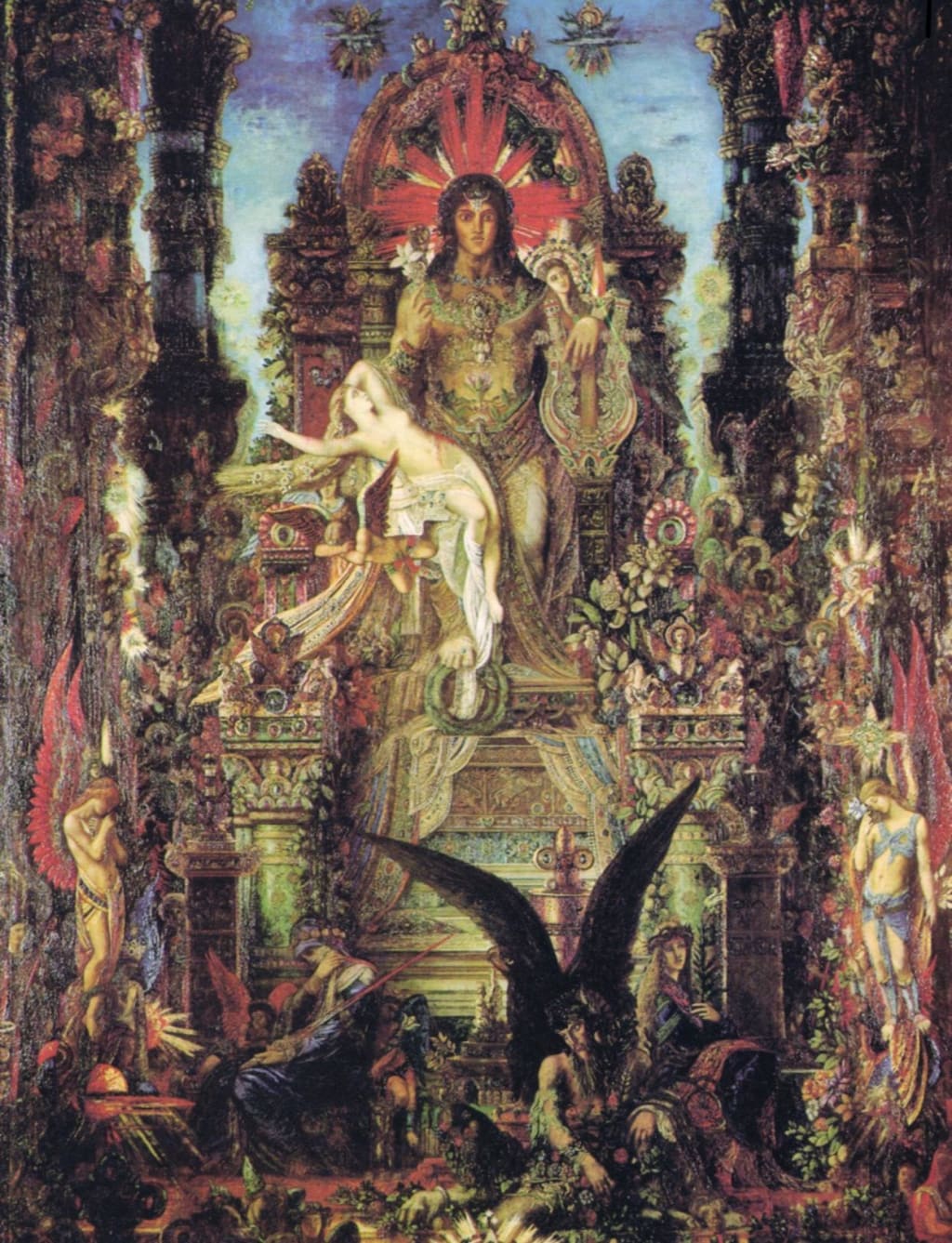
Created in 1895 Jupiter and Semele was the artist’s final masterpiece. (pictured above) It depicts the tragedy that, according to Greek mythology, was about Semele, a human princess of Thebes who catches the eye of Jupiter, a perpetual philanderer. He seduces the princess, and she becomes pregnant. When Jupiter’s jealous wife, the goddess Hera, finds out, she sets out to punish Semele. Hera convinced the mortal princess to ask Jupiter (who had promised to grant Semele any wish) to show her his true form. Obliged to comply with her request, Jupiter revealed his magnificence – a constant storm of lightning bolts. Semele was killed immediately. Jupiter ripped the infant from her womb, sewing the baby into his own thigh until it was ready to be born. The infant would grow to be Dionysus, the god of wine and the only god born of a mortal woman. Moreau’s painting depicts a bejeweled and glorious Jupiter staring intensely ahead as Semele, face frozen in terror, swoons in his lap. The bloody wound on her side suggests that Semele is dead in the painting; her unborn child has already been removed from her body. The seven-by-four-foot painting was a stunning finish to Moreau’s 30-year career, painted only a few years prior to his death in 1898.
About the Creator
Rasma Raisters
My passions are writing and creating poetry. I write for several sites online and have four themed blogs on Wordpress. Please follow me on Twitter.
Keep reading
More stories from Rasma Raisters and writers in Art and other communities.
'Till Death We Do Art
There would be nothing divine in this world without art. Nature may surpass the divine to all intents and purposes, but like everything it absorbs and is absorbed by, it remains here, stuck on the surface of this world, ever-present, physically bound to the universe.
By Avocado Nunzella BSc (Psych) -- M.A.P 15 days ago in Art
5 Ways to Trust Your Creative Ideas
When I go through creative dry spells, I tend to think that generating more ideas is what is going to get me through it. However, I've learned the hard way that this isn't the case. But, having more ideas doesn't make us more creative. In fact, it can have the opposite effect.
By Kathy Tsoukalas4 days ago in Art
A Historic Declaration
We the People of the Husbands of the United States of America, in Order to form a more perfect Union, and I mean you...with me...establish Justice, insure domestic Tranquility, provide for the common defence, promote the general Welfare, and secure the Blessings of Liberty to ourselves, after Puberty, do ordain and establish this Declaration of Co-Dependence.
By Gerard DiLeo5 days ago in Humans


Comments
There are no comments for this story
Be the first to respond and start the conversation.