
Book Excerpt: Building the Nordic Gärdsgård
A Practical Guide to Slanted Split-Rail Fences

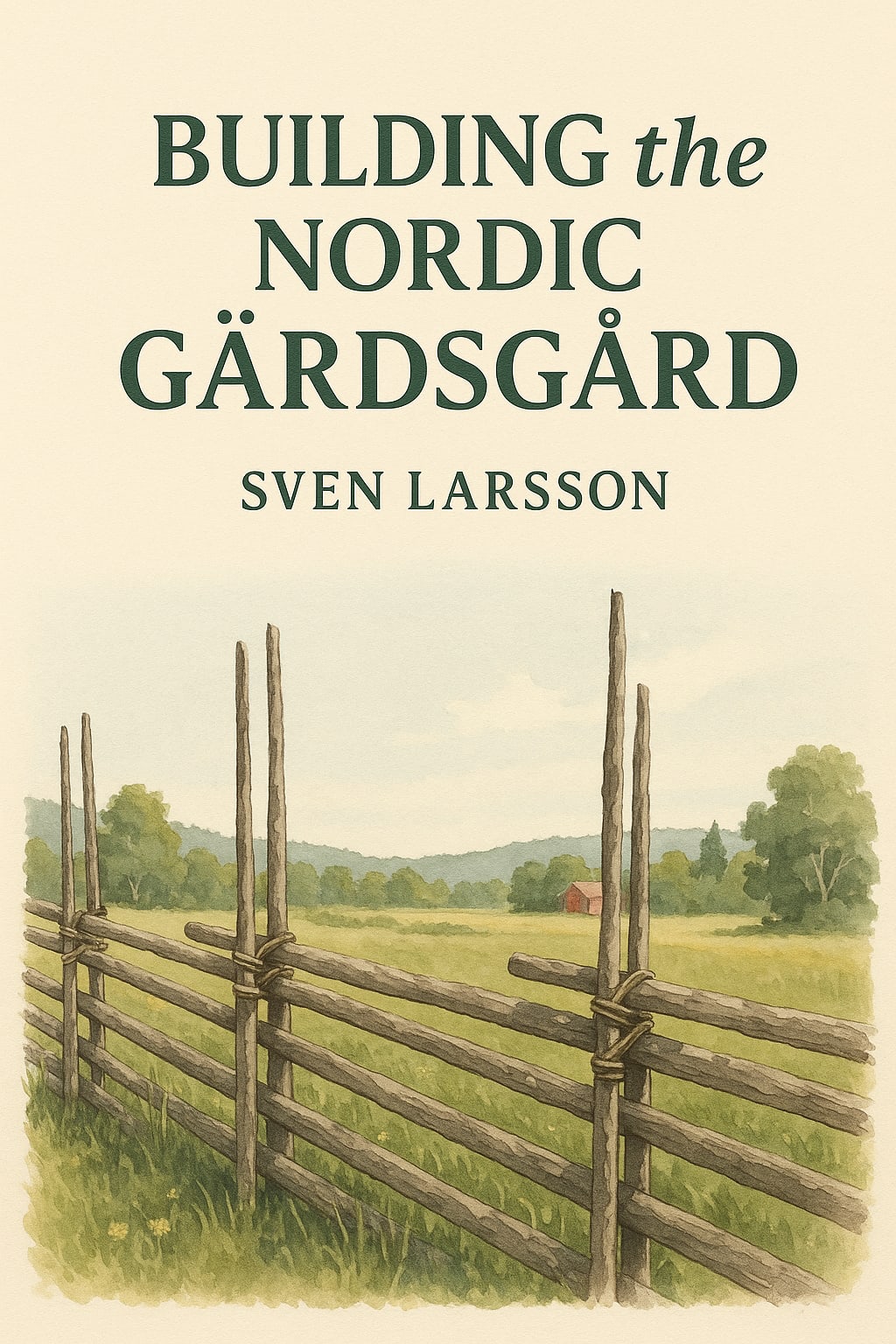
Gärdsgård - A fence that sounds like a forest
Stand beside an old Swedish hay field at sunrise. The silver-grey rails of the wooden fence creak in the warming air; resin trapped inside the spruce expands and the rails chafe against each other. That fence is a gärdsgård—a rail fence is made from wood only, without metal nor plastics, held together by geometry, friction, and tradition stretching all the way to the age of the Vikings.
When a fence is also a story
The gärdsgård (pronounced YEHRDS-gord) fence is woven entirely from organic material found in the local Swedish forrests. It uses no nails, no screws, and no wire. Two slender tree trunks are driven into the earth as a leaning pair, several split rails thread between them in a shallow zig-zag, and a green sapling twists around their tops to clamp everything tight. When the sapling dries it shrinks, the binding tightens, and the structure stiffens. That simple mechanism has kept animals in and humans out—or vice versa—for at least a thousand years in what is now Sweden, Norway, and the forested west of Finland.
This chapter explains how the design originated, how it burrowed into regional folklore, how it gained specific dimensions in national law, how it fits the ecology of northern forests, and most important—why people in the twenty-first century still bother to fell trees and split rails when a hardware store sells cheap metal mesh.
How far back does the pattern reach?

Physical evidence: Viking-Age split rails from the Mälaren region
Extensive Viking-Age excavations around Lake Mälaren have yielded occasional split spruce or pine timbers in contexts dated to the late tenth century. The clearest examples come from the 1990s investigations of Birka’s harbour defences, where several quarter-split stakes and rail-sized slats were recovered and radiocarbon-dated to c. 950 CE. The finds are fragmentary—none preserves a whole fence module—but they show that the technique of splitting logs for structural use was already in practice by the end of the Viking Age. No peer-reviewed report has yet documented a comparable split-rail fragment from nearby Hovgården; the reference sometimes repeated in popular summaries therefore remains unverified.
The word on parchment—gartzgarþar in the Gutalagen
The earliest secure written occurrence of the fence term appears in the Gotland provincial law code, Gutalagen, compiled in the 1220s–1230s. One clause orders farmsteads to provide "gartzgarþar"—boundary rail-fence sections—when tithes or communal labour are due. The Old Swedish plural gartzgarþar (modern Swedish gärdsgårdar) is used without glossing, implying that every reader already knew the object’s form. Although Bishop Bengt Magnusson of Linköping (d. 1237) issued several tithe letters for Gotland, no surviving charter of 1228 CE mentions rail-fence modules in the way later tradition claims.
Livestock, liability, and law
In the year 1367 a birch-bark letter written in what is now Turku, Finland, records Brother Eskil fining his neighbour two örar (about the value of a milk cow) after cows trampled rye "for want of proper gärdsgård." The incident proves that by the fourteenth century a broken rail could be expensive. Two hundred years later the Swedish parliament converted custom into statute: the Rural Code of 1734 set a minimum height of six rails and required the lowest rail to be less than one aln—about 59 centimetres—above the ground. If your neighbour’s animals escaped through a sub-standard fence, you paid.
Iron tries—and fails—to kill the craft
Barbed-wire patents reached Skåne, the southern agricultural heartland of Sweden, in 1876. Flat farms on rich clay switched quickly. Mountain farms, whose pastures lie in thin, rocky soils where iron was expensive to haul, stayed with wood. That regional economy is why the craft was never wiped out by hardware stores: in the forest belt, spruce is free.
***
Excerpt from the book Building the Nordic Gärdsgård - A Practical Guide to Slanted Split-Rail Fences by Sven Larsson.
About the Creator
Sven Larsson
Sven Larsson is a hobby builder of gärdsgård, a roundpole fence type, popular in Sweden. He is a an educator and published author of "Building the Nordic Gärdsgård"
Keep reading
More stories from writers in Art and other communities.
What Voice Cloning Technology Means for Creators and Digital Identity
The rise of artificial intelligence has reshaped the creative landscape in countless ways, from AI-generated visual art to automated music composition, and one of the most intriguing frontiers today is voice cloning. With tools that let users clone your voice using only a short sample of speech, creators and digital communicators are discovering new ways to produce audio content that feels natural and expressive.
By aliyashahzadi7 days ago in Art
“What If It Happens?”
Monday, 11 April 2022 Ishrat Jahan One of our friends, Mr. Farooq, is a middle-aged man, yet he has still not been able to free himself from his deeply suspicious and fearful nature. These days, I happened to have some free time, so I thought it would be a good idea to meet him and try to untangle the puzzle of his constant worries. By coincidence, he himself arrived at my humble home, jolting along in a rickshaw.
By Sudais Zakwanabout 13 hours ago in Art




Comments (1)
This gärdsgård fence sounds really interesting. It's amazing how it's held together without nails or screws. I wonder how long it takes to build one. I've built fences before, but using traditional methods like this seems like a lot of work. Do you think it's more durable than modern fences? Also, it's cool that it has such a long history, going back to the Vikings. How has it survived all these years?