
Amazing Paintings on the Ceiling
Famous artworks painted on ceilings

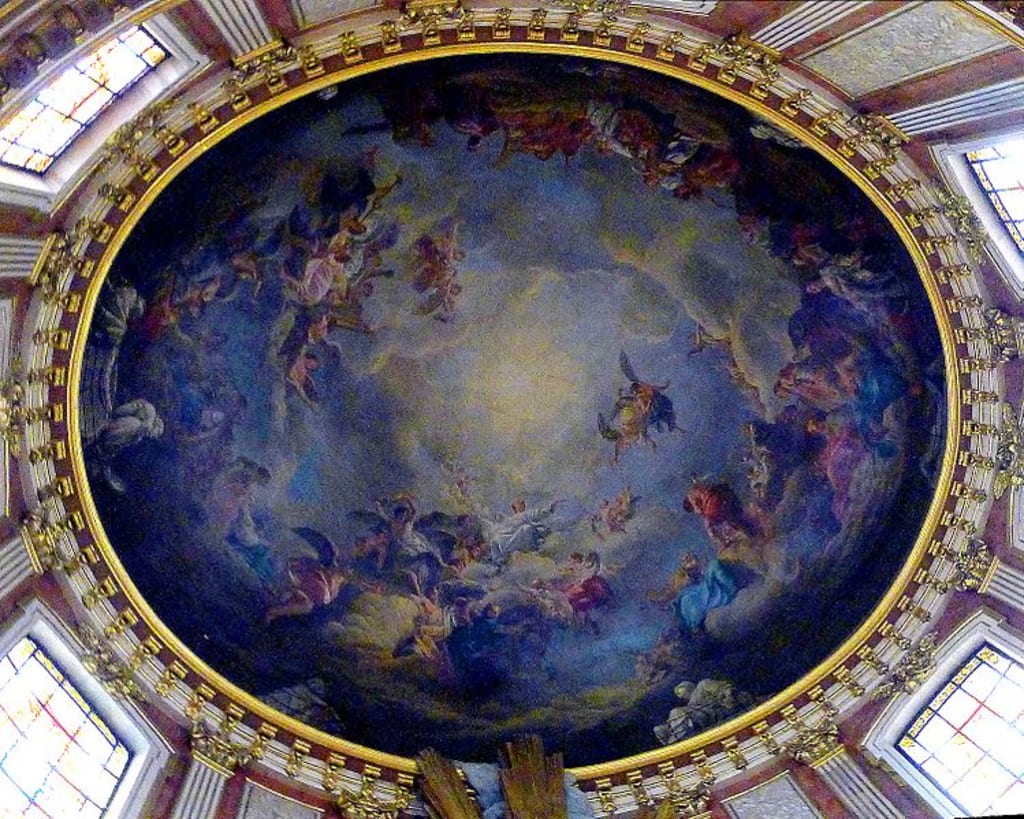
As a tradition in Renaissance, Baroque, and Rococo art, illusionistic ceiling painting uses “trompe l’oeil”. These are perspective tools such as foreshortening and other spatial effects used to create the illusion of three-dimensional space.
Assumption Jean-Baptiste Pierre (Pictured on top)

French artist Jean-Baptiste Pierre painted this artwork on the large oval dome on the Church of Saint-Roch in Paris. The church was built in the Baroque and Classical styles. French architect Francois Mansart created the design for the Chapel of the Virgin.
Borghese Gallery Ceiling Painting

Founded by Cardinal Scipione Borghese, the nephew of Pope Paul V, the Borghese Collection of paintings, sculpture, and antiquities is on display at the Galleria Borghese (reign 1605–1621). Located in what was once the Villa Borghese Pincicana, the Galleria Borhese in Rome, Italy. Twenty rooms spread out over two stories make up the Galleria Borghese. The first chamber of the Salone, the major huge space on the ground floor, features a gigantic trompe-l’oeil ceiling fresco by the Sicilian artist Mariano Rossi, who makes such effective use of foreshortening that his work appears practically three-dimensional.

The Gaulish siege of the Capitoline Hill is broken in this painting by Marcus Furius Camillus. Pietro Rotari painted the grotteschi ornaments, while Venceslaus Peter Boemo did the animal ornaments.
Camera degli Sposi Andrea Mantegna

Italian artist Andrea Mantegna created a series of illusionistic frescoes in a room known as the Camera degli Sposi or Bridal Chamber in the Ducal Palace in Mantua, Italy.

The ceiling is the focal point of the room but each wall also features different scenarios. It appears the ceiling opens into a blue sky. The illusionism of this painting influenced the ceiling paintings of Correggio and other Baroque artists.
Creation of Adam Michelangelo

This artwork is the central work created on the ceiling of the Sistine Chapel by Italian artist Michelangelo. The artist completed this ceiling painting between 1508 and 1512. It is a masterpiece of the Renaissance era. The artwork was commissioned by Pope Julius II.
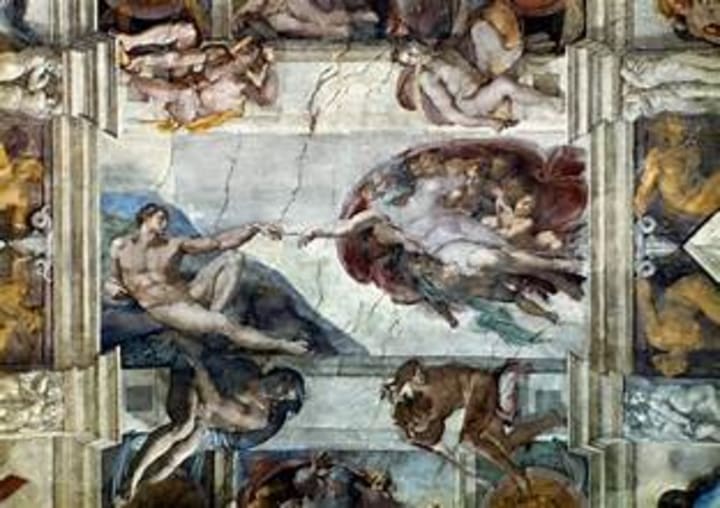
The nine scenes depicted are from the Book of Genesis. To be able to complete this painting Michelangelo lay flat on his back on a scaffolding.
Gallery of Maps Ignazio Danti

This artwork was created from the sketches of Italian Roman Catholic prelate, mathematician, astronomer, and cosmographer Ignazio Danti. A group of Mannerist artists among them Cesare Nebbia and Girolamo Muziano, decorated the high ceiling. The artwork is located on the west side of the Belvedere Courtyard at the Vatican.

The Gallery of Maps depicts a collection of painted topographical maps of Italy. It took Danti three years to created the 40 panels commissioned by Pope Gregory XIII.
Last Judgement Vasari and Zuccari

Italian Renaissance master Giorgio Vasari created this fresco painting the Last Judgement on the ceiling of the Cattedrale di Santa Maria del Flore in Florence, Italy.

The artwork was completed by Italian artist Federico Zuccari, after the death of Vasari. It was commissioned by Grand Duke Cosimo I de' Medici and can be seen above the dome of the church.
Salon d’Hercule Francoise Lemoyne

At the Palace of Versailles in Paris the Salon d'Hercule or Hercule Drawing Room is located on the ground floor of the chateau. It serves as a passgeway between the royal chapel in the North Wing nd the Grand Appartement du Roi. It was built in 1710 by Robert de Cotte for Louis XIV, the chamber was first known as the nouveau salon près de la chapelle (new salon near the chapel).
Construction of the salon d’Hercule resumed in 1724. Louis XV hired Jacques Gabriel, an architect; Claude-Félix Tarlé, a marbrier; Jacques Verberckt, a sculptor; and François-Antoine Vassé, a sculptor, to finish the space.

The ceiling artwork was created by French Rococo artist Francois Lemoyne and completed in 1736.
Triumph of the Name of Jesus Giovanni Battista Gaulli

Italian artists Giovanni Battista Gaulli created this fresco painting in the 17th century. It was painted on the ceiling at the Church of the Gesu in Rome and located in the nave of the Il Gesu. A dome was placed over the intersection of the nave and transept. The drastic disruption of the three-dimensional frame is one of Gaulli’s most original contributions. This gives the idea that the heavenly figures above have an actual presence in the church, as if they are floating directly over the viewers’ heads.

About the Creator
Rasma Raisters
My passions are writing and creating poetry. I write for several sites online and have four themed blogs on Wordpress. Please follow me on Twitter.
Keep reading
More stories from Rasma Raisters and writers in Art and other communities.
'Till Death We Do Art
There would be nothing divine in this world without art. Nature may surpass the divine to all intents and purposes, but like everything it absorbs and is absorbed by, it remains here, stuck on the surface of this world, ever-present, physically bound to the universe.
By Avocado Nunzella BSc (Psych) -- M.A.P 13 days ago in Art




Comments (1)
The use of "trompe l’oeil" in these ceiling paintings is really fascinating. It's amazing how artists like Mariano Rossi could make a ceiling look three-dimensional with foreshortening. I wonder how long it took them to perfect these techniques. And Andrea Mantegna's Camera degli Sposi must have been quite a sight. How did people react when they first saw these illusionistic frescoes?