


These amazing Gothic art paintings span from the 13th to the 15th centuries.
The Lamentation Giotto di Bondone (c. 1305)
Italian artist and architect Giotto di Bondone created this artwork which is one of the most famous panels in his fresco cycle which depicts the life of Christ. In this painting is the aftermath of the crucifixion of Christ showing his followers mourning over his dead body. The Virgin Mary cradles him and Saint John the Evangelist throws out his arms in grief. Giotto was often referred to as the Father of Western painting since he introduced depth, mass, and human emotion in the scenes depicted. In true Gothic tradition there is a gold-tinged background and the viewer can see angels swirling through the sky.
Annunciation with St. Margaret and St. Ansanus Simone Martini (1333)
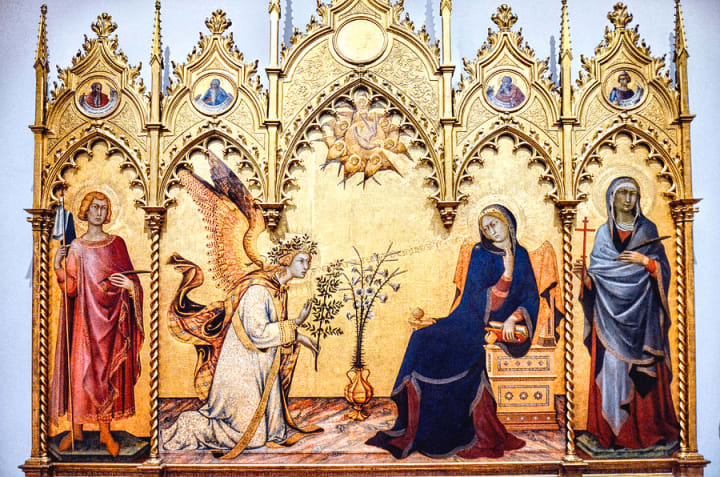
Italian painter of the International Gothic style Simone Martinit created this amazing altarpiece with his assistant Lippo. It depicts the Archangel Gabriel delivering news to the Virgin Mary telling her she will bear the son of God. Two local saints St. Margaret and St. Ansanus stand by.
Maestà Duccio di Buoninsegna

Sienese artist Duccio di Bouoninsega was also known as Duccio. He created the painting styles of Trecento Gothic and the Sienese school. The Maesta meaning Majesty was an large altarpiece created for the Siena Cathedral, a medieval church in Florence, Italy. The artwork consited of many panesl. The central image depicted is the enthroned Virgin Mary holding the Christ child and surrounded by angels and saints. True to the early Gothic paintings the background is golden and the rich colored robes refelct the Byzantine influence.
St. Luke Master Theodoric
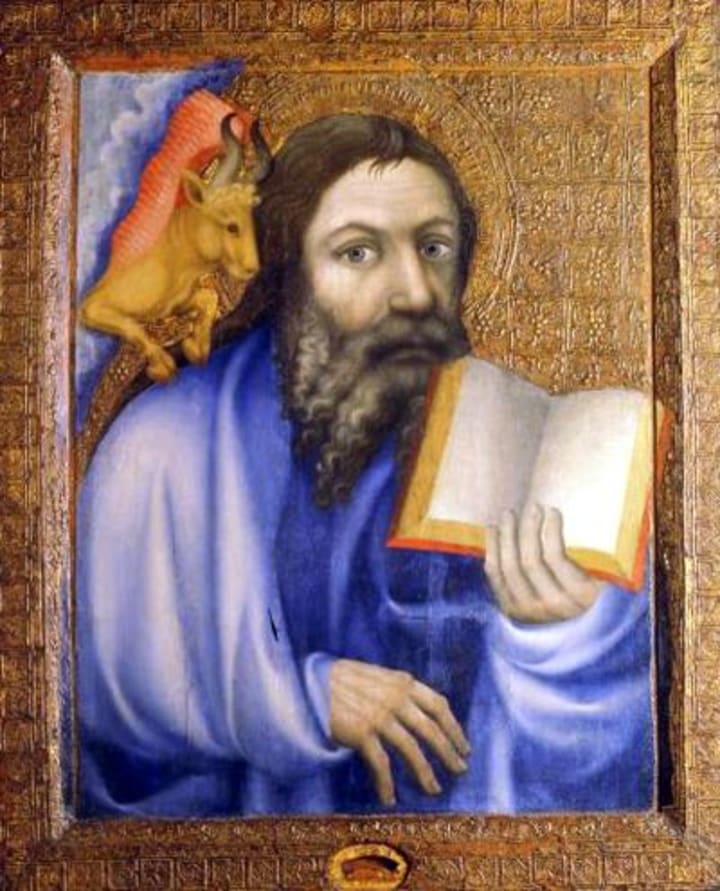
Czech artist Master Theodoric brought out Bohemian Gothic. He created a large cycle of portraits of the siants for the private chapel of Emperor Charles IV. Here is a close-up portratin of Saint Luke the Evangelist. He is wearing richly decorated robes and the background is gilded in gold.
The Hours of Jeanne d’Evreux Jean Pucelle

Parisian Gothic-era manuscript illuminator Jean Pucelle was commissioned by Queen Jeanne d'Evreux of France to create illustrations for a private prayer book.
The Annunciation Fra Angelico (c. 1437–1446)

Dominican friar and Italian Renaissance artist of the Early Renaissance Fra Angelico created this artwork for the Dominican convent of San Marco. It depicts the Virgin Mary receiving news from the Angel Gabriel in a cloister-like setting.
Très Riches Heures du Duc de Berry Limbourg Brothers
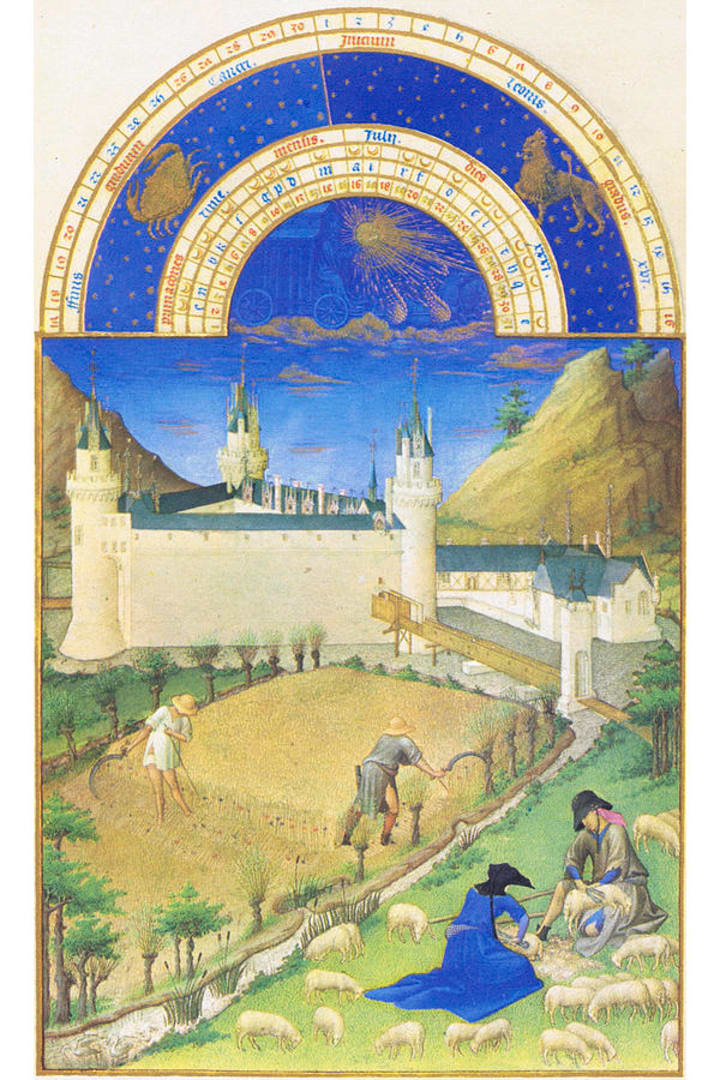
Dutch miniature artists who worked in France and Burgundy in the early 15th century Limbourg Bothers were commissioned by the Duke of Berry (was a title in the Peerage of France). The artists created calendar miniatures depicting scenes of aristocratic life with a background of the beautiful countryside and castles.
The Madonna of the Rose Bower Stefan Lochner
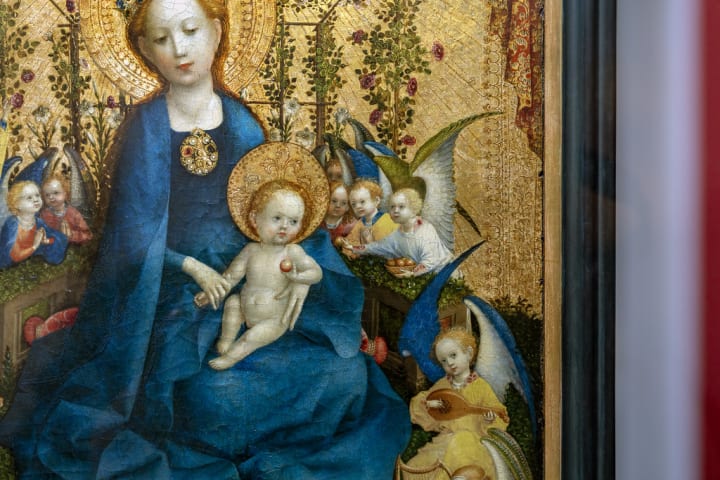
German artist of the late International Gothic period Stefan Locner depicted the Virgin Mary holding the infant Christ surrounded by angels with musical instruments in a rose garden setting,
Scepter of Charles V Hennequin du Vivier

Court goldsmith Hennequin du Vivier created this amazing artwork the Scepter of Charles V. It is also known as the Scepter of Charlemagne referring to the first King who owned this piece of regalia. The scepter has four different elements among them the shaft, a bulb, and a fleur-de-lis. The most amazing feature is the seated figure of Charlemagne, the first Holy Roman Emperor in the early 9th century.
Wilton Diptych
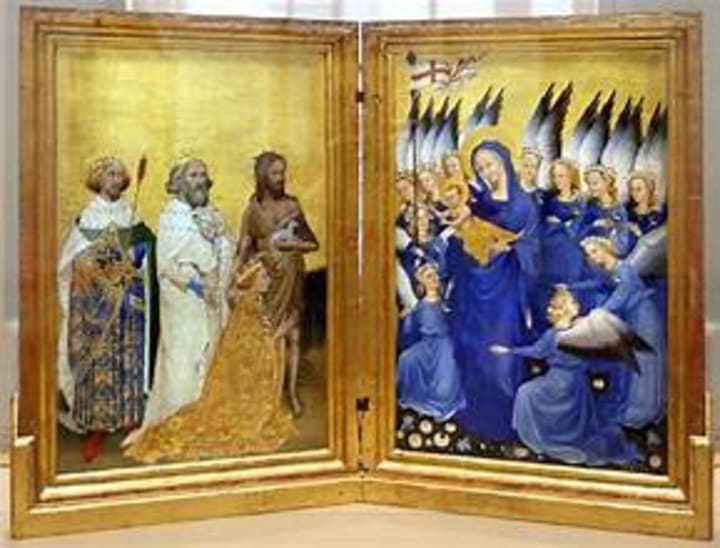
One of the most unusual Gothic artworks is the Wilton Diptych. This was commissioned by King Richard II of England in the late 14th century. It is one of the only religious panel paintings completed in England during the Gothic period to have survived. The artwork consists of two hinged panels one depicting King Richard II and the other the Virgin Mary and infant Jesus accompanied by angels.
Well of Moses Claus Sluter

Dutch sculptor Claus Sluter created this amazing sculpture which is considered to be the artist's Magnum Opus. It’s located just outside of the French city of Dijon, the capital city of the Burgundy region in northeastern France. The sculpture was commissioned by the Burgundian Duke Philip the Bold. It is a perfect example of International Gothic which integrates northern realism.
About the Creator
Rasma Raisters
My passions are writing and creating poetry. I write for several sites online and have four themed blogs on Wordpress. Please follow me on Twitter.
Keep reading
More stories from Rasma Raisters and writers in Art and other communities.
Kitchen Help by Amy Lyn Bihrle
Introduction I follow The Reiki Cat Lady on Facebook as they share some wonderful feline artwork and this lovely funny one caught my eye to inspire a story. They remind me of my friends Cherri and Amanda's and my daughter Juliet's cats that know where all the treats are hidden, in the kitchen.
By Mike Singleton 💜 Mikeydred 2 days ago in Art


Comments
There are no comments for this story
Be the first to respond and start the conversation.