
A Migration-Born Tradition: Japanese Porcelains
Short history of Japanese porcelain
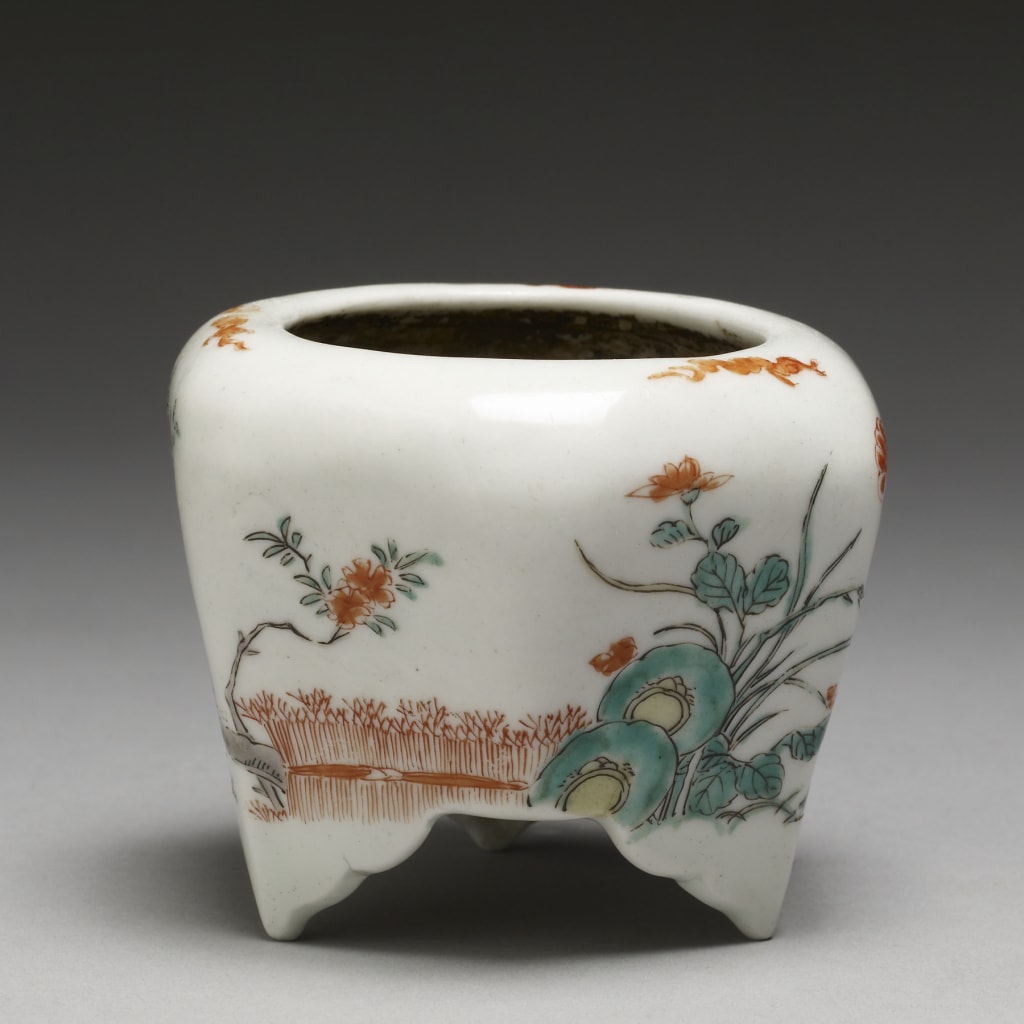
Japanese art, when evaluated as an artistic style and a unique set of values in the Far East, possesses a distinct language while also engaging in substantial interaction with the surrounding civilizations due to its geographical location. Especially Japan, China, and Korea have been the civilizations that experienced this interaction most extensively, partly owing to forced migrations resulting from wars and cultural exchanges through trade during peacetime. Among these three civilizations, Korea played an undefined role, serving as a geographical and socio-cultural bridge between China and Japan. Although Korean art is not as famous and renowned as Chinese and Japanese arts, it boasts a rich foundation and history comparable to these two civilizations.
While the Western world has primarily focused on Chinese and Japanese arts in Far Eastern Art, numerous remarkable pieces of Korean art can be found in many Japanese museums and private collections. The relationship between Japan and Korean art, in fact, contains information that allows us to understand the history of the region. Japan obtained many cultural developments, such as Buddhism, horse breeding, literary arts, and architecture, through Korea during approximately a thousand-year period from the 3rd century BC to the 8th century AD. Korea served as a constant intermediary with its face turned towards Japan, while remaining linked to China for centuries, enabling Japan to establish cultural contacts with China and later having direct contacts with China.
The transition from low-fired earthenware production to high-fired stoneware and porcelain in the world and the Far East was achieved thanks to China. The exact date when Chinese masters began to use the structure type known as stoneware remains uncertain, but it is known to date back to around the 1000s BC according to Chinese experts. The genuine production of porcelain, which some authorities classify separately among themselves, is believed to have begun during the Tang Dynasty period between AD 618 and 907 . Stoneware and porcelain production techniques remained mystical secrets exclusive to China for many years, and technical information such as kiln types, structures, and glaze contents were kept concealed from other nations. However, during China's Three Kingdoms period (AD 220-260), the migrating Chinese artisans taught the Korean potters pottery wheels and high-fired kilns necessary for stoneware firing. In Korea, closely linked to China in terms of ceramic production and techniques, porcelain production began during the Goryeo Dynasty (918-1392) with the production of celadon glazes, which were made extensively with a grayish body. The widespread production of pure white-bodied porcelain, on the other hand, corresponds to the beginning of the fifteenth century.
The two invasions by the Japanese to Korea in 1592 and 1597 caused the closure or destruction of almost all pottery centers. After these invasions, many master artisans were taken as prisoners and brought to Kyushu, the region in Japan where the ceramic craft flourished during the Momoyama and early Edo periods. These artisans were treated with great respect, their living conditions improved, and some were even rewarded with the title of samurai as a sign of great honor and respect. All of these artisans stayed in Japan and became naturalized citizens after peace was established with Korea.
One of these Korean master artisans, Li Sampei, discovered the kaolin source in the Mount Izumi region of Northern Kyushu around 1615. With this discovery, porcelain production, which had not been possible in Japan before, began. The initial examples were rough and had thick walls, and due to the low refinement of the clay, they were light orange in color. The glazed surfaces of these examples showed small pinholes, flaws, and traces left by flying wood chips inside the kiln.
The Japanese porcelains, with the contributions of Chinese artisans in terms of technical aspects, became one of the most significant commercial and cultural assets in the Far East. The internal conflicts that arose with the end of the Ming Dynasty in China brought porcelain production to a complete halt. Some of the Chinese artisans fled these wars and sought refuge in Japan, while Japanese artisans sought to learn the intricacies of porcelain production from Chinese artisans through travels to China. In the mid-17th century, one of the Japanese porcelain masters, Sakaida Kizaemon, settled in Nagasaki and learned the intricacies of the enamel decoration technique from Chinese artisans. He then introduced this technique in the Kakiemon region where his workshop was located. Especially the porcelains produced with this technique garnered great interest from European importers after the production in China came to a halt. Japan, becoming the sole producer during this period, established numerous porcelain workshops due to the increased demands. Considering the development periods of porcelain in China and Korea, Japanese porcelains achieved excellence in both style and technique within a very short period, partly thanks to migrant artisans. The works of the Japanese porcelain masters, who initially started by imitating Chinese porcelain, possessed such refined style and unique language that they were later imitated by Chinese porcelain producers attempting to re-enter the European market after the internal conflicts.
During this period overshadowed by wars and migrations, the demands of European consumers encouraged Japanese artisans to create new forms and designs. In addition, porcelain imports during the Edo period established an intercontinental communication network, creating a knowledge network about the period's trade, culture, art, and social structure and facilitating the transmission of this information to the present day. European porcelain items, which were first developed and marketed between 1708 and 1715, did not imitate Chinese or Korean porcelains due to the changing tastes of the period. Instead, until the influence of Neo-Classicism spread across Europe, they entirely followed the style and technique of Japanese porcelains.
References
Dunn, Michael (1999). “Japan”, The Art of East Asia, ed. E. F. Becker, Cologne: Könemann Verlagsgesselschaft, p: 498-672.
Dunn, Michael (1999). “Korea”, The Art of East Asia, ed. E. F. Becker, Cologne: Könemann Verlagsgesselschaft, p: 673-702.
Hesemann, Sabine (1999). “China” The Art of East Asia, ed. E. F. Becker, Cologne: Könemann Verlagsges- selschaft, p: 8-242.
Impey, Oliver (1984). Japanese Export Art of The Edo Period and Its Influence on European Art. Modern Asian Studies, Special Issue: Edo Culture and Its Modern Legacy, (18/4), p: 685-697
The Museum of Oriental Ceramics. (2014). http://www.moco.or.jp/en/intro/history_c/korea.php (31.05.2016)
Wilson, George B. (1905). The Ceramic Art of Japan, Brush and Pencil, (16 / 4), p:141-147.
About the Creator
Keep reading
More stories from Efe Türkel and writers in Art and other communities.
Exploring How Nature's Balance Shapes Design
In today's ever-expanding economic realm, the proliferation of design objects flooding the market has emerged as a cause for concern. Regrettably, consumer perspectives have become ensnared by manipulative marketing ploys and advertisements, leading to the accumulation of items with little genuine value. As consumerism evolves into a cultural phenomenon, manufacturers are locked in a perpetual race to unveil the next "must-have" product. This frenzy culminates in a deluge of hastily manufactured design objects, bearing an unsettling resemblance to an overflowing landfill.
By Efe Türkel3 years ago in Art
'Till Death We Do Art
There would be nothing divine in this world without art. Nature may surpass the divine to all intents and purposes, but like everything it absorbs and is absorbed by, it remains here, stuck on the surface of this world, ever-present, physically bound to the universe.
By Avocado Nunzella BSc (Psych) -- M.A.P 19 days ago in Art
The Taylor Swift Paradox: Breaking Down the Critiques Behind the World's Biggest Pop Star
The Taylor Swift Paradox: Breaking Down the Critiques Behind the World's Biggest Pop Star Introduction Taylor Swift is undeniably the defining pop culture icon of our era. With her record-breaking Eras Tour, massive economic influence, and fiercely loyal fanbase, she has achieved a level of superstardom rarely seen in modern history. However, with unprecedented fame comes intense scrutiny. Despite her monumental success, Swift faces a growing wave of criticism regarding her artistic choices, public persona, environmental impact, and business practices. For some, these factors have led to "Swift Fatigue," causing them to distance themselves from her work. Here is a comprehensive breakdown of the most prominent critiques leveled against the pop phenomenon.
By Nivard Anna4 days ago in Art
Early March 2026: 4 Goals Accomplished
It's early March and I've now accomplished my 4th writing goal for the year of 2026. Before diving into the behind-the-scenes of it... why not tell you up front what that accomplishment was? I was published in a 2nd publication for this year. Published in Helix Literary Magazine out of Central Connecticut State University. You can read it for free right now!
By Stephen Kramer Avitabile2 days ago in Writers




Comments
There are no comments for this story
Be the first to respond and start the conversation.