
Wojtek the Bear: Soldier of a Forgotten War
The True Tale of a Bear Who Fought Alongside Polish Troops in World War II
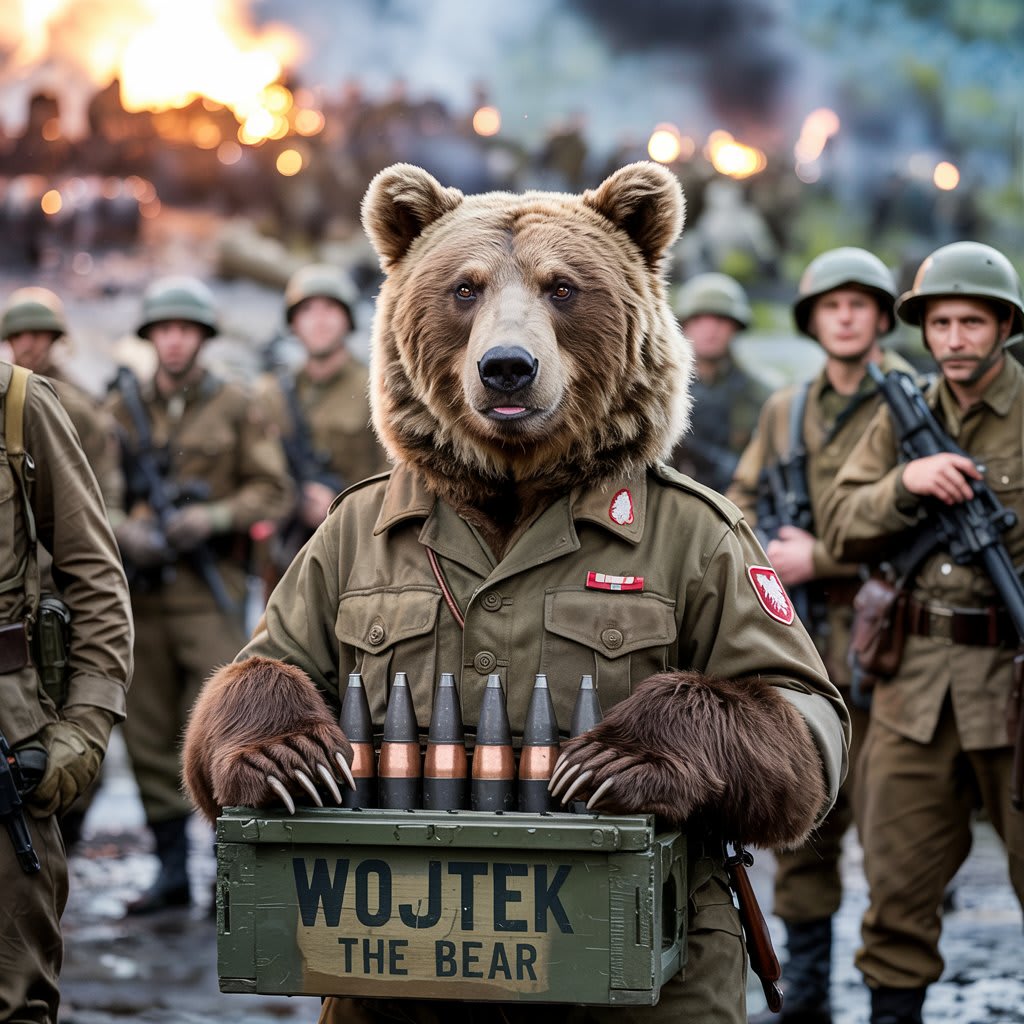
In the chaos of World War 2II, among the dust and desperation of battlefields, stories of courage and brotherhood often go unnoticed. But one such story — strange, beautiful, and deeply human — lives on in the memory of soldiers and the pages of history. It is the story of Wojtek, a bear who became a soldier, a brother, and a symbol of hope during humanity’s darkest hours.
It began in 1942 in the mountainous region of Ham Dan, Iran. A group of Polish soldiers, part of the Polish 2II Corps traveling through the Middle East, came across a young boy carrying a small bundle in a sack. The sack moved. Inside was a tiny Syrian brown bear cub — orphaned, hungry, and barely clinging to life.
The soldiers, weary from war and exile, saw something in the cub that stirred their tired hearts. One soldier offered the boy a few coins, a Swiss army knife, and some canned meat. The boy agreed, and the cub became theirs.
They named him Wojtek, pronounced “Voytek,” a common Polish name meaning "joyful warrior.” And joyful he was. Wojtek quickly became more than a mascot — he was family. The men shared their food with him, fed him condensed milk from an empty vodka bottle, and built a cozy tent with extra blankets for him to sleep in.
As Wojtek grew, so did his bond with the soldiers. He traveled with them through the deserts of Iraq, to Egypt, and eventually to the battlefields of Italy. He learned to imitate his comrades — sitting beside them during meals, drinking beer, and even trying to light cigarettes before munching them instead. He loved wrestling with the men, always gentle despite his growing size and strength. The soldiers never treated him as a pet. He was a fellow soldier, and they were his brothers.
When the Polish II Corps prepared to join the Allied campaign in Italy, there was a problem. Military transport regulations forbade animals from traveling aboard British ships. But the soldiers couldn’t leave Wojtek behind. He was one of them. So, they did what only true brothers would — they enlisted him.
Wojtek was officially drafted into the Polish Army. He was given a rank: Private. He was issued a serial number, and he even had a paybook. As a soldier, Wojtek was allowed to board the ship. The men cheered as he stepped onto the transport, a real soldier among them.
In 1944, during the brutal Battle of Monte Cassino, Wojtek’s legend was born. Amidst the deafening gunfire and chaos, Wojtek watched as his comrades ran back and forth carrying heavy crates of ammunition. Then, without training, without being asked, Wojtek stood on his hind legs, grabbed a crate, and began carrying it to the front lines. Again and again, he returned, helping supply the guns that kept the enemy at bay.
He never dropped a single shell.
Even in his final days, Wojtek would rise at the sound of Polish voices, searching for familiar faces from the past.
The men were stunned. Here was a bear — once a helpless cub in a sack — now doing the work of a trained soldier, under fire, without fear. Word of his heroics spread quickly. To honor his bravery, the unit changed their emblem to a picture of a bear carrying an artillery shell. Wojtek had become more than a mascot. He was a symbol of resilience, courage, and the unbreakable bond between soldiers.
After the war, the Polish troops were resettled in Scotland, and Wojtek went with them. He lived at the Edinburgh Zoo, where visitors would marvel at the bear who had once fought a war. But he was never alone. His former comrades visited him often. They would call out to him in Polish, and his ears would perk up. Sometimes, he would stand tall and wave a paw, as if saluting an old friend.
He never forgot them. And they never forgot him.
Wojtek died in 1963, at the age of 21 — old for a bear, but forever young in the stories of the soldiers who loved him. More than 3,000 people came to honor him at his passing. Statues now stand in his memory — in Edinburgh, London, Krak, and other places where his story touched hearts.
But Wojtek’s legacy is more than a statue or a military record. It is a story about friendship in the face of war, about finding light in darkness, and about the strange, beautiful ways we hold on to our humanity — even when the world seems to forget it.
In a war that left scars across nations and souls, Wojtek reminded everyone that love, loyalty, and courage know no species. He may have been a bear, but in every way that mattered, Wojtek was a soldier — a joyful warrior — and a brother to the end.
About the Creator
Keep reading
More stories from Shiraz Ali and writers in Writers and other communities.
The Rise of a Monarch
The soft light of early morning crept through the high windows of Kensington Palace on June 20, 1837. The city of London still slumbered, unaware that it was witnessing the end of one era and the beginning of another. In a modest bedroom, 18-year-old Princess Alexandrina Victoria lay asleep, oblivious to the quiet stirrings that would soon change the course of British history.
By Shiraz Ali10 months ago in Writers
Barriers to NLP Adoption in Healthcare Organizations
Natural Language Processing (NLP) has the potential to unlock enormous value in healthcare from improving documentation quality to streamlining revenue cycle operations and strengthening data governance. Yet despite years of promise, NLP adoption across healthcare organizations remains uneven and slow.
By Lilly Scott7 days ago in Writers


Comments
There are no comments for this story
Be the first to respond and start the conversation.