
Barriers to NLP Adoption in Healthcare Organizations
Why healthcare organizations struggle to scale NLP from pilot projects to production systems
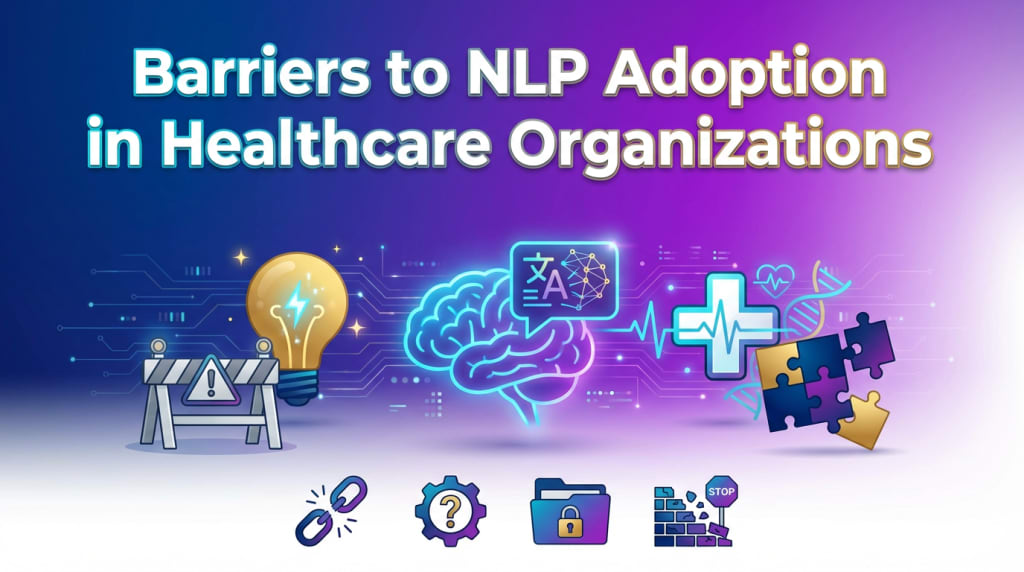
Natural Language Processing (NLP) has the potential to unlock enormous value in healthcare from improving documentation quality to streamlining revenue cycle operations and strengthening data governance. Yet despite years of promise, NLP adoption across healthcare organizations remains uneven and slow.
The reason isn’t lack of technology.
It’s the real-world barriers healthcare organizations face when trying to deploy NLP at scale.
Understanding these barriers is essential for leaders considering investments in advanced NLP platforms or specialized NLP Development services designed for healthcare environments.
1. Unstructured Data Complexity and Variability
Healthcare data is uniquely difficult for NLP systems to interpret.
Key challenges include:
- Highly variable clinical documentation styles
- Specialty-specific language and abbreviations
- Inconsistent terminology across providers
- Ambiguous or incomplete clinical narratives
As explained in HealthITAnalytics’ analysis of AI and NLP in healthcare documentation,unstructured clinical text remains one of the biggest obstacles to scalable AI adoption because accuracy depends on clinical context—not keywords alone.
When NLP systems struggle with nuance, trust in outputs drops quickly.
2. Lack of Domain-Specific NLP Models
Many NLP tools are trained on general-purpose language datasets rather than real-world healthcare data.
This leads to:
- Misinterpretation of clinical intent
- Loss of specialty-specific context
- Higher false-positive and false-negative rates
According to HIMSS’ guidance on AI adoption and governance in healthcare, AI initiatives frequently fail when models are not aligned with clinical language, workflows, and compliance requirements.
This gap is a major reason healthcare organizations turn to tailored NLP Development services that focus on medical, coding, and administrative language—not generic corpora.
3. Integration with Legacy Healthcare Systems
Healthcare IT ecosystems are deeply fragmented.
Common integration barriers include:
- Legacy EHRs with limited interoperability
- Siloed clinical, billing, and operational platforms
- Vendor lock-in and proprietary data formats
As highlighted by Becker’s Health IT coverage on AI integration challenges, even highly accurate AI tools fail to deliver value if they cannot be embedded directly into day-to-day clinical and administrative workflows.
Without integration, NLP outputs remain insights—not actions.
4. Data Quality and Documentation Gaps
NLP performance is only as strong as the data it processes.
Healthcare organizations often struggle with:
- Incomplete or inconsistent documentation
- Copy-paste behaviors in clinical notes
- Conflicting information across encounters
When NLP systems surface these issues, they often expose deeper documentation problems—creating resistance if organizations are not prepared to address them structurally.
5. Compliance, Privacy, and Security Concerns
Healthcare leaders are rightly cautious about deploying AI that processes sensitive patient data.
Key concerns include:
- HIPAA and GDPR compliance
- Data access controls and auditability
- Explainable decision-making
Both HealthITAnalytics and HIMSS consistently emphasize that governance and transparency are prerequisites for AI adoption—not optional enhancements.
Without these safeguards, NLP initiatives often stall during compliance review.
6. Limited Explainability and Trust
For NLP to be trusted in healthcare, stakeholders must understand why a system produced a particular output.
Trust barriers include:
- Black-box model behavior
- Lack of traceability from source text toinsight
- Absence of confidence scoring or rationale
When clinicians and compliance teams cannot validate NLP outputs, adoption slows—regardless of technical accuracy.
7. Workforce Readiness and Change Management
Technology alone doesn’t drive adoption—people do.
Healthcare organizations frequently encounter:
- Limited AI literacy among staff
- Fear of job displacement
- Resistance to workflow changes
- Insufficient training and onboarding
HIMSS research consistently shows that successful AI adoption depends as much on organizational readiness as on model performance.
8. Misaligned Expectations and ROI Pressure
Many NLP initiatives fail due to unrealistic expectations.
Common pitfalls include:
- Expecting end-to-end automation immediately
- Underestimating data preparation effort
- Measuring success only through cost reduction
NLP adoption is a capability-building journey, not a one-time deployment.
How Healthcare Organizations Can Overcome These Barriers
Organizations that succeed with NLP take a different approach:
- Start with high-impact, narrowly defined use cases
- Invest in healthcare-focused NLP Development services
- Design explainability and auditability from day one
- Integrate NLP directly into operational workflows
- Maintain human-in-the-loop oversight
- Pair technology rollout with structured change management
This approach moves NLP from pilot projects to production-scale value.
The Bottom Line
NLP can transform healthcare operations but only when adoption barriers are addressed head-on.
These challenges are not just technical. They are organizational, cultural, and regulatory.
Healthcare organizations that invest in purpose-built NLP Development services, supported by strong governance and change management, will be the ones that turn NLP from a promising concept into a trusted foundation for digital transformation.
About the Creator
Keep reading
More stories from Lilly Scott and writers in Writers and other communities.
How NLP Improves Accuracy in Medical Billing and Coding
Introduction: Why Medical Billing Accuracy Is Still a Problem Medical billing and coding errors remain one of the most persistent—and expensive problems in healthcare operations. Denials, delayed reimbursements, compliance audits, and revenue leakage often trace back to one root cause: language complexity in clinical documentation.
By Lilly Scott9 days ago in Writers
It's Winter
Anne Bernays and Pamela Painter — What If? Writing Exercise for Fiction Writers prompts The Exercise —Write a scene involving two characters. Have the point-of-view character presume something entirely different about the situation from what the other character's overt behavior seems to imply. For example, a landlord comes to visit, and the tenant suspects that it isn't a visit but an inspection. Make up several situations in which one character can fantasize or project or suspect or even fear what another character is thinking. The Objective - To show how your characters can use their imaginations to interpret the behavior and dialogue of other characters.
By Denise E Lindquist18 days ago in Writers
How to Succeed at the Benson Directory®
Congratulations and welcome to the Benson Directory® employee #22391! As our newest call handler, you will have the privilege of speaking with dozens of unique and interesting people on a daily basis as well as the opportunity to earn bonuses for high performance. Contained within this handbook you will find a set of ease to follow instructions designed to help you settle in to your new role and begin paving the way to success.
By S. A. Crawford4 days ago in Fiction



Comments
There are no comments for this story
Be the first to respond and start the conversation.