
The Rise of a Monarch
Queen Victoria's Ascension to the Throne in 1837
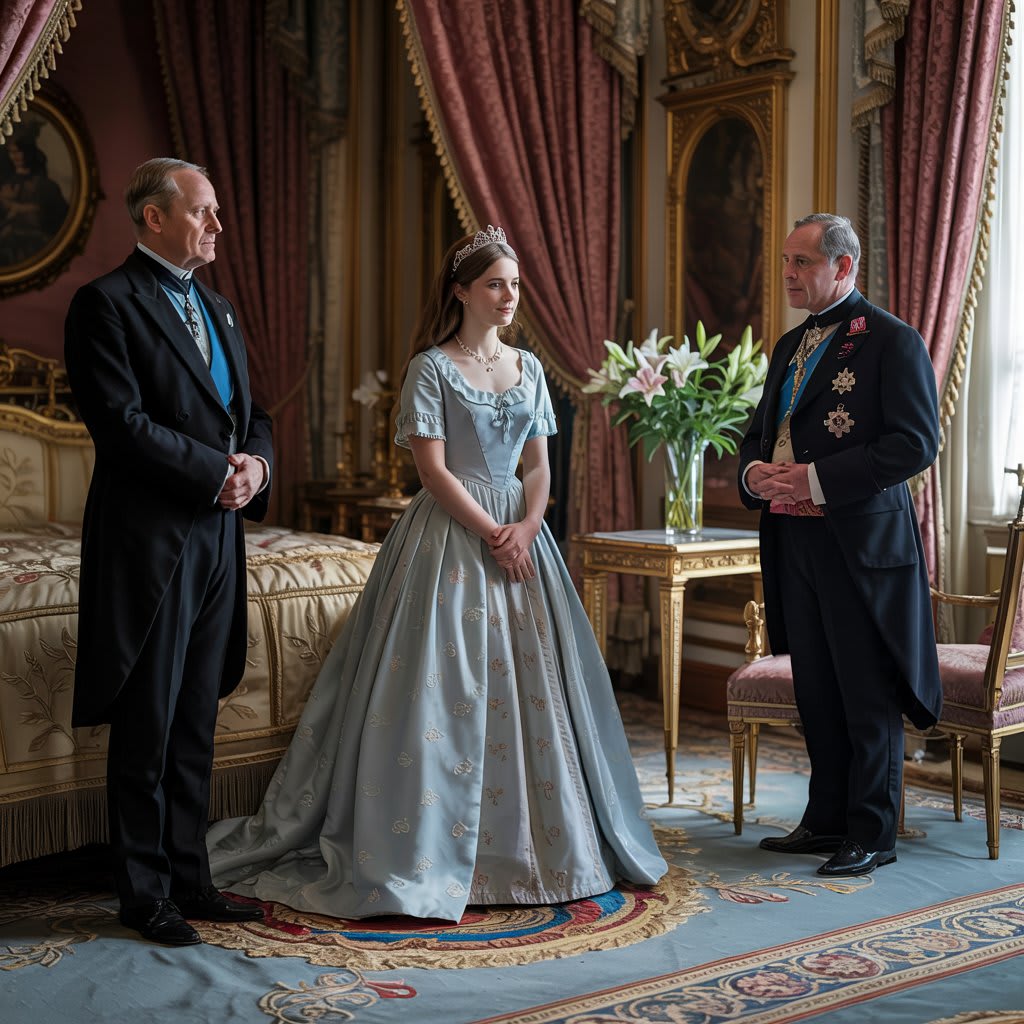
The soft light of early morning crept through the high windows of Kensington Palace on June 20, 1837. The city of London still slumbered, unaware that it was witnessing the end of one era and the beginning of another. In a modest bedroom, 18-year-old Princess Alexandrina Victoria lay asleep, oblivious to the quiet stirrings that would soon change the course of British history.
Outside her room, two solemn figures made their way through the palace corridors—Lord Conyngham, the Lord Chamberlain, and the Archbishop of Canterbury, William Howley. Their expressions were grave. Hours earlier, King William IV had passed away at Windsor Castle, having ruled for only seven years. His death marked the end of the Georgian era. Now, it was time to inform the next in line.
Victoria had been kept shielded from politics and power her entire life. Raised under the rigid rules of the "Kensington System" devised by her mother, the Duchess of Kent, and her mother's ambitious advisor Sir John Conroy, she had grown up in near-isolation. She wasn't even allowed to walk down the stairs without holding someone's hand. Every letter she wrote, every visitor she met, had been monitored. Despite this, Victoria developed a keen mind, a strong sense of right and wrong, and a quietly independent spirit.
When the knock came at her door just after 6 a.m., she was already half awake, sensing something unusual. Dressed quickly in a simple white gown, she opened the door herself—a rare act for a royal. Lord Conyngham and Archbishop Howley bowed deeply before her.
"Your Majesty," Lord Conyngham said, his voice firm but respectful. "The King has died. You are now Queen of the United Kingdom."
Victoria blinked, as if unsure she had heard correctly. Her heart pounded in her chest. She nodded slowly, her face composed though pale. “I understand,” she said softly.
She asked for a moment alone. Inside her room, she paced in silence. For the first time in her life, she was free of her mother’s control—but the weight of the crown was heavier than she had ever imagined. At just 18, she was to rule over an empire that spanned continents, over millions of subjects, and through a time of great political and social upheaval.
Later that morning, she met with her first Prime Minister, Lord Melbourne. A seasoned and shrewd politician, he would become her trusted mentor in the crucial first years of her reign. As she entered the drawing room, the men of the Privy Council—many twice her age—stood and bowed. They were prepared for a timid girl, a puppet of her mother. What they saw instead was a calm, poised young woman who looked each man in the eye as she greeted him.
In her clear, youthful voice, she announced her intention to reign under the name Victoria, not her first name, Alexandrina. It was a small act of assertion, but it sent a powerful message: she would not be controlled.
Over the next few days, Victoria navigated her new world with remarkable grace. She insisted on moving her bedchamber from her mother's apartments to her own private rooms—another defiant step away from the influence of the Duchess and Sir John Conroy. She began taking daily meetings with government officials, reading state papers with diligence, and asking probing questions that surprised her advisors.
The people of Britain were equally captivated. Newspapers praised the young queen’s modesty and intelligence. Crowds gathered outside Buckingham Palace—soon to become her official residence—for a glimpse of her. Though small in stature, with a high forehead, round face, and striking blue eyes, she carried herself with dignity far beyond her years.
But behind the regal composure, Victoria was still a teenager, grappling with loneliness and sudden power. She confided in her journal, writing page after page each night. “Since it has pleased Providence to place me in this station,” she wrote, “I shall do my utmost to fulfill my duty toward my country.”
Within weeks, she began attending council meetings regularly, sometimes outshining even her ministers with her command of detail. She listened, learned, and slowly gained the respect of those who once doubted her.
As the months passed, Victoria transformed from a sheltered princess into a determined monarch. Her bond with Lord Melbourne deepened, offering her both political guidance and emotional support. Under his mentorship, she began to understand the delicate balance between monarchy and government, tradition and progress.
The coronation would come the following year, but June 20, 1837, marked the true beginning of her reign. A reign that would last over 63 years—one of the longest in British history—ushering in an age of unprecedented industrial, cultural, and political change: the Victorian Era.
But it all began in that quiet moment before dawn, when a young girl opened her door, heard the words “Your Majesty,” and did not flinch.
About the Creator
Keep reading
More stories from Shiraz Ali and writers in Writers and other communities.
The Birth of a Bard
In the quiet spring of 1564, the air in Stratford-upon-Avon was thick with the scent of blooming flowers and something less welcome—fear. The plague had reached the town again. Red-painted doors marked the homes of the sick, and whispers of death traveled faster than the wind. Amid this anxious backdrop, in a modest timber-framed house on Henley Street, a child was born who would one day shape the English language like none before him.
By Shiraz Ali10 months ago in Writers



Comments
There are no comments for this story
Be the first to respond and start the conversation.