
Vocal (And Others) We Need To Be Told
You Broke The Rules, Follow The Guidelines Is Not Enough


Introduction
I have seen a few Vocal Creators getting stories rejected for "not following the guidelines", although this does not seem to be as frequent as it used to be, it is still an annoying thing when it does happen.
I wrote this piece a long time ago on how to try and deal with the situation:
So What Do We Need To Be Told?
If we have done something wrong we need an explicit reason why, so that we can rectify the situation. Often mine were rejected because the YouTube video could not be viewed in the USA, but I was never told why.
YouTube is atrocious with licensing information, I have asked for a notice saying where videos can be viewed but never received a reply. This does not seem to be a Vocal problem now but it gripes a bit when readers cannot listen to music, especially on my playlists and Beat pieces.
So if our stories are rejected we should get reasons like:
- "Not Enough / Too Many Words"
- "Pornographic / Explicit Pictures or Content"
- "Illegal Use Of Copyrighted Material"
- "Plagiarism"
- "AI Generated Content without flag"
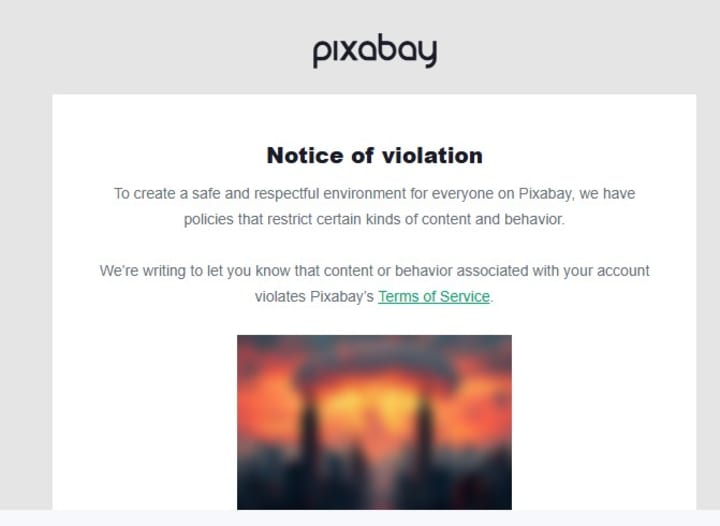
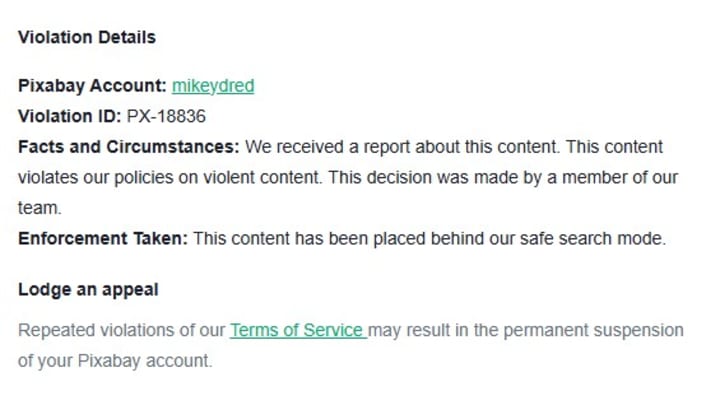
This is a notice I got from Pixabay this morning, which always worries me, but they still publish the pictures but they don't appear in safe search.
Someone had complained about the image, and while it shows a bomb going off I don't see what the problem was that the person who reported it had, but Pixabay gave me a full explanation of what had happened.
These are their terms of service and if you go through them you can find out what is allowed and what could be a violation.
This is my page, and it has three items that have resulted in Pixabay violations
Conclusion
This is just a request for Vocal to be clearer to creators when stories are rejected, and always give an explicit reason for the rejection.
About the Creator
Mike Singleton 💜 Mikeydred
A Weaver of Tales and Poetry
Join & Share In VSS
Creationati
Call Me Les ♥ Gina ♥ Heather ♥ Caroline ♥
Keep reading
More stories from Mike Singleton 💜 Mikeydred and writers in Writers and other communities.
The Ushers Of The Year's End: A Mikeydred December Dollar Prompt For All Vocal Creators
Introduction Every so often I set prompts in the Vocal Social Society and offer a dollar tip to five random creators who take part in it and ask them to share their stories in the comments and on the thread in the group.
By Mike Singleton 💜 Mikeydred about a year ago in Writers
The Comeback Generation: Why Starting Over After 30, 40, or 50 Is Becoming the New Path to Success
For decades, society told a simple story about success: figure out your life early, build your career fast, and lock in your future before you get “too old.” The message was subtle but powerful — if you didn’t make it in your twenties, you were somehow behind. Today, that story is breaking apart. Across the world, people in their thirties, forties, and fifties are walking away from careers, routines, and identities that no longer fit. They are starting businesses, learning new skills, moving to new cities, and chasing dreams they once believed were no longer allowed. This shift is being driven by more than just dissatisfaction. It’s being driven by clarity. With age often comes a deeper understanding of what truly matters. Many people spend their younger years chasing external approval — money, titles, or social status. But after years of experience, they begin to ask different questions. Do I enjoy my daily life? Does my work reflect my values? Am I proud of how I spend my time? For some, the answers lead to a powerful realization: staying the same feels riskier than starting over. Technology has made this kind of reinvention more possible than ever. Online courses allow people to learn new careers from their living rooms. Remote work opens doors to opportunities that were once limited by geography. Social platforms give individuals the ability to build personal brands, launch creative projects, or start businesses without massive upfront costs. What once required permission from companies, investors, or institutions can now begin with a laptop and an internet connection. But the comeback generation isn’t just about opportunity. It’s about mindset. One of the biggest barriers to starting over is fear — fear of failure, judgment, and wasted time. Many people worry that changing direction means admitting they made a mistake. But a growing number of voices are reframing that idea. They see their past not as a failure, but as training. Every job, relationship, and challenge becomes part of a skillset. Communication, resilience, problem-solving, and emotional intelligence don’t disappear when someone switches careers or goals. They carry forward, often making older beginners stronger than younger ones. There is also a quiet confidence that comes with experience. Younger people often feel pressure to prove themselves. Older beginners tend to care less about appearances and more about meaning. This shift in focus can lead to deeper commitment and greater satisfaction. Of course, starting over is not easy. It can involve financial uncertainty, uncomfortable learning curves, and moments of self-doubt. Watching younger people succeed in the same space can trigger insecurity. The question “Am I too late?” can echo loudly in the mind. But many in the comeback generation are discovering a powerful truth: there is no universal timeline for a meaningful life. Some of the most successful entrepreneurs, artists, and leaders didn’t find their true path until later years. What they often share is not youthful speed, but persistence. They kept moving forward, even when progress was slow and the outcome uncertain. There is also a cultural shift happening. Communities are becoming more supportive of non-linear life paths. Changing careers, taking breaks, and exploring new identities are becoming more accepted. The idea of having “one job for life” is being replaced by the idea of having many chapters. In this new story, life is not a straight road — it’s a landscape. Sometimes you climb. Sometimes you wander. Sometimes you stop and choose a completely new direction. And that choice, made at any age, can be an act of courage. The comeback generation isn’t trying to turn back time. They are using it — using what they’ve learned, what they’ve survived, and what they now understand about themselves. Because success is no longer being defined by how early you start. It’s being defined by how boldly you choose to continue.
By Hazrat Usman Usman3 days ago in Writers
Smart phones, Humans and Aliens.
WARNING. I will be tapping into one of your favorite creative tensions: The absurdity of humans worshipping their glowing rectangles as if they were tiny oracles. There’s something deliciously poetic about that contradiction, and it lends itself beautifully to an instructive proviso.
By Novel Allen5 days ago in Poets




Comments (13)
Definitely second this. The Vocal team keeps up such good communication with the community in many areas but I feel like this one has lacked just a bit. It would certainly help out the writers and reduce the number of rejected stories.
Okay the person who reported that photo of yours is such a wuss! And yes, I would love for Vocal to follow Pixabay's footsteps
Hi Mike, I had a story rejected this week and racked my brain trying to think what I had done wrong. I was mortified, waiting for that note to say you have been banned for ...... Then I realized I had not made the word count. I'm too used to poetry, I guess. I will not make this mistake again, though. Thanks for the insight.
Interesting topic. Thanks for the info.
I have asked for this in the past as I have also aksed for a possible area where we may inquire as to why a story of our failed to reach the judges in challenges. I suggested it be a pay request ( perhaps $5.00) for the serious person wanting to know.
What a reasonable request to be made and to make sure we all do the right things. Good work.
⭐️👏Clear guidance is the best and information on rejections should be clear - otherwise Vocal is relying on the writer to interpret their guidelines. If guidelines need to be flushed out and updated, all the better. Agree, agree, I hate when sites give blanket answer and referral to their guidelines. Refer back with specific issue.
Thank you, it makes sense. I had a story rejected recently, vocal told me why, maybe, so I corrected it, vocal rejected it again, with explicit ressons stated, so I eliminated certain names of characters, vocal rejected it again, so I gave up. Looks like vocal just like the content of my story.
Well done. I've been seeing those kind of stories on Discord mostly and I've often thought it was weird there wasn't more of an explanation. Hopefully this gets taken care of soon.
Well said!
Very helpful suggestions. Would be easy for Vocal to implement
It would definitely be helpful to have clearer guidelines about what is and isn't allowed.
This is great Mike. Many a time we may cross a line we're not aware of and it's good to know so that we can cross back.