
Revolute Literary Magazine, with a Highlight on Poet Robin Gow
Poetry Journal and Poet Review


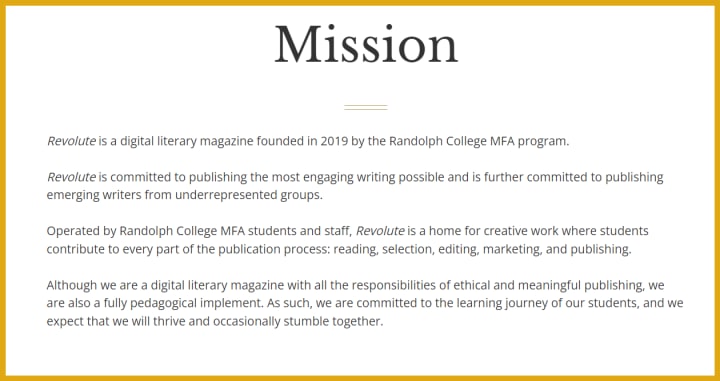
"Operated by Randolph College MFA students and staff, Revolute is a home for creative work where students contribute to every part of the publication process: reading, selection, editing, marketing, and publishing."
Revolute is an online poetry magazine based in the Randolph College's MFA program in Lynchburg, Virginia in the United States. It publishes annually; since started in 2019 it has produced three issues.
My top critique is their strong curation. They have a consistent voice without being slave to form.
Not having a consistent voice isn't inherently bad (lacking a consistent voice is a different beast.) Variation can work and variation can also be present in consistency (see Defunkt Magazine which maintains both consistency in voice and variation).
Variation in voice is risky as it can fall flat by confusing the reader. On the other side, consistency in voice while staying engaging can be challenging to maintain in curation, also potentially falling flat by boring the reader instead.
Revolute acknowledges this tricky balance in their about page, which is something I love about them. The selection process is a journey between the effort and work of hopeful poets and the growth of the students with the guidance of their teachers.
To give you a taste of what I love about Revolute, I'll focus primarily on issues 3 due to time and space constraints. (Issues 1, 2, and 4 can be found here, here, and here. The latest issue, issue 5 on Revolute's main page until the 2025 issue is published, then it will be found under the read button.)
Issue 3 struck me as being driven by the voice of storytelling through the inextricable presence of the narrator. Primarily about people by people through people, it shies away from excessive abstraction (not that abstraction is bad, I love drowning in Dali like pieces) while presenting offerings with poetic, lyrical (non-rhyme) cohesion.
If you're a lover of poetry I strongly advocate to explore all five issues, subscribe/bookmark Revolute, and even go back and re-read pieces periodically.
If you're a poet-hopeful here are a few things I like about it.
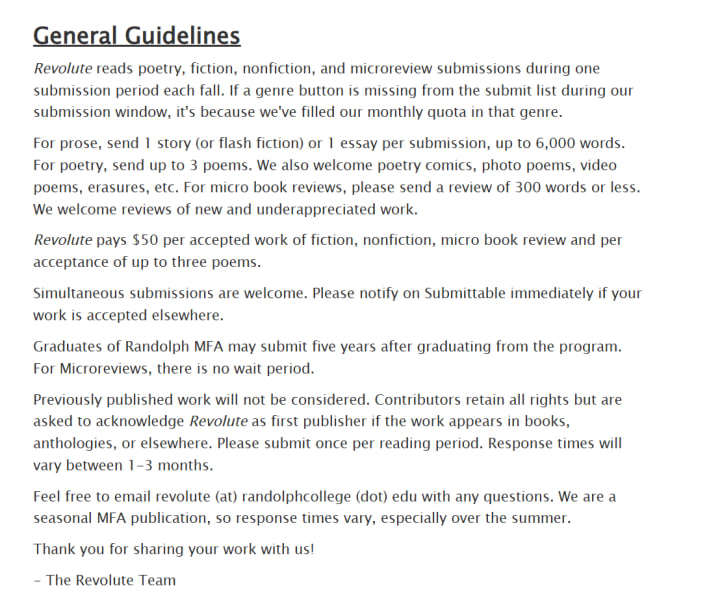
- No submission fees. I understand why mags charge fees, but it can be quite a barrier. I always seek out feeless opportunities, as the ability to pay fees can be a hardship.
- They pay authors. I'm not going to shade most publications that don't. Editing is often a labor of love; Submittable, hosting and other aspects cost money. But creators deserve some kind of renumeration or honorarium where possible. At least throw $10 to selected poets, especially if you're a press that makes profit or a university (with the caveat that a shocking amount of universities don't respect their presses). I won't share how much they pay, as that can always change, but you can go take a peek. Note: they can't pay international poets as of this writing.
- Submittable. I'm perfectly fine with other avenues to submit your pieces to a mag. But submittable is a very easy platform to use. It allows you to find opportunities, access guidelines and magazine website, gives the mag ample tools to guide you through the process, keeps a listing of all the pieces you've submitted, and provides great communication tools between the author and editors.
- Fantastic curation. If your piece is selected for Revolute you can be assured it was done with great care and thought. And if you're not, you know that your piece received ample consideration. You may not have made the mag, but you were read by real human beings, and carefully so. Isn't that a core of what we all want? To have our work seen and valued?
- Transparency. I like that they explain who they are and what their values are.
- Variety. In addition to traditional poetry they also accept
- comics,
- photo poems,
- video poems,
- erasures
- prose,
- fiction and flash-fiction,
- nonfiction and essays,
- micro book reviews
Things you should know
- They are entirely digital.
- They maybe not be able to pay international writers.
- They have one three month submission window per year in the fall.
- They're submission limits fill up fast, so submit early.
- They allow simultaneous submissions (you can submit your piece to other mags while its at theirs, as long as you withdraw it if its accepted elsewhere).
- They DON'T accept previously published works. (Which I'm not terribly thrilled about as an industry standard). I can't find any guidelines on whether blog or social media posts count as previously published.
- They accept up to three poems (and also prose, fiction, flash-fiction, nonfiction, essays, micro book reviews)
- You can find their full guidelines on submittable and should always follow those guidelines over this review.
Final Verdict*
Would I choose to submit to Revolute? Yes.
Would I recommend others to read Revolute? Yes.
*Read recs will almost never be no. I prefer to use my limited time to read magazines I like. But they won't always be yes. "Would I choose to submit" doesn't mean I have or will submit but that I consider it worth my time. Unlike read recs, this could be a big fat no, as not all publications are my taste or terms may put me off. I did not submit to Revolute for the 2023 issue.
Poems that spoke to me
This part is hard because there are many poems I like in this issue, and it feels as if leaving them out is to say they aren't skilled, touching or otherwise excellent. Alas, I have to whittle them down. Let me assure you the curation in issue 3 is excellent. While not all poems are for all people, you won't waste your time reading the pieces in this issue, whether I've highlighted them or not. I'll start with the poet and their work that most stood out to me, and then give you a few other recommendations.
Highlighted Poet
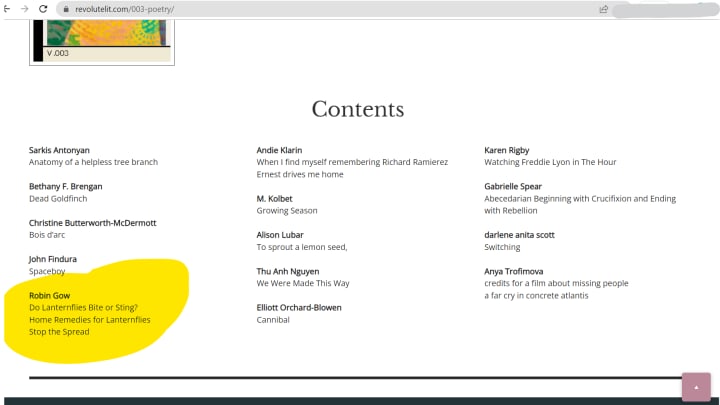
I selected Robin Gow to highlight for how their poems had me wrapped up and swallowed by the end before I could realize it. You can find my take on Gow's work at this link, which I will add once its gets approved.
Their bio reads:
Robin Gow is a trans and queer poet and YA/MG author from rural Pennsylvania.
The pieces that grabbed me were three poems about lanternflies:
- Do Lanternflies Bite or Sting,
- Home Remedies for Lanternflies,
- Stop the Spread
My Take? Go read them. They're worth it.
I was reading through the issue because I wanted to understand if my impression that Revolute's focus on storytelling about people through a narrator's personal voice was consistent. I wanted to see how that consistency is achieved. Form? Vocabulary crafting? Person POV? Focus on "I" versus depersonalized noun driven? This made me particularly curious about poems that didn't seem obvious in doing this at first.
This is why I opted to read Gow's pieces rather than give a quick skim and move on, even though the titles of the poems struck me as nothing special. Simple, direct, not poetic. They could almost be queries you quickly tap into a google search bar.
I'm glad I took my time with them; I was extremely impressed. Gow took me on a journey I didn't know I was signing up for and it turned out I wanted to be there. I wanted to stick it out. I needed to know the author's relationship with and to lanternflies.
Go ahead and give these poems a go and then if you feel like it tell me in the comments which piece you liked best or a few of your favorite lines. If they're not your cup of tea, what piece was your favorite in any of the three issues of Revolute?
Additional Poem Recommendations:
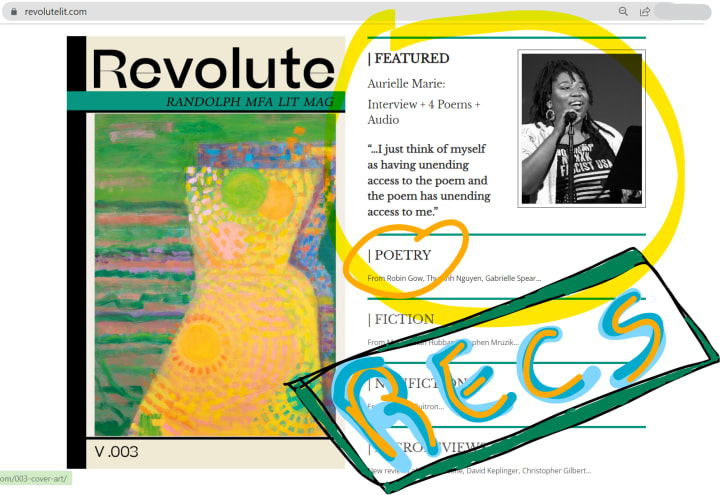
Below are additional poems I thought were great. Honestly the whole issue is worth the read, but I have to limit myself to just a few. These are some top contenders.
Andie Klarin's When I find myself remembering Richard Ramierez. Klarin has two pieces at this link. While they are both solid, the piece on Ramirez is mesmerizing. The imagery captures you and doesn't let you go.
Gabrielle Spear's Abecedarian Beginning with Crucifixion and Ending with Rebellion is amazing. I will tell you the title put me off and the first few lines pushed me away. I assumed it would be a piece about western Christianity, which is all fine and good, but its just not my bag. In pursuit of trying to understand how Revolute explores voice I gave myself a few lines before doing a skim and moving on. I am so glad I did.
This piece slowly grew powerful and by the end I was feeling the raw ache of loss and secrecy of mothers and massacre in Rwanda. By capturing that essence, that essence of secreting away pieces of mourning from great tragedy and the crush of political power, the sense of self-healing was profound.
darlene anita scott's** Switching is worth a read. The language is strong, turning images with each line. It has an easy to read format of two lines each and is neither short nor long. Then end is my favorite, and while I won't spoil it in its entirety for you, I loved these lines
"His name is a void she closes at will, hardly
the depth between skin and muscle"
Go peek.
Christine Butterworth-McDermott's Bois d’arc
This piece is a quiet build -- narrative, pensive, full of thoughts. Its magic really weaves towards the end, which starts to fill with an ethereal quality
My favorite line (of many strong ones) when this happens is
…Sometimes, a stag stabs the moonlight
in a meadow,
There is a quietness in our discovery of the author and the world they live in. These lines are possibly my favorite
No one has ever held me
like these leaves, bowing down with their heavy
inedible fruit.
What are your favorite lines?
Anya Trofimova's …………..credits for a film about missing people
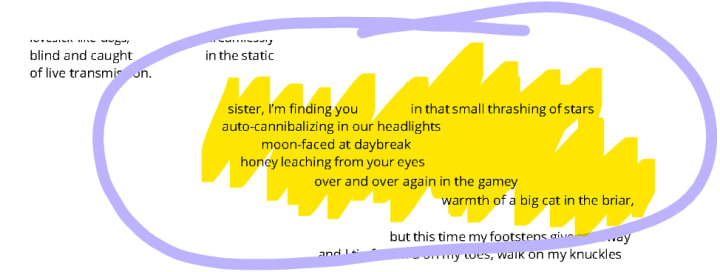
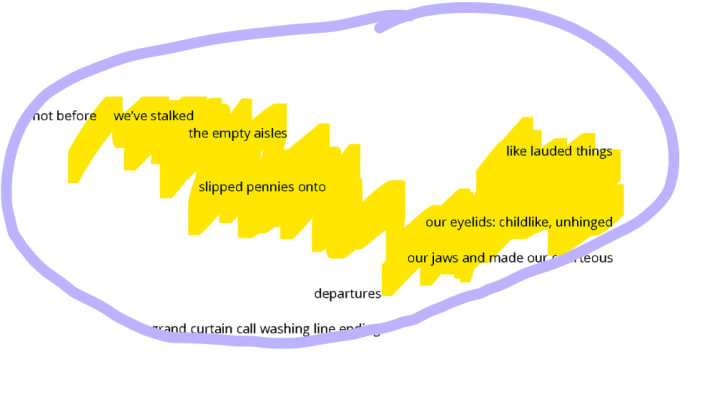
I'm a big fan of form poems, poems that use spacing and lines to draw our eye and thoughts. Trofimova does that here with "…………..credits for a film about missing people" and their second poem "a far cry in concrete atlantis". The form is clearly important in both as Revolute has presented the pieces as embedded images. The first is more dense in words and punch, while the second, being more sparse, is easier to absorb.
In keeping with emphasis on the importance of form, here are my favorite sections of each:
Excerpt from "…………..credits for a film about missing people"
Excerpt from "a far cry in concrete atlantis".
Conclusion
Overall I like Revolute quite a lot, both as a landing pad for authors and as a world of wonder for readers. It's on my list of places to submit and I encourage you to browse their work.
Are there pieces that you like from their issues? What are their titles and your favorite lines?
_______________________________________________
**The name was copied and pasted directly from the website, where it was not capitalized.
About the Creator
WOA
Just trying it out to see what its like.
Silver Screen Magic with Mae West
American actress and singer Mae West became a popular film actress during the Great Depression. She started entertaining in vaudeville, then performed on Broadway, and finally went to Hollywood. She signed up with Paramount Pictures and made her debut in the 1932 film “Night After Night.” She also starred in musicals, comedies, and crime dramas. The American Film Institute named her one of the best classic Hollywood actresses.
By Rasma Raisters4 days ago in Geeks



Comments
There are no comments for this story
Be the first to respond and start the conversation.