


Oh my god! The holidays are about to end! Let me enjoy these last moments in the best possible way: let me play as much as I can, let me eat as much as I can... And then you finally realize that you haven't completed your 'holiday homework!'
Yeah, we've all been through that! This love, devotion, and affection for the holidays, wrapped in wonder, compels the writer to write about it in the best possible way.
Before moving on...
I would like to deliver a big thank you to Laura Pruett for creating this amazing challenge and inspiring a writer to capture her joyous moments!
It's Holy Days for me!
In my country (India), most of the holidays are centered around festivals. Therefore, I call them 'Holy Days.' The celebrations and memories create an everlasting impression that we cherish for years to come!
Three festivals that give you most holydays are as follows. .
Festival of lights : Diwali...!!
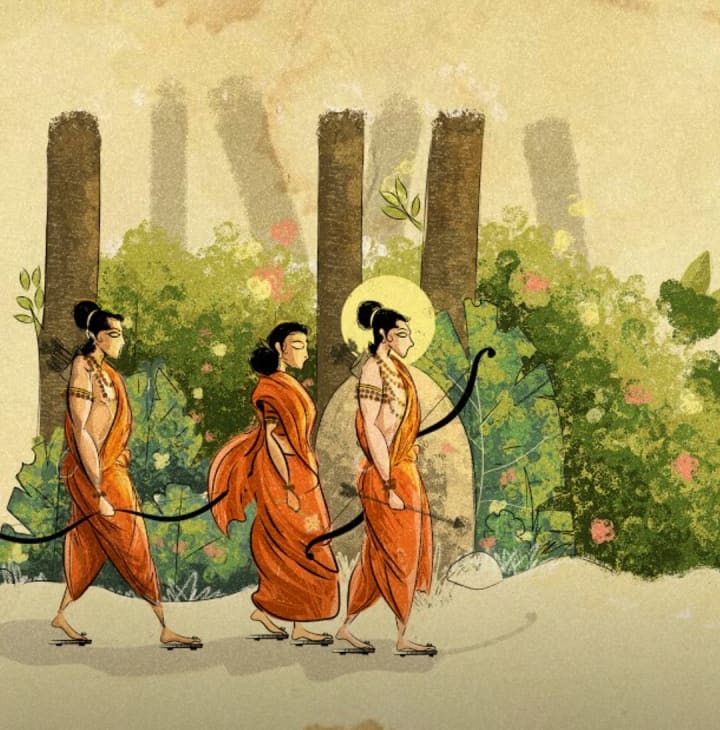
According to the most popular legend from the hindu epic Ramayana, Diwali marks the day when Lord Rama, Devi Sita and Lakshmana returned to Ayodhya after 14 years of exile.
Diwali is a festival of 4 days!
Marked by festive fervour, Diwali is a time when friends and families meet, exchange gifts and enjoy eating delicious meal. Before festival gains its momentum, one month prior to it deep cleaning of houses is a must! And guess what, one month prior to Diwali, our family fell terribly sick but my mom was persistent and made us indulge in the deep cleaning process and finally at the end our house was sparkling clean and we were healthy again!
Day 1
Dhanteras marks the beginning of the 4 days long Diwali celebrations.After a day of cleaning the house, people worship Lakshmi, the goddess of wealth to bless them with prosperity in the coming year.They also worship Kuber the treasurer of wealth.It is said that buying gold jewellery and new utensils on this day helps bring good fortune.
Day 2
The main festival, the festival of lights and lamps - Diwali, is celebrated on the second day. Firstly, homes are decorated with beautiful rangolis. They look something like this:

Then after the sunsets, goddess Lakshmi (goddess of wealth) and God Ganesha ( Worshipped as remover if obstacles) are worshipped. The puja is followed by feasting and burning crackers.

Day 3
The day after the Diwali is celebrated as Gowardhan puja by some communities in the north, west and the central regions honouring the legend of hindi God, Krishna who lifted the Goverdhan mountain to save the cowherd and farming communities from incessant rains and floods triggered by Lord Indra's anger.
Day 4
The last or the 4th day of the festivities is marked by celebrating Bhai Dooj (brothers day). It is also known as Bhau Beej, Bhai Tilak or Bhai Phonta. It celebrates the sacred bond between a brother and sister. The sister puts a tilak on her brother’s forehead while the brother gives her a gift to show his love.

- What does my tummy adore?!
- Suran Aloo Ki Sabji: This is a curry made with suran (also known as elephant yam) and aloo (potatoes). The yam has a unique, slightly earthy flavor, and when combined with potatoes and spices, it creates a hearty and flavorful dish often served with puris or rice.
- Puri: Puri is a type of deep-fried bread made from unleavened wheat flour dough. It is typically puffed up when fried and is commonly served with various side dishes.
- Kheer: Kheer is a traditional Indian dessert made from rice, milk, and sugar. It’s typically flavored with cardamom, saffron, and garnished with nuts such as almonds and cashews. It’s a rich, creamy dish enjoyed as a sweet ending to the meal.
- Various Sweets: Diwali is famous for its wide range of sweets, including ladoos, barfis, pedas, and gulab jamun. These sweets are typically made from ingredients like flour, sugar, milk, ghee (clarified butter), and nuts, and are often infused with flavors like cardamom, saffron, or rosewater.
Festival of fertility: Chhat Puja
Chhath Puja is a 3 days of elaborate celebration in honour of the Sun. It involves a long fast without water, and making offerings to Usha and Pratyusha -the light of the rising and the setting Sun respectively -while standing in a water body.

Mother Aditi gave birth to Surya (The sun God)as a son on the sixth day of Kartika (November) . Chhath Puja emphasizes sun gazing at dawn and dusk. Scientifically, these times are ideal for safe sun exposure due to lower UV radiation levels. The sun’s angle during these periods allows for beneficial light exposure without the harmful rays, allowing devotees to safely draw physiological and psychological benefits from sunlight. After this fasting the reproductive system becomes more fertile
Day 1 - Nahaye khaye
This day marks the beginning of 36 hours of long fasting without food and water. The devotees dedicate themselves to spiritual cleansing. This fast is observed by mothers for the long lives of their children.
Moreover, all the materials required for worship are bought. This includes, all the winter fruits, flowers , diyas ( lamps) , et cetera.

On this day, lauki dal and rice are traditionally eaten for lunch. Lauki dal is a comforting dish made with bottle gourd (lauki) cooked in a spiced lentil base, paired with rice. This combination is light, nutritious, and satisfying. The day ends with your favorite dinner of kheer and puri. Kheer is a creamy, sweet rice pudding flavored with cardamom, saffron, and often garnished with nuts, while puri is a deep-fried, puffed bread that complements the kheer perfectly. This meal is both wholesome and indulgent, making for a delightful way to end the day.
Day 2 - Kharna
This day involves series of rituals highlighting devotion and self discipline. On this day offerings are made to the pratyusha ( the setting of the sun). After the devotional offerings, Arghya ( of water ) is given to the setting of sun in the riverbank.
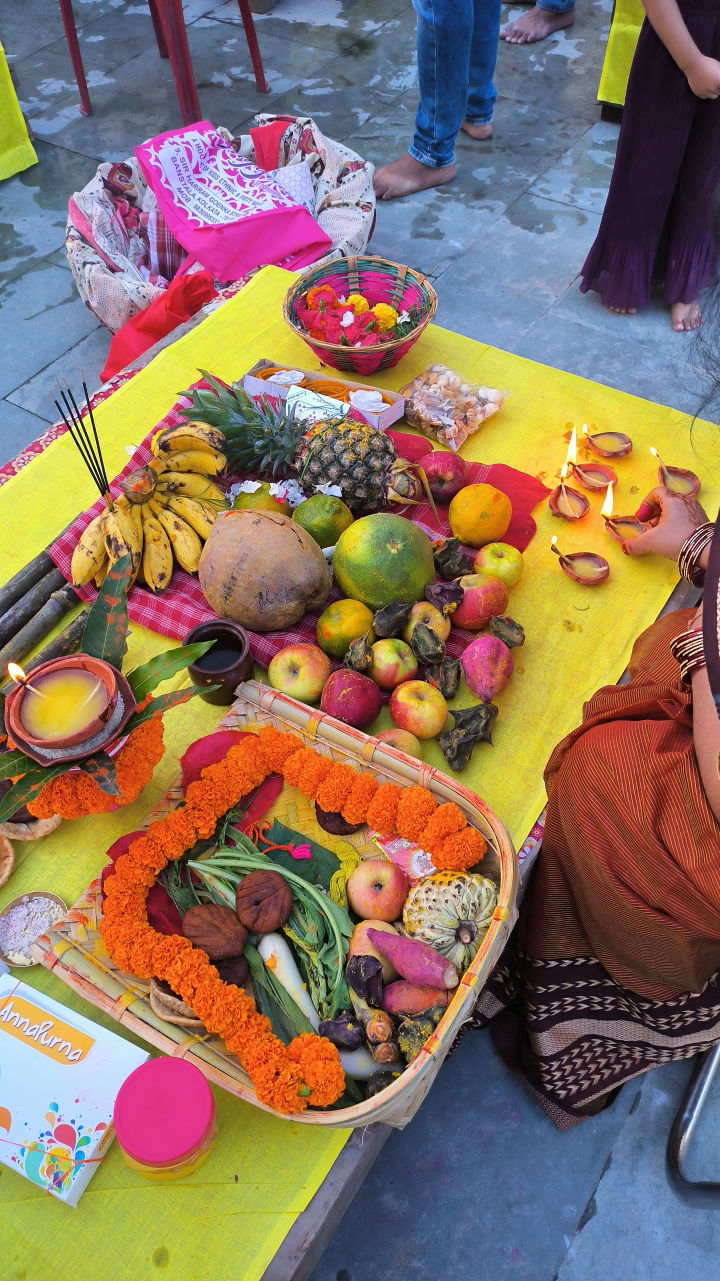
Arghya is something like my brother is giving while my mom prays to the goddess of growth and fertility, in the video below :
Day 3 - the fast finally ends!!
The devotees wake up before the sunrise and take bath and get ready to pray and give the morning Argha ( of milk) to the rising sun.

After the prayers, the ladies apply sindoor to each other's foreheads.Sindoor is a traditional red or orange-red powder that Hindu women apply along the parting of their hair, typically as a symbol of marriage. Something like this:

- What does my tummy loves to devour?!
Thekua is made from simple ingredients like wheat flour, jaggery (or sugar), ghee (clarified butter), and cardamom. The dough is prepared by mixing these ingredients, and the mixture is then shaped into small round or oval discs. These discs are deep-fried until golden and crispy.
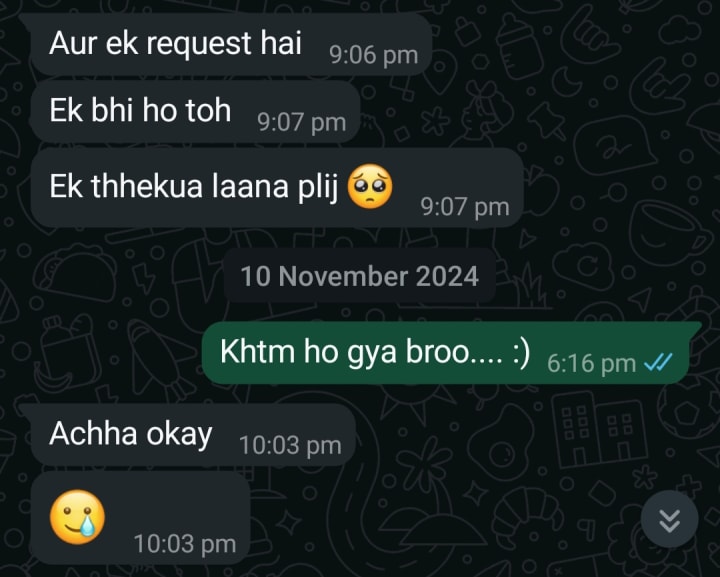
This is my friend pleading me to get thekua if possible but little did he know that I devoured them all!!!!
Festival of colours : Holi
Did you ever feel like bathing in colours or just playing with them! If yes, lucky for you, holi is the festival with comes with 2 days of joyful and awesome holydays.
Day 1 - Holika dahan

- The story behind. .
Holika Dahan is a key ritual during the Hindu festival of Holi, symbolizing the victory of good over evil. The story behind this tradition is rooted in Hindu mythology, particularly the tale of Prahlad, his father Hiranyakashipu, and the demoness Holika.
According to the legend, Hiranyakashipu was a powerful demon king who was granted a boon that made him invincible—he could not be killed by man or beast, inside or outside, during the day or night, or by any weapon. With this newfound power, Hiranyakashipu became arrogant and demanded that everyone worship him instead of the gods. However, his son Prahlad was a devotee of Lord Vishnu, which angered the king.
Despite his father's repeated attempts to make him renounce his faith, Prahlad remained devoted to Lord Vishnu. In a fit of rage, Hiranyakashipu ordered his sister, Holika, who had a special cloak that protected her from fire, to sit with Prahlad in a blazing fire. Holika believed that the cloak would protect her, but the divine will intervened. As Holika sat in the fire with Prahlad, the cloak flew off her and covered Prahlad, saving him, while Holika was burned to death
Therefore on this day ubtan is massaged all over your body and then it is burned in the bonfire representing holika ( the evil) there by emphasizing the burning of the evil and negativity. Sarso (mustard) ubtan is a traditional natural skincare remedy made using mustard seeds (sarso) as the main ingredient. It helps in improving blood circulation, cleansing the skin, and promoting a healthy glow.
Day 2 - Holi
Colours that shape our life,
Colours that bring a joyous smile to our life,
Colours that fills your life with love
With compassion,
And with gratitude.
On this day, people get wild with colours. The whole atmosphere turns colourful. Either you are thrown in a big pool full of colours or you are doomed with those water guns also known as pichkari!
And if your face is coloured with Gulal coloured powered which usually gets a imprint on your face if you wash it, then you will have to live with a colourful face for a few days!

- What does my tummy adore?!
1.Gujiya
Gujiya is a deep-fried pastry, typically filled with a mixture of sweetened khoya (reduced milk), nuts, and sometimes dried fruits. It is often made during festivals like Holi and Diwali.
2.Jackfruit Curry
The jackfruit curry is usually prepared with onions, tomatoes, ginger, garlic, and a variety of Indian spices like turmeric, cumin, coriander, and garam masala, giving it a rich, flavorful base.
3.Malpua
Malpua is a traditional Indian sweet, often made with a batter of flour, sugar, and coconut (sometimes with bananas), fried into pancakes, and soaked in syrup. It is usually served as a dessert or during festive occasions.
With heavy heart.. You are coming closer to the end of this read..
As much as I enjoyed writing it, I hope you enjoyed reading it too. The challenge mentions three, but I am willing to write more! I am happy to write about how I was the first one to get a dashing look on Eid in order to devour those tasty meals, or how my friend and I were the only Santas to devour all the chocolates that we bought for others. If you are willing to read more about lovely holydays, then do tell me in the comments. I will be very grateful to write about it. Bye bye, and thank you for reading :)!
About the Creator
Anwesha
The one who showers every plant, keep trust in that gardener's chant.
Reader insights
Nice work
Very well written. Keep up the good work!
Top insights
Excellent storytelling
Original narrative & well developed characters
Expert insights and opinions
Arguments were carefully researched and presented
Eye opening
Niche topic & fresh perspectives
On-point and relevant
Writing reflected the title & theme
Writing To Succeed
If you want to find something that will help readers find your writing, possibly expand your audience, and maybe even get you noticed for other things, then you’re not alone. But how can you get it done in a world full of want-to-be writers? Look less at what you’re writing now, and more at what other writers have used to boost their views and reads.
By Jason Ray Morton 2 days ago in Writers
Difficulties Of Holidays On Vocal
Introduction Last week I had a wonderful week in Alnwick, but tried to keep up on Vocal, although my time was less than I normally have, plus a little more difficult because I was using a ten-year-old laptop with a faulty keyboard (the space bar does not always register, meaning I have to keep going back to separate words).
By Mike Singleton 💜 Mikeydred a day ago in Writers
The BAFTA Awards
By now, in a stunning departure from recent years, most of the world is aware of what happened at the BAFTA film awards. Social Media Headlines will tell you the bare bones: that John Davidson, a Tourette's Syndrome advocate, shouted a racial slur at two Actors of Colour, Michael B Jordan and Delroy Lindo.
By Natasja Rose5 days ago in Psyche



Comments (3)
Absolutely love the detailed descriptions of these vibrant festivals. Chhath Puja's rituals are so fascinating. Festivals are truly special.
I was truly captivated by this article! Your in-depth exploration of Indian festivals and sacred days was not only informative, but it also painted a vivid picture that drew me in completely. The way you described the cultural significance, historical context, and unique rituals associated with each celebration allowed me to appreciate the rich tapestry of traditions that make up Indian heritage. From the colorful decorations to the mouthwatering dishes that are prepared, you brought to life the joyous atmosphere that surrounds these festivities. I find it fascinating how every festival has its own set of stories and symbols that resonate deeply with people across generations. Your writing style is engaging and immersive, making it feel like I was right there, experiencing the celebrations firsthand. This level of detail is something I haven't encountered often on Vocal, and I wholeheartedly believe that you have created something truly unique. I eagerly look forward to reading more about these sacred days and the intricate customs that accompany them. Keep up the great work, Anwesha. Your title is very wonderful✨
I have so many questions relating to these ceremonies and festivals because I'm still quite unsure about the rituals, but all of them look interesting! I knew about HOLI, It's so colorful and it seems fun to see ya'll dipped in the endless streams of colors and smiles. Every single woman and man who fasts has my gratitude ❤ Fasting is worship for us. And we do it for 30 days, so I'm quite familiar with it... And what about that; Thhekua? What's that? Never heard about it. But it sounds like something delicious. And your cravings for food are mine too 😩 That "sindoor", those ladies are applying on each other's forehead? Isn't that a thing that Men do? To Marry a woman? At least that's what Indian dramas have shown us 😅 Btw, your "festivals" look so colorful and I appreciate that you've uploaded this piece.