
From Concept to Creation: How Tripo Studio is Revolutionizing 3D Design
Tripo Studio


For decades, 3D content creation has resembled an exclusive club with steep membership fees: years of technical training, expensive software suites, and high-end hardware requirements. Even for professionals, the traditional pipeline involves a frustrating dance between multiple specialized applications—one for modeling, another for texturing, a third for rigging, and yet more for optimization and rendering. This fragmentation doesn't just create technical barriers; it disrupts creative flow, turning what should be an inspiring process into a technical obstacle course.
Then came Tripo Studio, an AI-native 3D workspace that's fundamentally rethinking how we create in three dimensions.
"I'd spent years trying to learn traditional 3D software," shared a product designer during a recent Tripo community showcase. "Within minutes of using Tripo Studio, I had generated and refined a model that would have taken me days in my usual workflow. It felt like someone had finally opened a window in a stuffy room."
The Unified Workspace: Tripo Studio's Revolutionary Approach
What makes Tripo Studio transformative isn't just its ability to generate 3D models from text or images—though it excels at both. Its true innovation lies in creating a unified environment where the entire 3D creation process unfolds seamlessly within a single interface.
When you first enter Tripo Studio, you're greeted by a thoughtfully designed workspace organized around seven intuitive tabs:
1. Batch 3D Gen: The starting point where image to 3D and text-to-3D transformations happen
2. Smart Low Poly: Creating optimized models perfect for games and real-time applications
3. Topology: Controlling mesh structure without deep technical knowledge
4. Generate in Parts: Creating intelligently segmented models ready for editing
5. Assets: Managing your personal library of creations
6. Property: Transforming and adjusting materials with intuitive controls
7. History: Tracking your creative process with non-destructive editing
This isn't merely an aesthetic choice—it represents a fundamental rethinking of how creators interact with 3D tools. Instead of forcing users to adapt to complex technical workflows, Tripo Studio follows the natural creative process, guiding both beginners and professionals through a logical progression from idea to finished asset.
Six Features That Transform the Creative Process
While the entire platform feels refreshingly cohesive, six standout features demonstrate how Tripo Studio is redefining what's possible in AI-assisted creation:
1. Intelligent Segmentation: Understanding Structure, Not Just Surfaces
Traditional ai 3d model generator tools produce "monolithic" models—single mesh objects that require extensive technical knowledge to edit. Tripo Studio's Intelligent Segmentation feature automatically analyzes a model's structure and, with a single click, splits it into meaningful, editable parts.
For an industrial designer we interviewed, this feature proved game-changing: "I was working on a drone concept and needed to experiment with different propeller designs. In traditional software, I'd have to rebuild the entire model for each variation. With Tripo's segmentation, I simply selected the propeller components and modified them independently, testing five different designs in minutes instead of days."
2. Smart Retopology with Adaptive Meshing
Creating optimized, animation-ready meshes traditionally requires manual retopology—a tedious process where artists rebuild models vertex by vertex to achieve clean topology. Tripo Studio's Smart Low-Poly feature employs an adaptive meshing algorithm that automatically generates production-quality topology.
The system analyzes the model's curvature and feature importance to distribute polygons efficiently, preserving detail where it matters while aggressively simplifying flat or less visible areas. Unlike simple decimation algorithms that uniformly reduce polygon counts, this approach maintains proper edge flows around deformation areas (joints, facial features) critical for animation.
Performance benchmarks show that models optimized with Smart Low-Poly render 30-45% faster in real-time engines while maintaining over 90% of the visual fidelity compared to high-polygon originals—a significant improvement over standard decimation techniques that achieve similar performance improvements but with much greater visual degradation.
3. Multi-View Generation: Beyond Single-Image Limitations
Most image to 3D tools struggle with creating accurate models from limited perspectives. Tripo Studio's multi-view generation allows uploading images from different angles to create remarkably faithful representations.
"For client presentations, I used to spend days creating basic 3D mockups of products from concept sketches," explained a product visualization specialist. "Now I take photos of a rough prototype from multiple angles, and Tripo Studio combines these perspectives into a detailed digital model that captures every curve and proportion perfectly."
4. Magic Brush: AI-Assisted Texture Refinement
Perhaps the most innovative texturing tool in Tripo Studio is the aptly-named Magic Brush. This feature allows users to paint over areas needing adjustment, and the AI generates contextually appropriate texture details that blend seamlessly with surrounding materials.
For creators who've struggled with traditional UV mapping and texture painting, this feels revolutionary. One digital artist described it as "having an expert texture painter collaborate with you in real-time." When a character model showed unwanted artifacts on its clothing, instead of exporting to an external program, they simply used the Magic Brush with a text prompt describing the correct texture, painting it directly onto the problematic area.
5. One-Click Optimization and Rigging: Production-Ready Assets
Creating assets suitable for games, VR, or animation typically requires painful compromises between visual quality and performance. Tripo Studio's Smart Low-Poly feature intelligently optimizes models while preserving visual fidelity where it matters most.
Even more impressively, the Uni-Rig system automatically generates a functional skeletal rig for characters in seconds—a process that traditionally takes hours or days of technical setup. A small indie game developer described this combination as "the difference between spending a week on a single character and being able to generate, optimize, and rig an entire game's worth of characters in an afternoon."
6. Coming Soon: Revolutionary Model Import Capabilities
In an exciting development for professional users, Tripo AI has announced that within the next week, Tripo Studio will introduce a revolutionary upload feature that allows users to import their existing 3D models into the platform. This capability will extend all of Tripo Studio's powerful AI-assisted tools—segmentation, retopology, texturing, and rigging—to models created in traditional software.
This upcoming feature represents a significant strategic expansion, positioning Tripo Studio not just as a generation tool but as a comprehensive optimization and enhancement platform for all 3D workflows. Professionals will be able to leverage Tripo's AI capabilities to streamline the most technical and time-consuming aspects of their existing pipelines.
"The ability to upload existing models will be transformative for our workflow," shared a 3D artist from an early access program. "We can maintain our specialized modeling techniques for initial creation, then use Tripo Studio to handle the tedious aspects like retopology, UV unwrapping, and rigging—truly getting the best of both worlds."
Real-World Applications: From Concept to Reality
What makes Tripo Studio particularly valuable is how it transforms concrete projects across different domains:
Game Development: Accelerating Asset Creation
For game developers—especially indie teams with limited resources—Tripo Studio represents a radical acceleration of the asset creation pipeline. By generating, optimizing, texturing, and rigging models within a single environment, developers can focus on what matters most: game design and player experience.
"Before Tripo, asset creation was our biggest bottleneck," shared an indie developer. "We'd spend weeks modeling basic environmental props or character concepts. Now we can generate dozens of options in minutes, select the best ones, and have them game-ready almost immediately."
Product Design: Rapid Visualization and Iteration
Product designers find particular value in Tripo Studio's ability to rapidly transform concepts into detailed 3D models. For a startup developing an innovative kitchen appliance, the platform enabled quick iteration on design concepts before investing in expensive physical prototypes.
"We uploaded rough sketches and reference images to generate detailed 3D models that our team could examine from every angle," the lead designer explained. "This allowed us to refine our design direction and identify potential issues much earlier in the process, saving weeks of development time and thousands in prototyping costs."
Architectural Visualization: From Plans to Immersive Spaces
For architects and interior designers, Tripo Studio bridges the gap between technical plans and immersive visualization. By transforming 2D floor plans and mood board images into fully realized 3D environments, it helps clients better understand proposed spaces.
One interior designer reported: "The ability to generate and modify 3D spaces based on client feedback in real-time during meetings has transformed our approval process. Changes that used to require days of back-and-forth now happen instantly, with clients making confident decisions after seeing realistic visualizations."
Digital-Physical Production: From Screen to Object
Perhaps most impressively, Tripo Studio bridges the digital-physical divide with its integrated Print & Delivery service. Users can design custom objects and order physical 3D-printed versions directly through the platform—eliminating the usual complexity of preparing models for printing and finding reliable production partners.
A product designer who created custom promotional items shared: "I designed personalized desk sculptures for our top clients, ordered them through Tripo's print service, and had them delivered directly. The entire process—from concept to physical object arriving at the client's office—took less than two weeks with minimal technical headaches."
Democratizing 3D Creation Through Accessible Design
Tripo Studio's pricing structure reflects its philosophy of democratizing 3D creation. The free Basic tier offers 300 credits monthly—enough to experiment and create simple models—while Professional (19.90/month),Advanced(49.90/month), and Premium ($139.90/month) tiers provide increasing capabilities.
What makes this structure particularly powerful is its licensing distinction: models created on the free tier are public with a Creative Commons license, while paid tiers enable private, commercially usable assets. This creates a natural transition path as creators move from experimentation to professional projects.
For freelancers and small studios, this accessibility represents a profound shift. Projects that once required outsourcing to specialized 3D artists can now be handled in-house, maintaining creative control while dramatically reducing costs and turnaround times.
The Technology Behind the Magic: TripoSR and Strategic Innovation
What's particularly fascinating about Tripo's approach is its strategic embrace of the open-source community. While many competitors rely on closed, proprietary systems, Tripo's foundational technology—TripoSR, co-developed with Stability AI—is available as an open-source project.
This represents a sophisticated market strategy. By providing powerful, free, open-source tools, Tripo builds grassroots community support while establishing technological credibility. Users who integrate TripoSR into their workflows naturally gravitate toward the more polished, feature-rich experience of Tripo Studio when their needs evolve.
"What impressed me about Tripo wasn't just the technology, but the philosophy behind it," noted a developer who contributes to open-source 3D projects. "They're building an ecosystem where the core technology is accessible to everyone, while the premium experience offers genuine value through workflow integration and advanced features."
Beyond Tools: A Community of Creation
What solidifies Tripo's impact isn't just the technology but the vibrant community forming around it. Through Discord, showcase events, and user-generated content libraries, creators spanning all skill levels share discoveries, techniques, and inspiration.
The development team's approach—building based on hundreds of creator interviews—shows in thoughtful features that anticipate real workflow needs. "It feels like they actually understand how creative people think," observed a 3D artist during a community event. "The tools get out of your way and let you focus on creating."
This community-centric development extends to the roadmap, with upcoming features like full-scene generation, environment creation, and advanced animation tools shaped directly by user feedback and real-world use cases.
The Dimensional Future: Where Creativity Meets Technology
As the platform continues to evolve, Tripo Studio points toward a future where the barrier between imagination and creation becomes increasingly permeable. Projects that once required teams of specialized artists working for weeks can now be realized by individuals in days or even hours.
When reflecting on how image to 3D and ai 3d model generator technologies are transforming creative industries, we glimpse a future where the limiting factor in creation isn't technical skill but imagination and creative vision.
This doesn't mean the end of traditional 3D artistry—quite the opposite. By automating technical hurdles and streamlining tedious processes, tools like Tripo Studio free artists to focus on the creative aspects that truly require human judgment and aesthetic sensibility. The most exciting possibilities emerge when AI assistance and human creativity work in concert.
As one early adopter eloquently put it: "Tripo Studio doesn't replace the artist; it replaces the technical obstacles that have historically kept so many creative minds from fully expressing their vision in three dimensions."
And perhaps that—more than any specific feature or capability—represents the true promise of this platform: a world where anyone with a creative vision can bring it to life in all three dimensions, limited only by imagination rather than technical barriers.
About the Creator
sammmy
Passionate digital writer focused on SEO, tech, and marketing. I create engaging, value-driven content to inform and inspire readers.
Early March 2026: 4 Goals Accomplished
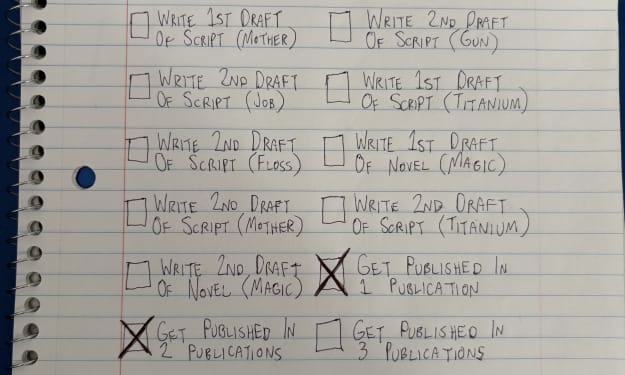
It's early March and I've now accomplished my 4th writing goal for the year of 2026. Before diving into the behind-the-scenes of it... why not tell you up front what that accomplishment was? I was published in a 2nd publication for this year. Published in Helix Literary Magazine out of Central Connecticut State University. You can read it for free right now!
By Stephen Kramer Avitabile5 days ago in Writers
The Library of Lost Things
The rain didn’t just fall in Oakhaven; it sighed. It was the kind of gray, relentless drizzle that made you want to stay inside and count your regrets. I found myself standing in front of a building I’d passed a thousand times but never truly noticed: a narrow storefront with a peeling wooden sign that read The Library of Lost Things.
By Nolan Ellisa day ago in Writers
The BAFTA Awards
By now, in a stunning departure from recent years, most of the world is aware of what happened at the BAFTA film awards. Social Media Headlines will tell you the bare bones: that John Davidson, a Tourette's Syndrome advocate, shouted a racial slur at two Actors of Colour, Michael B Jordan and Delroy Lindo.
By Natasja Rose7 days ago in Psyche



Comments
There are no comments for this story
Be the first to respond and start the conversation.