
Valley of Whales (Wadi Al Hitan)
Best day trips from Cairo

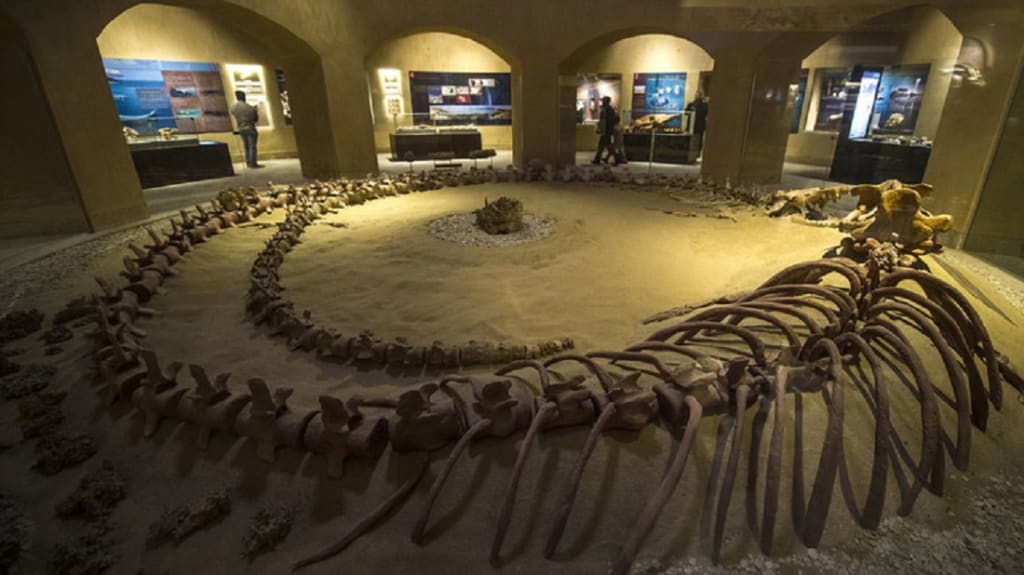
Did you know that whales were originally land animals like hippos and only then gradually turned into inhabitants of the seas? If you still don't believe in evolution, it is worth going to the Egyptian desert.
The Valley of the Whales is the place where the theory of evolution ceases to be just a theory and becomes a visible reality that can no longer be denied. In Arabic, this place is called Wadi Al-Hitan and is located 150 km from Cairo, in the western part of the Egyptian desert. The valley is an ancient whale cemetery. Looking at the red fossils in the middle of the desert, it is almost impossible to believe that the Tethys Ocean splashed here in the Mesozoic era, washing two ancient continents: Gondwana and Laurasia. However, it was so: the ocean receded, the continents split, the plates moved, and the whale graveyard appeared on the surface of the sands.
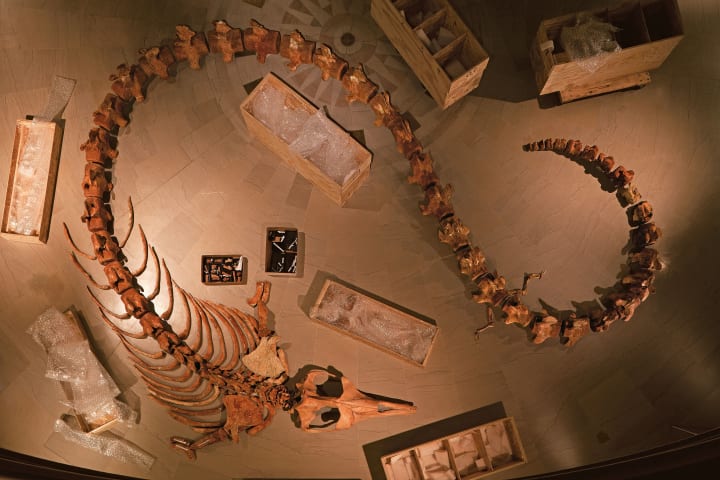
Fossil skeletons of whales were first discovered in the winter of 1902–1903. But for more than eight decades, the valley has hardly been explored, as it is located in a remote and inaccessible part of the desert. Only with the advent of four-wheel drive vehicles did scientists finally come to grips with this most interesting paleontological place on the planet.
What did they find there? Ancient fossils of extinct animals, some of which are 40 million years old. Bones of prehistoric fish, snakes, turtles, crocodiles and sea cows. But most of all paleontologists were interested in the remains of giant whales in large numbers and in an excellent degree of preservation. Some finds survived to such an extent that scientists were able to make out even the contents of the stomachs of these giants. The Valley of the Whales became a scientific sensation and caused an influx of curious tourists who were eager to take with them a fragment of a fossil or a prehistoric bone as a souvenir. Therefore, the question arose about the preservation of a rare archaeological site. In 2005, the site was included in the UNESCO World Heritage List.

The main reason why the UN agency decided to take over the Valley of the Whales is the priceless fossil remains of the earliest and now extinct suborder of whales - the Archaeoceti. These fossils vividly illustrate the course of evolution: the transformation of a whale from a land animal to an ocean mammal. Paleontologists have found skeletons of archeocetes with preserved hind limbs. The Wadi Al-Hitan Valley, which has preserved hundreds of diverse skeletons of whales, has helped to visually demonstrate the stages of evolution of these animals. Other fossil material found at this site allowed for the reconstruction of the natural environment and ecological conditions of that time.
The scientific potential of Wadi Al-Hitan has not yet been exhausted: the valley brings new discoveries. For example, in 2015, Egyptian scientists managed to find here the remains of a Basilosaurus - a huge whale that swam in the Tethys Ocean 36-45 million years ago. During life, females of this species reached a length of 18 m, and males - 21 m. The surviving skeleton is one of the largest remains of an ancient mammal known to science. During life, this predator was the most enormous creature of its era and terrified all inhabitants of warm seas, including whales of other species. Scientists have found rudimentary bones of his hind legs.
In a word, if it seems to you that Darwin's theory is damp - and it is only 160 years old - then when traveling to Egypt, hurry to see these visible artifacts of evolution, and not just the well-known pyramids.
About the Creator
Angela Benette
A travel specialist mainly concerned with inspiring travelers to Egypt with the best tours and holiday activities they can do during their trip to Egypt.
Keep reading
More stories from writers in Wander and other communities.
Literary Heartbeats
Step through an unassuming storefront in Saratoga Springs, New York. Let the city’s familiar bustle fade behind you. Sink into the creak of hardwood floors as your gaze is drawn toward a labyrinth unfolding, room after room, swollen with stories. This is the Lyrical Ballad Bookstore—a place where literary ghosts linger, and generations of readers, writers, and dreamers have lost themselves amid 200,000 volumes of wonder.
By Kristen Barenthalera day ago in Wander
Away from the Crowds in Oklahoma
Imagine traveling in Catoosa and seeing the Blue Whale. This blue creature was built by Hugh Davis in 1972 as a 34th wedding anniversary gift for his wife. Since then, people driving down Route 66 have admired it. Another purpose for building the whale was so that it could serve as a swim dock for neighborhood children to dive and slide into a pond.
By Rasma Raisters3 days ago in Wander




Comments
There are no comments for this story
Be the first to respond and start the conversation.