
Follow the Path
Getting lost in the majesty of Zion National Park

The sudden and brazen intensity of the sun pierced through my eyelids and startled me awake. The eight-hour drive from Cora, Wyoming had been rainy and grey, and the unremarkable landscape of flat plains and lonely highways lulled me into a deep sleep. I needed the rest. My partner and I were fresh off a four-day excursion in Wyoming, where we explored the untamed beauty of Yellowstone and Grand Teton National Parks. Our bodies, tender and sore, ached from traversing miles of rugged terrain, yet our spirits were as high as they’d ever been. Grateful, but hardly satiated, we craved to behold even more striking beauty and experience greater heights of adventure. As we drove through the colorful and carefree town of Springdale, Utah, and into Zion National Park, we could hardly anticipate the abundance of both astonishing beauty and wonder-inspiring excitement that awaited us.
Cruising through the entrance route leading to the Watchman Campground, one of the first things that captured my attention was the bounty of diverse plant life. This trip was my first to the western United States. Before this experience, I had always associated the southwestern area of Utah, where Zion is located, with a desert climate. And I had always equated deserts with barren, brittle landscapes that were too dry to support much life at all, especially plant life. I was pleasantly shocked to find a myriad of plant species flourishing effortlessly. Dispersed clusters of prickly cholla cactus and wild sagebrush spread their branches high and wide, embracing the sun, while sacred datura and coyote gourd vines crawled across the earth, sprawling over vast swaths of land.
Later, when we would hike the nearby trails, we’d discover even more thriving vegetation: pinyon pines and Utah juniper with their coarse bark, and twisted limbs, winding into erratic and elegant contortions, and inconspicuous grottos carved into rocky slopes lush with verdant maidenhair ferns. As it turns out, Zion National Park contains four distinct biomes, desert, riparian (vegetation near river banks), woodland, and coniferous forest, allowing it to sustain a plethora of wild flora and fauna.
Beyond the foreground of cacti, and shrubbery were heaps of Navajo Sandstone, carved into formidable canyons by the everflowing Virgin River. Broad bands of brilliant reds, oranges, and browns alternately layered on top of one another, configuring psychedelic-looking rock formations that were so stunning, the sight of them rendered me nearly breathless. The air felt effervescent with energy. Cultivated by the ancient Puebloans and Southern Paiute for thousands of years, Zion National Park has rich cultural and historical significance. The spiritual presence of the indigenous people who inhabited this land for so long felt nearly palpable. It was easy to understand how mountains and rock formations came to adopt such majestic and ethereal names as “Angel’s Landing,” “The Altar of Sacrifice,” and “Court of the Patriarchs.” I could feel my chest expanding as I became overwhelmed with respect, gratitude, and absolute humility.
As we pulled into the campground we were greeted by a wonderful woman, Miss Perez, who I’d come to affectionately call our “camp mama.” Though small in stature, her spirit was gigantic. She embraced us with a warmth and kindness that was profound and pure. She graciously welcomed us to the park, sharing some of its history and how it became the landmark that it is today, highlighting trails and areas that might be of special interest, and even checking on us later in the afternoon, as we settled at our campsite. Her smile shone as bright as the midday sun, and one could feel the love radiating from her as distinctly as a heat haze radiating from the asphalt on a hot summer day.
Ambling down the winding paths that encircled the canyons, we quickly became aware that while the campgrounds hosted a rotation of travelers and wanderers, others had established this land as their permanent residence. Mule deer casually strolled about the park, snacking on twigs and grasses, occasionally plopping down beneath the shade of Gambel oak, or staring curiously, as campers set up their sites, otherwise unphased by the presence of humans. At that moment, I felt lucky to coexist so intimately with Zion’s wildlife and grateful that these handsome creatures were willing to generously share their space with us.
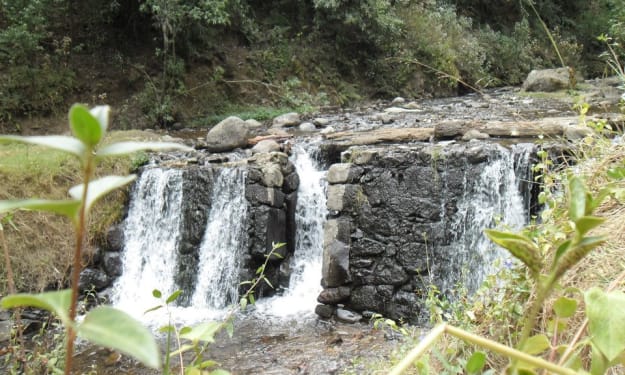
As the sun set, we followed the path pictured in the photograph and arrived at the banks of the Virgin River. We sat for a while, taking in the day, and watching the rays of the evening sun sparkle and dance on soft ripples in the flowing stream. We inhaled the earthy, citrusy aroma of pine wafting through the air. Plateau and short-horned lizards scuttled across the sands, bobbing their heads and doing push-ups, warning us to keep our distance. We gladly obliged. Drunk with happiness, we rested our heads and gazed up at the clear sky, noticing it transition to a deep blue as the sun ducked below the horizon. Feeling full and satisfied from the day’s activity, we’d almost forgotten about the spectacular light show that was about to take place once night fully set in.
I have always enjoyed the energy of campgrounds at night. I find it comforting, the airy quiet of the evening, interspersed with the crackling of burning firewood, and the gentle rumble of intimate conversations and light-hearted laughter. I love the communal nature of campgrounds, the feeling of connectedness that comes from knowing we are all here for the same reason, to fellowship with nature, and by extension, even if indirectly, with one another. Once darkness had overcome daylight, we laid out near a fire of our own and watched the stars, big and bright, and zipping across the sky in every direction. The day had been perfect. Giddy and brimming with joy, we gently drifted to sleep as the funk-infused, spiritual jazz of the Shaolin Afronauts’ album, Follow the Path, played softly in the background.
About the Creator
Keep reading
More stories from writers in Wander and other communities.
Take a Hike in Mexico
The Ajusco Summit Trail, located in the Cumbres Del Ajusco National Park, is one of the most popular hikes in Mexico. Hikers hike to the peaks of Ajusco or Malacatepeti for awesome views. Trails take hikers through forests and rough terrain. The trail is a 10 km long loop and is a high-altitude trek. The trail passes through high mountain pine forests and alpine meadows, providing a diverse hiking experience.
By Rasma Raistersabout 17 hours ago in Wander
Coastal Series: Part I (Washington State)
Washington does not introduce its coastline. It lets you find it... There’s no sudden reveal, no postcard moment engineered for the windshield. The coast arrives gradually, in pieces... Through rain-darkened trees, through logging towns that never rebranded themselves, through long stretches of road where the radio fades, and the sky lowers itself closer to the ground.
By The Iron Lighthousea day ago in Wander


Comments
There are no comments for this story
Be the first to respond and start the conversation.