
Breaking Free as a Woman Writer
How to find your unique voice


As I’ve recently written, I have to be one of the few people of my generation to select “creative writing” as a career choice in middle school, high school, and continuing through graduate school who actually did it. While I’ve done many different jobs throughout my life, the one constant has been writing for myself — but I’ve also quit fiction writing for long periods, up to eight years at a time.
Is this advice for aspiring writers? Well — maybe.
When I lived in Woodland Hills (2003–2005), I took film courses at UCLA Extension, where the instructor, a really great guy who had worked on Star Trek: The Next Generation and similar shows, quickly realized I “wasn’t like the other students.” In Los Angeles, I estimate at least 75% of the population either has a script or is working on one. Even with such a huge number of people working at writing, it’s not often that writers are able to discover their unique voice. At this time I also worked on media tie-in novels for a popular show, along with the popular show’s star.
It was Apollo from the original Battlestar Galactica! How is this amazing? Who did I have a crush on in Junior High?
Richard Hatch (rest in peace dear Richard) — Apollo from 1970s Battlestar Galactica.
Yes, I worked with Richard Hatch on his Battlestar Galactica books. You’ll see another person’s name on them, somebody who was not up to the job. Who else was available who could? I’ll also say that Richard was the kindest, sweetest, most imaginative man ever. Maybe a little “all over the map” storywise but who was I to say inventing a new main character 40,000 words into an outlined story could be a “mistake”? I wrote one of these books over President’s Day weekend in 2002, so if you want to know if it is possible to write a 75,000 word book in 3 days: yes, it is. But don’t expect any literary prizes …
A brief digression
OK, not only did I get the chance to work with a guy I seriously had a twee girly crush on (Richard), I also had somebody I had a slightly older but equally twee crush on read (perform) my work — like — oh, my GOD read it and influenced the rest of my writing career. Hey you know you guys that consume ‘product’? Here’s some ‘product’ for you
(Female Science Fiction Writer Audible Version).
When this collection of my best short fiction was sold to Audible and went into production at Deyan Audio in Studio City, I got an email from one of the voice actors: Keith Szarabajka. “I’m reading these three stories,” he said. “And the female characters all seem to be connected somehow. Are they?” The stories included “Heart of Jade,” and “Shakespeare in Hell” (novella).
Oh, these aren’t connected, I nearly wrote … they are ..
Aspects of me oh my God.
Did I mention I had a crush on Keith Szarabajka when he played “The Equalizer’s” young protege in the 80s TV show? Uh … yes it was the same guy! By the way Keith is a great writer too.
So, yes, Keith with his incredible acting skills accurately decoded that I was writing female characters with things in common with … me. My issues. Like “The Dark Lady” in “Shakespeare in Hell” is not so much the supposed historical Emilia Bassano but flaming pissed-off me, forced to sit endlessly in critique rooms with horrible writers, waiting for them to strut their time upon the stage, desperate for the chance to excel. Let us hope I will not go her way and succumb to Beelzebub, but rather Will’s way . . .
And hearing him read my work aloud, along with the other gifted voice actors, confirmed my feeling that I had always had but never voiced: I was writing everything to be read aloud. Not like a screenplay. Simply read aloud, a tradition that dates back to the earliest days of the novel.
This makes two levels of voice
We have our own natural voice as writers. Then there’s another level: the voice others hear and echo — the voice they make in their heads when they read, either silently or aloud. When Keith jogged me into the realization that my female characters were strongly related to me personally, it set me on the path I’ve followed ever since. It made me realize that if I was going to put “myself” into fiction, as well as other people I knew for real, I owed it to not just myself, but others, to portray them as truthfully as possible.
My values are truth, reality, genuineness, and also beauty and nobility. I do not mean “nobility” in the royal sense, I mean it in the sense that within each of us is the capacity for noble thoughts, feelings, actions, and sacrifice. Another crucial value for me is freedom, the most important of them all.
When I read Wallace Shawn’s beautiful essay on “Why I Call Myself Socialist,” I felt that all of these things came full circle.
Wally says, “Contrary to the popular misconception, the actor is not necessarily a specialist in imitating or portraying what he knows about other people. On the contrary, the actor may simply be a person who’s more willing than others to reveal some truths about himself.”
One reason why I always wrote is that I felt it was impossible to express myself via the spoken word, and I wanted to express thoughts and ideas to others. I was raised in a deeply emotionally abusive household. While external signifiers of my creativity were highly rewarded (good grades, winning awards), my actual creativity and personal taste were not only disrewarded, they were actively punished. I developed an elaborate artifice of doing what others wanted, to the point where I could write entire novels, novellas, and novelettes not realizing that an invented character was in fact, an aspect of myself.
Just like the Egyptians
Occasionally I’ll comment in “conservative” circles, most recently on a popular conservative author’s social media where an historian reader had said that the ancient Egyptians were culturally stagnant and valued conformity and uniformity, resulting in a long-lasting, yet “stagnant” culture. OK so check this out: better than 95% of any type of writing instruction and coaching programs, along with Amazon algorithms “reward” by instructing others to do “just like what everyone else did before.” Think about those keywords, my friends. Think about those “story structures” and even programs that help you plot. The whole “pantser” vs. “plotter” thing. Yeah. Don’t be “Just like the Egyptians” (who were unlikely to be that way, anyway).
The heroine’s journey
In the early 2000s, living in Woodland Hills, I began to assemble a book of “The Heroine’s Journey” because I felt, instinctively, that traditional outlines of various story models, starting with Campbell’s Hero’s Journey, did not fit a woman’s heroic journey. I collected stories of heroic women. I began mapping out structures for such journeys. One day when I was putting pages into the three ring binder I’d assembled, my “partner” and erstwhile editor Alan Rodgers came in and said harshly, “Why are you wasting time on that? No one cares about that.” Here is what later happened with Alan.
I’m writing this because at the time I didn’t know for certain Alan was wrong. Part of me believed him. He had been an important NYC editor, author of bestsellers, and edited many works by other writers, including ones I thought were much better than I was.
Alan redpilled my writing: he quit editing Without Absolution, my first collection, halfway through. He probably didn’t edit a line of Imago, my first novel. All he did was make the covers and typeset the interiors. These books were among the first, if not the first originally-published print-on-demand softcover and hardcover books (2000–2001).
What did all this cost me? When I took the Battlestar Galactica contracts I was told, “If you write these media books it will set your own writing back a long time. Maybe years.” That was correct. I’d already been through non-editing and redpilling so I didn’t even understand what I was doing with various stories (Alan particularly hated “Shakespeare in Hell” which in reality, is a long-lasting favorite among readers even with that rage-girl Emilia spoiling things for the gentlemen). At Alan’s urging, I did read a significant number of bestselling blockbuster sci-fi and fantasy books.
Where does my writing fit in? I thought.
With big guns, don’t hold the powder
The short sci-fi reviewer for Locus magazine (an industry-specific publication) once wrote, “Her writing is fine on a sentence level.” This was a little similar to the chap who said I only had any published work because Alan was my boyfriend and I had a good body.
So here is a story and it’s really why I felt compelled to write this today. This morning I saw this tweet:
So, this was one of the issues of The Magazine of Fantasy & Science Fiction where I co-appeared with Harlan Ellison, a man that had been a trusted mentor since I attended the Clarion Science Fiction Writer’s Workshop at MSU in 1984. You can see the cover is for Harlan, not for me, and not illustrating “To Kiss the Star.” I wrote recently about the experiences leading up to that publication.
“To Kiss the Star” was inspired by my friend from Chapman University’s graduate writing program, Julie Jones. Julie was born with Spinal Muscular Atrophy (SMA). And this story answered my question, asked while in class with her, “Why would God give a ridiculous excuse for a person like me a strong, healthy body while a beautiful, wonderful person like Julie has these grave disabilities that limit her movement and threaten her health so much?”
Well SMA did not and does not limit her mind and spirit: hence, “To Kiss the Star.”
Alan Rodgers, my redpiller former partner, once “cleared” an entire writing workshop at Chapman University by asking the gathered group, “What are you adding to the discourse?” I had to sneak out to the parking lot with him because a couple of the guys were so enraged by this that they wanted to punch him out.
I knew to ask this question about what my work added to the “general discourse,” but for a long time, I didn’t know to ask myself, “Who are you? What do you bring to the table?”
Having known me since the earliest days, Harlan Ellison knew I had big guns to bring to the table and he always encouraged me and praised what I did, in specific and in general terms. When I say “big guns” I mean technical skill and capacity. That is sufficient to earn a living as a writer. Jim Blaylock wrote in his introduction to Without Absolution, “Amy is the single most competent writer I’ve encountered in over 20 years of teaching.”
But to do more? That’s not competency. That’s personal. That comes from inside. It’s the things that Keith saw in the instinctive quality of these female characters I wrote. It’s what Wally Shawn writes about in his moving essay about being an actor and feeling empathy: understanding what empathy truly is.
It took me many years to understand what it was to move beyond technical skill and competency. To truly find my own voice.
Of course there are people who are natural writers since day one (and perhaps I am one in a small way). There are writers who write stories of such blinding, undeniable truth and voice that they reveal a genuine saga of human heroism, like Alice Walker did when she wrote The Color Purple. I know quite a bit about the Victorian novelists and I think Robert Louis Stevenson was telling some exciting, and still deeply truthful stories. At his best, Oscar Wilde tell much more truthful and powerful tales than the artifice of his still-funny and charming plays. Both working writers. A gay man and a 90 pound consumptive geek.
It’s hard to find these truths, not just searching through the billions of published words, but also the bestseller lists or widely-shared “best-of” lists for various genres and types of work.
But the way to start to find your own voice is not to ignore the advice or work of others. It’s to listen, quietly, to yourself. Perhaps — to have a trusted friend read your work aloud and listen to it. As women, and this article is written primarily for women, we are taught to think, act, and do to please others. But our writer’s voices come from within.
As women, most of us barely can accept our own bodies and preferences. But we must, and we must discover our own stories and voices. They are needed now, more than ever.
We need to undertake the Heroine’s Journey. It starts with a single step.
About the Creator
Amy Sterling Casil
I'm an award-winning author of 45 books, hundreds of short stories, and many articles. I live in SW Florida now but am a So Cal native born and raised. That there is my daughter.
Keep reading
More stories from Amy Sterling Casil and writers in Viva and other communities.
He Was the Strong, Silent Type
How can you fit a great love affair into a few words? When my daughter was about 7, I was newly divorced and we had moved into a big two-story house in my hometown of Redlands in Southern California. I thought she was old enough to care for a dog so we went to an adoption event where a young, slender Jack Russell Terrier sat nervously in a crate.
By Amy Sterling Casil4 years ago in Petlife
The goddess of ten thousand names.
I wanted to write about the goddess Isis for some time now, but felt like my understanding of her is too limited, and my perspective won’t do this powerful archetype a justice. Mainly because, just like the title of this essay suggests, she was the embodiment of countless archetypes, and I haven’t studied them enough.
By Eva Smitte3 days ago in Viva
Early March 2026: 4 Goals Accomplished
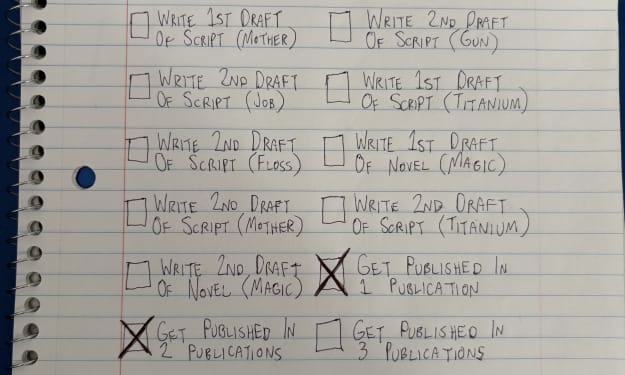
It's early March and I've now accomplished my 4th writing goal for the year of 2026. Before diving into the behind-the-scenes of it... why not tell you up front what that accomplishment was? I was published in a 2nd publication for this year. Published in Helix Literary Magazine out of Central Connecticut State University. You can read it for free right now!
By Stephen Kramer Avitabile5 days ago in Writers
Comments
There are no comments for this story
Be the first to respond and start the conversation.