
Vietnam Organic Food Market Size and Forecast 2025–2033
Rising Health Awareness, Sustainability Goals, and Government Support Push Vietnam’s Organic Food Industry into a High-Growth Decade

Vietnam Organic Food Market Overview
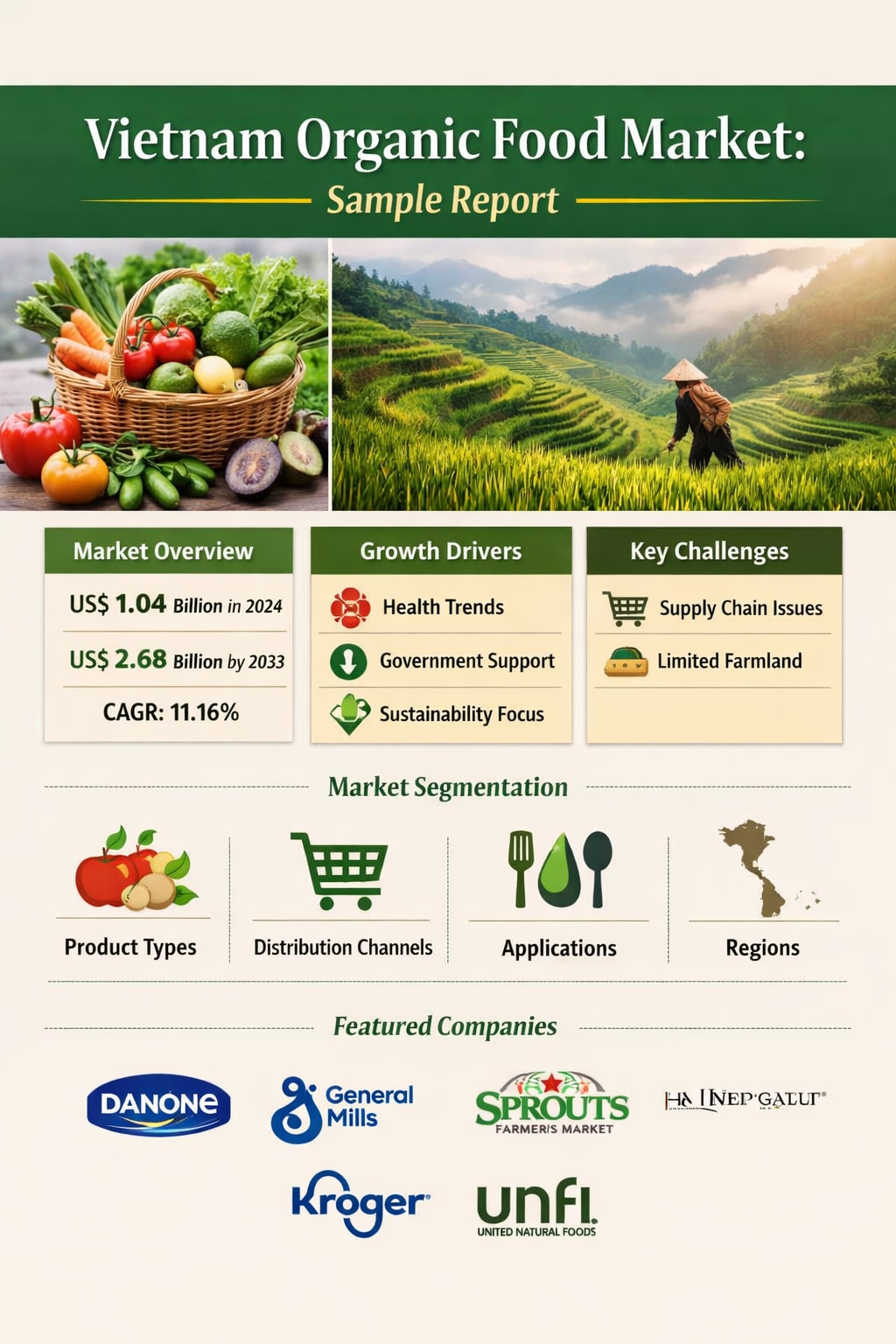
The Vietnam Organic Food Market is entering a decisive growth phase, driven by changing consumer lifestyles, rising health awareness, and stronger focus on environmental sustainability. According to industry estimates, the Vietnam Organic Food Market is expected to reach US$ 2.68 billion by 2033, up from US$ 1.04 billion in 2024, expanding at a robust CAGR of 11.16% from 2025 to 2033. This impressive growth trajectory reflects a deep transformation in how Vietnamese consumers think about food quality, safety, and long-term wellbeing.
Organic food refers to agricultural products grown and processed using environmentally friendly practices such as crop rotation, organic fertilizers, and natural pest control techniques. These products avoid genetically modified organisms (GMOs), synthetic pesticides, chemical fertilizers, artificial preservatives, and additives. As a result, organic food is widely perceived as cleaner, safer, and more nutritious compared to conventionally grown alternatives. Many consumers also associate organic products with higher levels of antioxidants and beneficial nutrients, as well as better taste and freshness.
In Vietnam, the appeal of organic food is strongly linked to concerns about food safety and long-term health. Over the past decade, rapid urbanization, industrialization, and intensive farming practices have increased public attention on issues such as chemical residues, pesticide use, and food contamination. This has encouraged a growing segment of consumers—especially in urban centers—to seek out organic and naturally sourced products.
Beyond health, organic food also aligns with Vietnam’s broader sustainability goals. Organic farming helps protect biodiversity, improves soil health, conserves water resources, and reduces environmental pollution. By minimizing the use of harmful chemicals, it supports long-term agricultural resilience and contributes to climate change mitigation. These environmental benefits are increasingly recognized by both consumers and policymakers, further strengthening the foundation for market expansion.
Another important factor supporting growth is the widening availability of organic food across multiple distribution channels. Supermarkets, hypermarkets, specialty stores, and online retail platforms are making organic products more accessible than ever before. At the same time, rising incomes and a growing middle class are enabling more consumers to afford premium food options, including organic fruits, vegetables, dairy, grains, and processed foods.
Taken together, these trends suggest that Vietnam’s organic food market is not just a niche segment anymore. It is gradually becoming a mainstream part of the country’s food and beverage industry, with strong growth prospects over the next decade.
Key Growth Drivers for the Vietnam Organic Food Market
Government Support and Policy Initiatives
The Vietnamese government plays a crucial role in shaping the future of the organic food market. In recent years, various policies and initiatives have been introduced to encourage farmers and agribusinesses to adopt organic farming practices. These include financial incentives, subsidies, and technical support programs designed to reduce the cost burden of transitioning from conventional to organic farming.
One of the most important contributions of government policy is the development of certification and quality control systems. By establishing clear standards and certification frameworks, authorities help ensure the authenticity and reliability of organic products. This, in turn, builds consumer trust—an essential factor in a market where credibility and transparency are critical.
In addition, awareness campaigns and training programs are being promoted to educate both producers and consumers about the benefits of organic agriculture. These efforts aim to expand the area under organic cultivation, improve product quality, and promote sustainable agricultural practices nationwide. Over time, such policies are expected to strengthen the entire organic ecosystem, from farm to retail shelf, supporting steady market growth.
Health and Food Safety Awareness
Health and food safety concerns are among the strongest drivers of organic food demand in Vietnam. Consumers are becoming increasingly aware of the potential risks associated with conventional food production, including pesticide residues, chemical additives, and artificial preservatives. This awareness is especially pronounced in urban areas, where access to information and media coverage of food safety issues is higher.
Organic food, positioned as a cleaner and more natural alternative, appeals strongly to health-conscious consumers. Many people associate organic products with better nutrition, fewer harmful substances, and improved overall wellbeing. Parents, in particular, are showing greater interest in organic options for children, driven by concerns about long-term health and development.
As lifestyles become busier and stress levels rise, there is also a broader shift toward preventive healthcare and wellness-oriented consumption. Food is increasingly viewed not just as a source of calories, but as a tool for maintaining health and quality of life. This mindset is expected to continue fueling demand for organic food products across Vietnam in the coming years.
Environmental Sustainability Concerns
Environmental awareness is another powerful force shaping Vietnam’s organic food market. Issues such as soil degradation, water pollution, loss of biodiversity, and climate change have become more visible and more urgent. As a result, many consumers are actively seeking products that are produced in an environmentally responsible way.
Organic farming practices align closely with these values. By avoiding synthetic chemicals and emphasizing natural processes, organic agriculture supports healthier ecosystems, improved soil fertility, and more sustainable use of natural resources. For environmentally conscious consumers, buying organic food is not just a personal health choice—it is also a way to support more sustainable and ethical farming systems.
This growing emphasis on sustainability is also influencing retailers and food brands, many of which are expanding their organic product lines to meet changing consumer expectations. Over time, this alignment between environmental values and consumer behavior is expected to further accelerate the growth of the organic food market in Vietnam.
Challenges in the Vietnam Organic Food Market
Lack of Organized Production Chains
Despite strong growth potential, the Vietnam organic food market faces several structural challenges. One of the most significant is the lack of well-organized and standardized production chains. Many organic producers operate on a small scale, often with limited access to modern logistics, quality control systems, and certification processes.
This fragmentation can lead to inconsistent product quality and limited traceability, both of which are critical for building consumer trust. In the organic sector, buyers want assurance that products truly meet organic standards and are free from contamination. Without strong and transparent supply chains, it becomes harder to guarantee this level of confidence.
The absence of organized production and distribution systems also makes it more difficult for the industry to scale up and compete effectively in both domestic and international markets. Addressing this issue will require greater coordination among farmers, processors, distributors, and regulators, as well as increased investment in infrastructure and quality assurance systems.
Limited Land Allocation for Organic Farming
Another major constraint is the limited amount of land currently dedicated to organic agriculture in Vietnam. Compared to the country’s total agricultural area, organic farming still occupies a relatively small share. This limits overall production capacity and makes it challenging to meet the rapidly growing demand for organic products.
As consumer awareness rises and export opportunities expand, the need for larger organic farming areas becomes more pressing. Expanding land allocation for organic agriculture would help increase output, improve supply chain efficiency, and enhance Vietnam’s competitiveness in the global organic food market.
However, transitioning land from conventional to organic farming is not a simple process. It requires time, investment, and technical expertise, as well as supportive policies and market incentives. Overcoming this challenge will be essential for sustaining long-term growth in the sector.
Regional Insights: Organic Food Market in Vietnam
East Vietnam Organic Food Market
East Vietnam is one of the most dynamic regions for organic food consumption, particularly in and around major urban centers such as Hanoi, Hai Duong, and Hai Phong. Rising incomes, growing health awareness, and heightened concerns about food safety are driving strong demand for organic products in these areas.
The increasing presence of organic foods in large retail chains such as Co.opmart, WinMart, Lotte Mart, and MM Mega Market highlights the mainstreaming of organic consumption. Even though organic fruits and vegetables often cost 25–35% more than conventional alternatives, many consumers are willing to pay the premium for perceived quality, safety, and health benefits.
In regions like Lam Dong, organic vegetable cooperatives have helped farmers improve their incomes and living standards by participating in higher-value supply chains. The development of production and consumption linkages, along with the gradual expansion of organic farming areas, continues to support market growth in East Vietnam. However, challenges such as the need for standardized certification and limited land availability remain important issues to address.
West Vietnam Organic Food Market
West Vietnam, including areas such as Cà Mau, Tuyên Quang, and Bến Tre, is also witnessing steady growth in organic food production and consumption. This expansion is supported by increasing consumer awareness and targeted investments in organic agriculture.
For instance, Saigon Co.op has invested in a large organic farming project in Cà Mau, producing certified organic fish, vegetables, and rice sold under the Co.op Organic brand nationwide. Bến Tre is focusing on organic coconut products, while Tuyên Quang Province is promoting organic orange cultivation. These initiatives demonstrate how regional specialization can help build strong organic value chains.
Despite these positive developments, West Vietnam faces similar challenges to other regions, including limited land availability and the need for more consistent certification and quality control systems. Addressing these issues will be key to sustaining long-term growth in the region’s organic food market.
Vietnam Organic Food Market Segmentation
By Product Type (8 Viewpoints)
Organic Fruits and Vegetables
Organic Meat, Poultry, and Dairy
Organic Processed Food
Organic Bread and Bakery
Organic Beverages
Organic Cereal and Food Grains
Others
Among these, organic fruits and vegetables currently account for a significant share due to high consumer demand for fresh and chemical-free produce. However, organic processed foods, beverages, and bakery products are gaining traction as urban lifestyles create demand for convenient yet healthy options.
By Distribution Channel (5 Viewpoints)
Supermarkets / Hypermarkets
Specialty Stores
Convenience Stores
Online Retail Stores
Others
Modern retail formats play a crucial role in expanding market reach, while online channels are becoming increasingly important, especially among younger and urban consumers who value convenience and product variety.
By Application (4 Viewpoints)
Bakery and Confectionery
Ready-to-Eat Food Products
Breakfast Cereals
Others
The use of organic ingredients in ready-to-eat foods and breakfast cereals is growing rapidly, reflecting changing consumption patterns and demand for healthier convenience foods.
By Region (4 Viewpoints)
East
West
North
South
Each region contributes differently to market growth, depending on income levels, urbanization, retail infrastructure, and agricultural specialization.
Competitive Landscape and Company Analysis
The Vietnam organic food market features a mix of international and regional players that contribute to product availability, innovation, and supply chain development. Key companies covered in the market include:
Danone S.A.
General Mills Inc.
Sprouts Farmers Market Inc.
The Hain Celestial Group Inc.
The Kroger Company
United Natural Foods Inc.
Dole Food Company Inc.
These companies are analyzed from four main viewpoints:
Overview
Key Persons
Recent Developments
Revenue
Their involvement highlights the increasing global interest in Vietnam’s organic food sector and the growing integration of the country into international organic supply chains.
Final Thoughts
The Vietnam Organic Food Market is on a strong growth path, projected to rise from US$ 1.04 billion in 2024 to US$ 2.68 billion by 2033, at a CAGR of 11.16%. This growth is being powered by rising health awareness, stronger focus on food safety, increasing environmental consciousness, and supportive government policies.
While challenges such as fragmented production chains and limited land for organic farming remain, ongoing investments, policy support, and growing consumer demand are steadily reshaping the market landscape. As organic food becomes more accessible and more trusted, it is likely to move even further into the mainstream of Vietnam’s food industry.
Over the next decade, the organic food sector in Vietnam is set to play a key role not only in improving consumer health, but also in promoting sustainable agriculture, protecting the environment, and enhancing the long-term resilience of the country’s food system. 🌱
About the Creator
Keep reading
More stories from shibansh kumar and writers in Trader and other communities.
Australia Chicken Poultry Market Trends & Summary (2025–2033)
Introduction The Australia Chicken Poultry Market is entering a decisive growth phase, driven by changing consumer diets, rising health awareness, technological modernization, and a strong push toward sustainability and food safety. According to industry estimates, the market is expected to reach US$ 5.15 billion by 2033, up from US$ 3.03 billion in 2024, growing at a CAGR of 6.08% from 2025 to 2033. This steady expansion reflects not only increasing domestic consumption but also structural shifts in how poultry is produced, processed, distributed, and marketed across the country.
By shibansh kumarabout 5 hours ago in Trader
Philippines Factoring Market 2026: to Grow from USD 18.35 Billion to USD 27.48 Billion by 2034
Philippines Factoring Market Overview The Philippines factoring market — a financial service that helps businesses convert accounts receivable into immediate working capital — is on a steady growth trajectory as firms seek alternatives to traditional credit and capital-raising mechanisms. According to IMARC Group data, the Philippines factoring market size reached USD 18.35 billion in 2025 and is expected to grow to USD 27.48 billion by 2034, representing a compound annual growth rate (CAGR) of 4.12 % from 2026 to 2034.
By Manisha Dixitabout 16 hours ago in Trader



Comments
There are no comments for this story
Be the first to respond and start the conversation.