
Australia Chicken Poultry Market Trends & Summary (2025–2033)
How Health, Convenience, and Sustainability Are Reshaping Australia’s Favorite Protein

Introduction
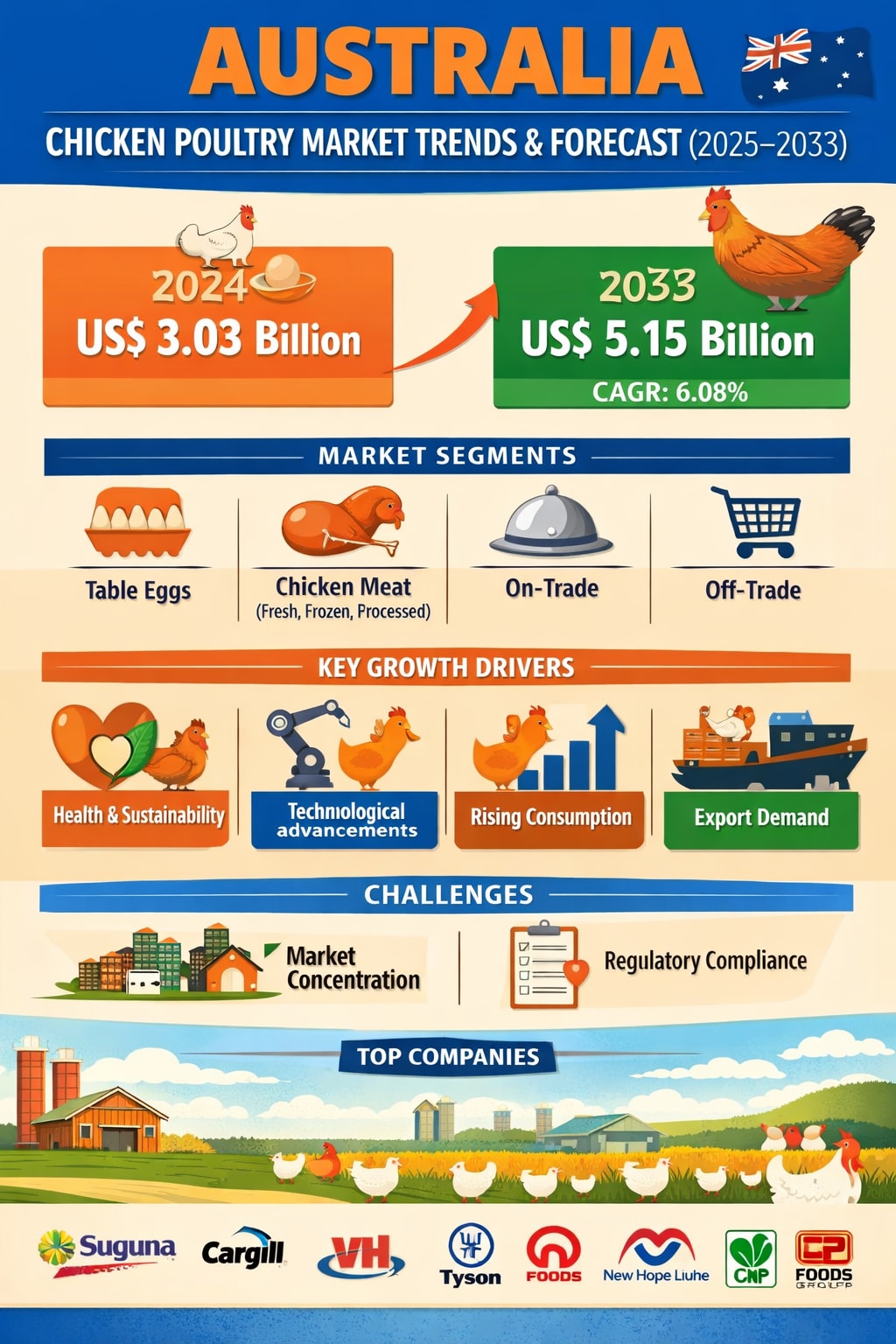
The Australia Chicken Poultry Market is entering a decisive growth phase, driven by changing consumer diets, rising health awareness, technological modernization, and a strong push toward sustainability and food safety. According to industry estimates, the market is expected to reach US$ 5.15 billion by 2033, up from US$ 3.03 billion in 2024, growing at a CAGR of 6.08% from 2025 to 2033. This steady expansion reflects not only increasing domestic consumption but also structural shifts in how poultry is produced, processed, distributed, and marketed across the country.
Download Sample Report
Chicken has firmly established itself as Australia’s most consumed animal protein. Its affordability, versatility, and perception as a healthier alternative to red meat have made it a staple in households, restaurants, and quick-service outlets alike. At the same time, the industry is evolving under pressure from rising input costs, stricter environmental and biosecurity regulations, and growing consumer demand for ethically and sustainably produced food.
The Australia Chicken Poultry Market & Forecast report segments the industry by Product—including Table Eggs and Chicken Meat (Fresh/Chilled, Frozen/Canned, and Processed)—and by Distribution Channel, split between On-Trade and Off-Trade formats such as Supermarkets/Hypermarkets, Specialty Stores, Online Retail, and Others. Together, these segments paint a picture of a mature but still dynamic market that is adapting to new consumer expectations and operational realities.
Australia Chicken Poultry Industry Overview
The chicken meat industry is one of the most important pillars of Australia’s agricultural sector. Over the past three decades, Australians have steadily increased their chicken consumption to the point where it now stands as the country’s most popular meat protein. Average per capita consumption has crossed the 50-kilogram mark annually, underlining how deeply embedded poultry has become in everyday diets.
Structurally, the industry is highly vertically integrated. Major producers such as Baiada Poultry and Inghams Enterprises together control more than 70% of the market. These companies oversee nearly every stage of the value chain—from breeding and feed milling to processing, packaging, and distribution. This level of integration has helped ensure consistent quality, stable supply, and operational efficiency, but it has also contributed to concerns around market concentration and competitive balance.
Despite its strong fundamentals, the sector is not without challenges. Rising feed and labor costs have put pressure on margins, while the ongoing threat of avian influenza outbreaks remains a serious risk. In recent years, outbreaks have resulted in significant losses for parts of the poultry industry, prompting stronger government and industry responses. For example, the South Australian government has invested more than $2 million in technology to enhance biosecurity systems and improve outbreak management capabilities.
Sustainability has also become a central theme. The Australian Chicken Meat Industry Sustainability Framework highlights the sector’s commitment to reducing environmental impact, improving animal welfare, and promoting responsible production practices. These efforts are increasingly important as consumers and regulators alike demand greater transparency and accountability from food producers.
Market Growth Outlook: 2025–2033
With the market projected to grow from US$ 3.03 billion in 2024 to US$ 5.15 billion by 2033, the Australian chicken poultry industry is set for a decade of steady expansion. A 6.08% CAGR indicates not just volume growth, but also value growth driven by product diversification, premiumization, and improved supply chain efficiencies.
Several long-term trends are shaping this outlook:
A continued shift toward protein-rich, balanced diets
Rising demand for convenience and ready-to-cook or ready-to-eat poultry products
Greater emphasis on food safety, traceability, and sustainability
Increasing use of automation, data analytics, and biosecurity technologies
Expansion of modern retail and online distribution channels
Together, these factors suggest that the industry’s growth will not be purely cyclical, but structural—anchored in lasting changes to consumer behavior and production methods.
Key Growth Drivers in the Australia Chicken Poultry Market
1. Health and Sustainability Trends
Health consciousness is one of the strongest forces driving poultry consumption in Australia. Many consumers view chicken as a leaner, healthier source of protein compared to red meats, largely due to its lower fat content and versatility in balanced diets. According to data from the Australian Department of Agriculture, Fisheries, and Forestry, poultry has become the most consumed meat in the country, exceeding 40 kilograms per person per year.
Affordability also plays a major role. In an environment where households are increasingly mindful of food budgets, chicken remains a cost-effective protein option that can be used across a wide range of cuisines and meal formats. From home cooking to quick-service restaurants, poultry fits neatly into both everyday meals and convenience-driven lifestyles.
At the same time, sustainability is becoming a key purchasing criterion. Demand for free-range and organic poultry is growing as consumers pay closer attention to animal welfare, environmental impact, and ethical sourcing. This shift is encouraging producers to invest in more transparent supply chains and higher welfare standards, reinforcing poultry’s long-term appeal in the Australian meat market.
2. Technological Advancements
Technology is transforming how poultry is produced, processed, and distributed in Australia. Automation has already made a significant impact, particularly in areas such as feeding, watering, and processing, where it reduces reliance on manual labor and improves consistency and efficiency.
Biosecurity technologies are also playing a critical role. Advanced monitoring systems help detect potential disease risks earlier, reducing the likelihood of large-scale outbreaks and minimizing losses. These systems not only protect animal health but also strengthen consumer confidence in food safety.
In addition, data analytics is increasingly being used to optimize feed usage, energy consumption, and water management. By improving resource efficiency, producers can reduce costs and environmental impact at the same time. In a market where sustainability and profitability are closely linked, these innovations are becoming a key competitive advantage.
3. Rising Poultry Consumption
Australia’s appetite for poultry continues to grow, driven by the same health, affordability, and convenience factors that have shaped consumption trends over the past two decades. Chicken’s versatility makes it suitable for a wide range of dishes, from traditional home-cooked meals to fast food and premium ready-to-eat products.
Government dietary guidelines and public health messaging that promote balanced diets have also supported poultry’s position as a preferred protein source. As consumers look for practical ways to maintain healthier eating habits without sacrificing taste or convenience, poultry is likely to remain at the center of Australian food culture.
The growing popularity of responsibly produced chicken—such as free-range and organic options—adds another layer of value growth, allowing producers to tap into premium segments while still serving the mass market.
Challenges Facing the Australia Chicken Poultry Market
1. Market Concentration and Fair-Trading Concerns
One of the most debated issues in the Australian poultry sector is its high level of market concentration. With Inghams Enterprises and Baiada Poultry controlling around 70% of the market, smaller producers often face limited bargaining power when negotiating contracts and pricing.
This has raised concerns about fair trading practices and supply chain transparency. Industry bodies such as the National Farmers Federation have called for a mandatory code of conduct to ensure more balanced relationships between large processors and smaller farmers. Such measures are seen as essential for promoting healthy competition, protecting smaller players, and maintaining long-term industry resilience.
While consolidation has brought efficiency and scale, addressing these concerns will be crucial for maintaining trust and fairness across the sector.
2. Regulatory Compliance and Environmental Reporting
From 2025 onward, new climate and environmental reporting regulations are set to increase the compliance burden on poultry producers. These rules will require detailed disclosure of emissions not only from direct operations but also across the wider supply chain.
For many producers, especially smaller ones, this means investing in new data collection systems, reporting tools, and operational processes. While the long-term goal is to promote sustainability and transparency, the short-term impact includes higher costs and increased administrative complexity.
Balancing regulatory compliance with commercial viability will be one of the key management challenges for the industry over the coming years.
Australia Chicken Poultry Market Segmentation
By Product
From a product perspective, the market can be viewed in two broad categories:
Table Eggs
Chicken Meat, which is further segmented into:
Fresh / Chilled
Frozen / Canned
Processed
Fresh and chilled chicken continues to dominate due to consumer preference for minimally processed food, while processed and frozen products are gaining ground thanks to convenience-driven lifestyles and the growth of ready-to-eat and ready-to-cook meal solutions.
By Distribution Channel
The market is also segmented by distribution into:
On-Trade (restaurants, hotels, catering, food service)
Off-Trade, including:
Supermarkets/Hypermarkets
Specialty Stores
Online Retail
Others
Off-trade channels, particularly large retail chains, account for a major share of sales due to their wide reach and strong private-label offerings. However, online retail is emerging as a fast-growing channel, supported by changing shopping habits and improved cold-chain logistics.
Competitive Landscape and Company Analysis
The market features a mix of global and regional players, with key companies including:
Suguna Foods
Cargill Inc.
VH Group
Tyson Foods, Inc.
NH Foods Ltd.
New Hope Liuhe
Charoen Pokphand Group
Doyoo Group
Wen’s Food Group
Sunner Development Co.
Each of these companies is typically analyzed across four main dimensions: Overview, Key Persons, Recent Developments, and Revenue Performance. Competitive strategies in the Australian market increasingly focus on operational efficiency, product innovation, sustainability initiatives, and supply chain resilience.
Future Outlook: Where the Market Is Headed
Looking ahead to 2033, the Australia Chicken Poultry Market is expected to remain one of the most stable and strategically important segments of the country’s food and agriculture sector. Growth will be supported by steady demand, technological modernization, and the ongoing shift toward healthier and more sustainable diets.
At the same time, the industry will need to navigate rising costs, stricter regulations, and structural challenges related to market concentration. Companies that invest early in technology, transparency, and sustainability are likely to be best positioned to capture long-term value.
With the market projected to reach US$ 5.15 billion by 2033, poultry will not only remain Australia’s favorite protein—it will also continue to be a key engine of growth within the broader agribusiness economy.
Final Thoughts
The Australia Chicken Poultry Market stands at a crossroads of tradition and transformation. Strong consumption fundamentals, favorable health perceptions, and expanding retail and foodservice channels provide a solid base for growth. At the same time, technological innovation and sustainability are redefining how the industry operates and competes.
While challenges such as regulatory pressure and market concentration cannot be ignored, the overall outlook remains positive. With a projected 6.08% CAGR from 2025 to 2033, the sector is well on track to strengthen its role in Australia’s food system—delivering not just volume, but value, resilience, and long-term relevance in a changing global food landscape.
About the Creator
Keep reading
More stories from shibansh kumar and writers in Trader and other communities.
Global Oatmeal Market Size and Forecast 2025–2033: A Healthy Staple Finds Its Moment
Global Oatmeal Market Overview The global oatmeal market is steadily carving out a stronger position in the everyday diets of consumers around the world. According to Renub Research, the oatmeal market is expected to reach US$ 9.67 billion by 2033, up from US$ 6.05 billion in 2024, growing at a CAGR of 5.35% from 2025 to 2033. This growth reflects more than just a shift in breakfast habits—it signals a broader transformation in how consumers think about health, convenience, and nutrition.
By shibansh kumarabout 17 hours ago in Trader
Mexico Wealth Management Market Growth, Outlook and Industry Analysis
Market Overview — Mexico Wealth Management Market The Mexico Wealth Management Market has emerged as a dynamic segment within the country’s broader financial services industry, driven by rising affluence, expanding investor sophistication, and an increasingly diversified financial ecosystem. Wealth management in Mexico encompasses a wide range of services — from traditional financial planning and asset allocation to advanced portfolio construction, tax planning, legacy planning, and digital advisory solutions. This market serves a diverse client base, including high-net-worth individuals (HNWIs), mass affluent investors, and retail clients seeking tailored investment strategies and long-term financial security. The sector also includes both traditional human advisory models and hybrid or automated (robo-advisory) platforms that cater to different investor needs.
By Kim Soo hyun5 days ago in Trader
Diabetic Nephropathy Market to Reach USD 16,750.4 Million by 2035: AI Innovations and Rising Diabetes Cases Fuel 4.65% CAGR Growth
The global diabetic nephropathy market is on a steady upward trajectory, projected to reach USD 16,750.4 million by 2035, growing at a CAGR of 4.65% between 2025 and 2035. The surge is largely driven by the alarming global rise in diabetes cases and the increasing burden of chronic kidney disease (CKD), one of the most serious long-term complications of diabetes.
By Adil Ali Khana day ago in Trader



Comments
There are no comments for this story
Be the first to respond and start the conversation.