
Africa Fertilizer Market Size and Forecast 2025–2033
How Food Security Goals, Policy Reforms, and Sustainable Farming Are Reshaping the Continent’s Nutrient Economy

Africa Fertilizers Market: Growth at the Root of Food Security
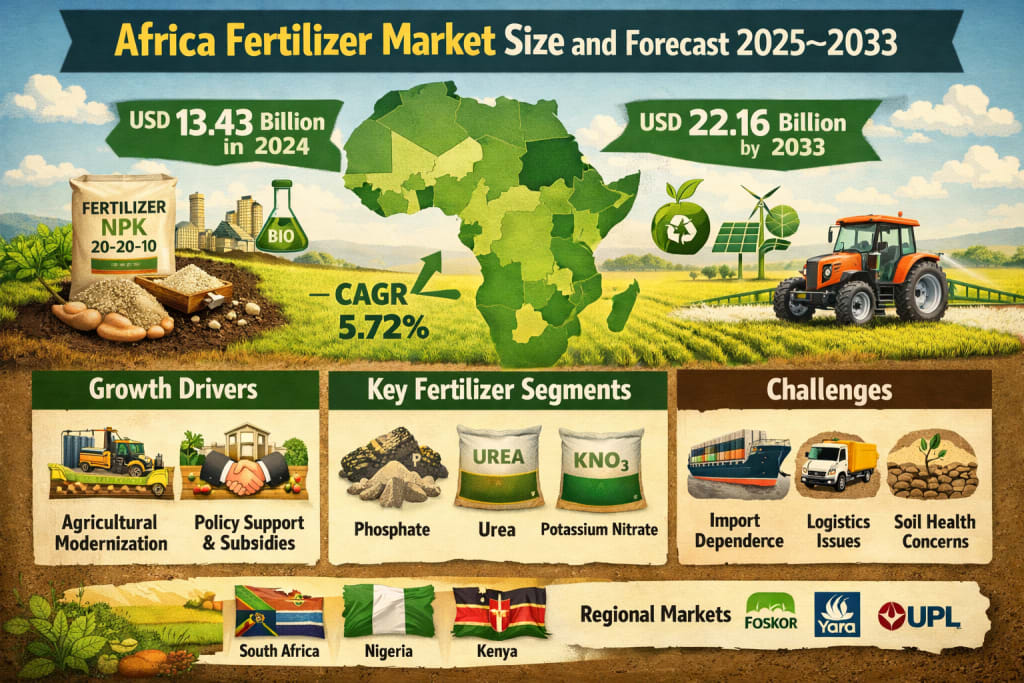
The Africa Fertilizers Market is entering a decisive decade, driven by the continent’s urgent need to improve agricultural productivity, ensure food security, and build more resilient farming systems. According to Renub Research, the market is valued at USD 13.43 billion in 2024 and is expected to grow at a compound annual growth rate (CAGR) of 5.72% between 2025 and 2033, reaching approximately USD 22.16 billion by 2033.
This expansion reflects more than just rising consumption of agricultural inputs. It signals a structural shift in African agriculture—from low-input, subsistence-oriented systems toward more commercial, productivity-focused, and sustainability-aware farming models. Fertilizers, both inorganic and organic, are becoming central to this transition, helping farmers close yield gaps, improve soil fertility, and stabilize food supplies in a region where population growth continues to outpace agricultural output.
At the same time, the market is being reshaped by policy reforms, local production initiatives, and growing interest in environmentally responsible nutrient management. Together, these forces are transforming fertilizers from a simple farm input into a strategic pillar of Africa’s long-term food and economic security.
Africa Fertilizer Market Overview
Fertilizers are materials applied to soil or plants to supply essential nutrients that promote healthy growth and higher yields. The most critical nutrients—nitrogen (N), phosphorus (P), and potassium (K)—form the backbone of modern crop nutrition. In Africa, where agriculture employs a large share of the population and contributes significantly to GDP in many countries, fertilizers play a crucial role in improving productivity on often nutrient-depleted soils.
Across much of the continent, years of continuous cultivation, limited crop rotation, and insufficient soil replenishment have led to declining soil fertility. This has made fertilizer use not just beneficial, but increasingly necessary. For staple crops such as maize, rice, wheat, sorghum, and cassava, balanced fertilization can mean the difference between subsistence yields and marketable surpluses.
In recent years, the market has also seen rising interest in biofertilizers and eco-friendly nutrient solutions, reflecting a broader push toward sustainable agriculture. These products aim to improve soil health, reduce environmental impact, and support long-term productivity rather than just short-term yield gains. Together, conventional mineral fertilizers and newer biological or specialty products are forming a more diversified and resilient nutrient ecosystem for African farming.
Key Growth Drivers in the Africa Fertilizer Market
Agricultural Modernization and the Push for Higher Productivity
One of the most powerful forces behind fertilizer market growth in Africa is the gradual modernization of agriculture. Many countries are moving away from purely subsistence farming toward more commercial, market-oriented production systems. Governments, development agencies, and private investors are promoting better agronomy practices, mechanization, improved seeds, and greater use of inputs to raise yields and reduce food imports.
As farmers adopt higher-yielding crop varieties and expand irrigated areas, the demand for balanced nutrient application naturally increases. This supports the use of both traditional macronutrient fertilizers and more specialized formulations. Extension services, demonstration farms, and farmer cooperatives are also helping translate research into practical field application, gradually increasing fertilizer adoption rates.
In parallel, the growth of organized value chains for crops such as maize, rice, oilseeds, and horticultural produce is creating more predictable and stable demand for fertilizers. These value chains often require consistent quality and volume, which in turn encourages more disciplined and planned nutrient management.
Policy Support, Subsidies, and Local Production Initiatives
Policy intervention remains a cornerstone of fertilizer market development across Africa. Many governments operate input subsidy programs, voucher schemes, or public-private distribution models to make fertilizers more affordable and accessible to smallholder farmers. These efforts are crucial in markets where purchasing power is limited and farm income is highly seasonal.
At the same time, industrial policies are increasingly focused on boosting domestic fertilizer production and blending capacity. Investments in port-based blending plants, regional distribution hubs, and storage infrastructure aim to reduce dependence on imports and lower transportation costs. Trade facilitation measures and improvements in logistics are also helping smooth supply flows and reduce price volatility.
A notable milestone in this direction was the Africa Fertilizer and Soil Health Summit held in Nairobi in May 2024, where African leaders endorsed the Nairobi Declaration. The initiative emphasized improving access to affordable, high-quality fertilizers—both inorganic and organic—while promoting better soil health management across the continent.
Rising Demand for Horticulture and High-Value Crops
Urbanization, changing diets, and export opportunities are driving strong growth in horticulture and other high-value crops such as fruits, vegetables, and flowers. These crops require more precise and intensive nutrient management, which boosts demand for specialty fertilizers, foliar feeds, and fertigation-compatible products.
Producers targeting export markets or premium urban consumers often operate under strict quality and traceability standards. This makes them more willing to invest in consistent, certified inputs and technical advisory services. As a result, this segment tends to adopt new fertilizer technologies faster than staple crop systems, creating a valuable niche for higher-margin products.
Regional initiatives, such as the COMESA–EAC Horticulture Accelerator Programme, are further supporting this trend by strengthening value chains and encouraging investment in modern production systems.
Challenges Facing the Africa Fertilizer Market
Logistics Constraints, Import Dependence, and Price Volatility
Despite its growth potential, the African fertilizer market faces significant structural challenges. Many countries remain heavily dependent on imported raw materials or finished products. High freight costs, port congestion, weak inland transport networks, and multiple handling stages all add to the final price paid by farmers.
Seasonal demand peaks around planting times often lead to supply bottlenecks and sharp price increases, which can delay application and reduce crop yields. Exchange rate fluctuations and global commodity price swings—especially in energy markets—further amplify local price volatility.
Smallholder farmers, who typically buy in small quantities and have limited access to credit, are the most exposed to these risks. Without sustained investment in infrastructure, logistics, and regional trade integration, these constraints will continue to limit broader fertilizer adoption.
Soil Health Issues and Knowledge Gaps
Another major challenge is the mismatch between fertilizer use and actual soil needs. Many African soils suffer from long-term nutrient depletion, micronutrient deficiencies, and imbalanced fertility profiles. Yet, in practice, many farmers still rely on generic NPK formulations without soil testing or tailored recommendations.
Limited access to affordable soil testing services, weak extension systems, and fragmented supply chains for specialized blends mean that fertilizers are often used inefficiently. In some cases, this can even worsen soil problems, such as acidification or micronutrient imbalances.
Bridging this knowledge gap—through farmer training, private-sector agronomy services, and better diagnostic tools—will be essential to ensure that increased fertilizer use translates into sustainable productivity gains.
Key Product and Segment Insights
Africa Phosphate Fertilizer Market
Phosphorus is a critical nutrient in many African cropping systems, particularly for early root development and crop establishment. The continent holds significant phosphate rock reserves, supporting both export-oriented production and domestic value chains for products such as DAP, MAP, and single superphosphate.
Demand is driven by both staple crops and horticulture, although challenges remain around affordability, availability of water-soluble grades, and phosphorus fixation in tropical soils. Growing awareness of balanced fertilization is expected to support steady growth in this segment.
Africa Urea Fertilizer Market
Urea is the most widely used nitrogen fertilizer in Africa due to its high nutrient concentration and relatively low cost per unit of nitrogen. It plays a central role in boosting yields of cereals and other staple crops. However, the market remains highly sensitive to global price cycles and seasonal demand patterns.
While local production in some countries helps stabilize supply, many markets still rely heavily on imports. Increasing use of efficiency-enhanced urea products and better application practices could improve nitrogen use efficiency over time.
Africa Potassium Nitrate Fertilizer Market
Potassium nitrate occupies a smaller but growing niche, particularly in high-value horticulture and fertigation systems. Its dual supply of potassium and readily available nitrate nitrogen makes it attractive for quality-focused production, although its higher cost limits adoption to more commercial and technically advanced farms.
Inorganic and Liquid Fertilizer Segments
Inorganic fertilizers dominate the market in volume terms, forming the backbone of large-scale nutrient supply. Meanwhile, liquid fertilizers are gaining traction in irrigated systems, greenhouses, and high-value crop production due to their ease of application and rapid nutrient uptake.
Application and Crop-Based Demand
The largest share of fertilizer consumption in Africa comes from staple food crops, driven by the need to close yield gaps and strengthen food security. However, vegetables, fruits, and other high-value crops represent a fast-growing and more technology-intensive segment, where specialty products and tailored nutrition programs are increasingly common.
Regional Market Highlights
South Africa remains the most developed and commercially sophisticated fertilizer market on the continent, supported by strong manufacturing, blending, and retail infrastructure.
Nigeria, with its vast arable land and large farming population, represents one of the biggest volume markets, although distribution efficiency and quality control remain key challenges.
Competitive Landscape
Major players operating in the African fertilizer market include:
Foskor
Gavilon South Africa (MacroSource, LLC)
Haifa Group
ICL Group Ltd
K+S Aktiengesellschaft
Kynoch Fertilizer
UPL Limited
Yara International ASA
These companies compete across product portfolios, distribution reach, local partnerships, and technical support services, while also investing in blending, logistics, and farmer engagement initiatives.
Final Thoughts
The Africa Fertilizers Market is no longer just about supplying nutrients—it is becoming a strategic lever for economic development, food security, and environmental sustainability. With the market expected to grow from USD 13.43 billion in 2024 to USD 22.16 billion by 2033, the coming years will be defined by how effectively policymakers, businesses, and farmers work together to build more efficient, affordable, and knowledge-driven nutrient systems.
If infrastructure gaps, knowledge barriers, and supply chain inefficiencies can be addressed, fertilizers will play a transformative role in unlocking Africa’s vast agricultural potential and securing a more resilient food future for the continent.
About the Creator
Vietnam Organic Food Market Size and Forecast 2025–2033
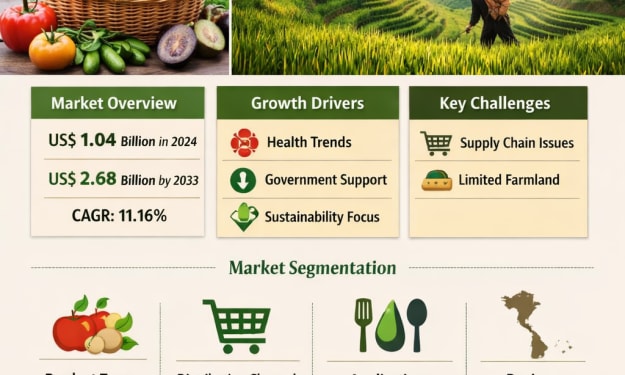
Vietnam Organic Food Market Overview The Vietnam Organic Food Market is entering a decisive growth phase, driven by changing consumer lifestyles, rising health awareness, and stronger focus on environmental sustainability. According to industry estimates, the Vietnam Organic Food Market is expected to reach US$ 2.68 billion by 2033, up from US$ 1.04 billion in 2024, expanding at a robust CAGR of 11.16% from 2025 to 2033. This impressive growth trajectory reflects a deep transformation in how Vietnamese consumers think about food quality, safety, and long-term wellbeing.
By shibansh kumarabout 7 hours ago in Trader



Comments
There are no comments for this story
Be the first to respond and start the conversation.