
United States Motorcycle Market Size and Forecast 2025
Recreational Riding, Electric Innovation, and Tech-Driven Performance Redefine America’s Two-Wheeler Industry Through 2033

United States Motorcycle Market Overview
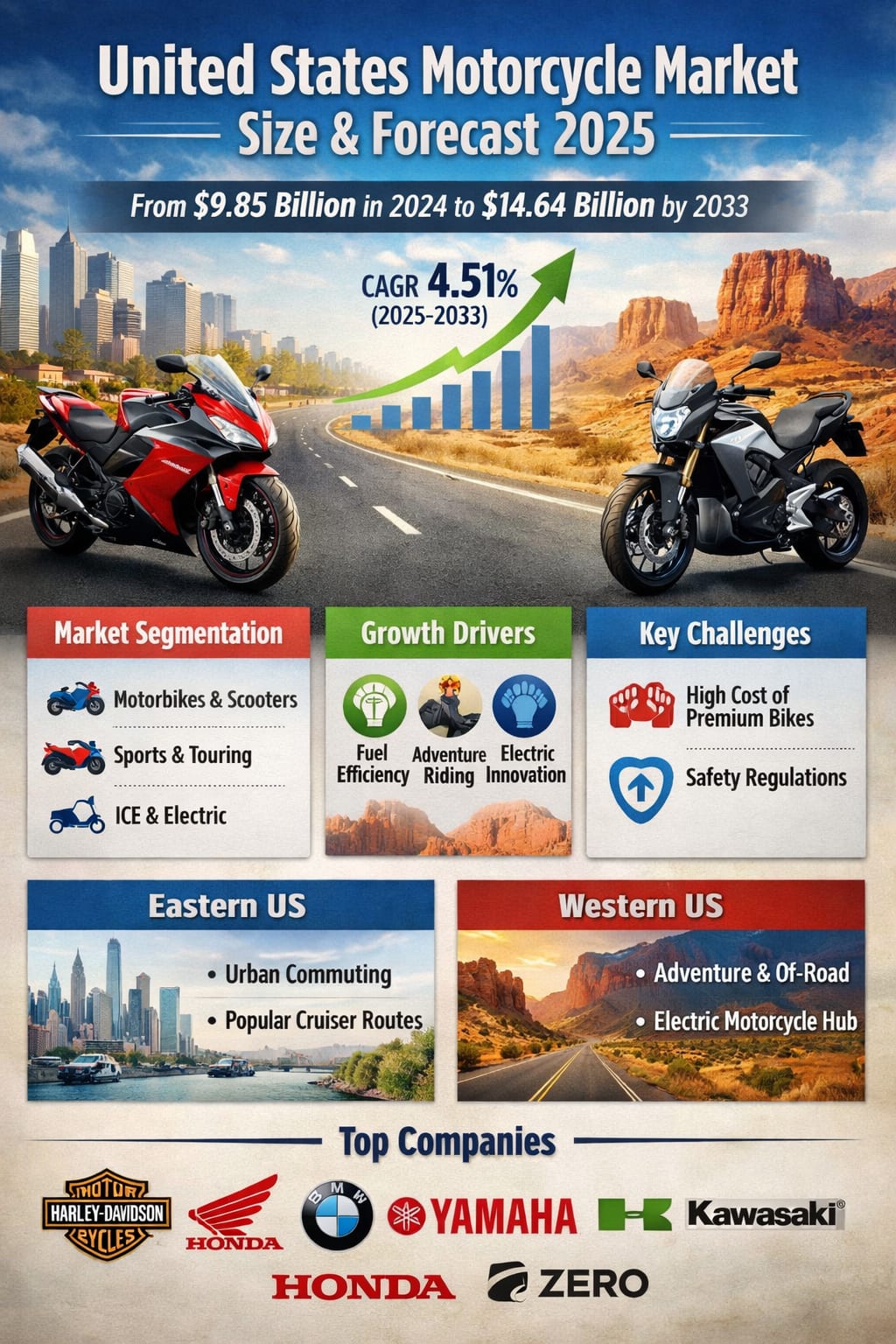
The United States motorcycle market continues to hold a unique position within the broader automotive and mobility landscape, blending lifestyle, performance, and practical transportation into one dynamic industry. In 2024, the U.S. motorcycle market stood at US$ 9.85 billion and is projected to expand to US$ 14.64 billion by 2033, growing at a compound annual growth rate (CAGR) of 4.51% from 2025 to 2033. This steady growth reflects a combination of shifting consumer preferences, technological innovation, and the rising appeal of motorcycles as both recreational machines and efficient mobility solutions.
Motorcycles, by design, offer agility, fuel efficiency, and a distinctive riding experience that cars simply cannot replicate. The U.S. market includes a wide spectrum of two-wheelers—from scooters and mopeds built for urban commuting to high-performance sports bikes, long-haul touring motorcycles, rugged adventure bikes, and a fast-emerging class of electric motorcycles. Each category caters to a different rider profile, making the market diverse and resilient.
The United States also boasts one of the world’s most recognizable motorcycle cultures. Iconic brands such as Harley-Davidson, Indian, Honda, Yamaha, and Kawasaki are deeply embedded in the country’s motorcycling identity. Major events like Daytona Bike Week and the Sturgis Motorcycle Rally attract hundreds of thousands of enthusiasts each year, reinforcing motorcycles not just as vehicles, but as lifestyle symbols. At the same time, younger riders are increasingly drawn to customization options, advanced safety features, and smart connectivity, signaling a shift toward a more tech-driven future for the industry.
With innovation accelerating and consumer expectations evolving, the U.S. motorcycle market is positioned for sustained, multi-dimensional growth over the next decade.
United States Motorcycle Market Growth Drivers
Growing Need for Fuel-Saving and Economical Transportation
One of the most consistent drivers of motorcycle adoption in the United States is their cost efficiency compared to traditional passenger cars. As fuel prices fluctuate and urban congestion continues to worsen, many commuters are turning to motorcycles as a practical and budget-friendly alternative. Motorcycles typically offer superior fuel economy, lower maintenance costs, and more affordable entry prices, especially in the 200cc to 400cc segment.
For city dwellers, motorcycles also provide the added benefit of easier parking and quicker navigation through traffic. This is particularly attractive to younger professionals and first-time vehicle buyers who are seeking mobility solutions that balance affordability with convenience. In parallel, growing awareness around environmental sustainability is nudging consumers toward smaller, more efficient vehicles, further supporting motorcycle demand in urban and suburban markets alike.
Growing Popularity of Recreational and Adventure Motorcycling
Beyond commuting, motorcycles play a major role in recreational and adventure travel across the United States. Weekend rides, cross-country tours, and off-road adventures have become increasingly popular, fueling demand for touring, adventure, and sports motorcycles. Riders are no longer just buying motorcycles as transport—they are investing in experiences.
Technological advancements have significantly enhanced this trend. Modern motorcycles now come equipped with improved suspension systems, better fuel efficiency, advanced navigation, ride modes, and electronic rider aids. These features have made long-distance and adventure riding more comfortable, safer, and more accessible to a broader range of riders.
The cultural side of motorcycling also continues to play a powerful role. Large-scale events, riding clubs, and organized tours keep the community vibrant and engaged. In May 2024, CFMoto continued expanding its footprint in the U.S. and European markets by offering well-equipped models at competitive prices, supported by its partnership with KTM’s parent company, Pierer Mobility. Such developments highlight how new and existing players are working to tap into the growing enthusiasm for recreational riding.
Growth of the Electric Motorcycle Market
The electric motorcycle segment is emerging as one of the most transformative forces within the U.S. motorcycle industry. Rising concerns about emissions, supportive government policies, and rapid improvements in battery technology are accelerating the shift toward electric two-wheelers. Manufacturers are investing heavily in models that offer longer ranges, faster charging, and smart connectivity features.
Brands such as Zero Motorcycles and Harley-Davidson’s LiveWire have already positioned themselves at the forefront of this transition, proving that electric motorcycles can deliver both performance and sustainability. Infrastructure improvements, particularly the expansion of charging networks in urban areas, are further strengthening consumer confidence in electric mobility.
In October 2023, Kawasaki introduced its first electric motorcycles in the U.S.—the Ninja e-1 and Z e-1—both sharing the same powertrain but targeting different rider preferences through distinct designs. Such launches signal that electric motorcycles are no longer niche products but a growing, competitive category within the mainstream market.
Challenges Facing the United States Motorcycle Industry
High Cost of Premium and Big-Engine Motorcycles
While the market is growing, affordability remains a key challenge—especially in the 400cc to 800cc and above 800cc segments. Premium motorcycles often feature advanced engineering, high-end materials, and cutting-edge technology, all of which drive up retail prices. In addition to the initial purchase cost, buyers must also consider higher insurance premiums, maintenance expenses, and the cost of replacement parts.
Although financing options have improved and manufacturers are introducing more competitively priced models, large-engine and luxury motorcycles still remain out of reach for many price-sensitive consumers. This limits the speed at which the premium segments can expand.
Safety Issues and Regulatory Implications
Safety continues to be a critical concern in the motorcycle industry. Compared to passenger cars, motorcycles expose riders to higher risks in accidents, which can discourage potential buyers. Regulatory requirements—such as helmet laws, licensing rules, and stricter emissions standards—also influence purchasing decisions and market dynamics.
On the positive side, manufacturers are increasingly integrating ABS, traction control, stability systems, and advanced rider-assist technologies into their models. While these innovations improve safety and rider confidence, changing public perception about motorcycle safety remains an ongoing challenge for the industry.
Segment Insights
United States Motorbikes Market
Motorbikes, including standard motorcycles, scooters, and lightweight commuter models, are particularly popular among urban commuters and first-time buyers. Their affordability, ease of handling, and low maintenance costs make them ideal for daily use. The growth of ride-sharing services and motorcycle rental platforms has also increased exposure to this segment, encouraging more consumers to consider two-wheelers as practical mobility tools.
With continuous improvements in design, fuel efficiency, and comfort, the motorbike segment is expected to maintain steady growth across U.S. cities.
United States Sports Motorcycle Market
Sports motorcycles cater to riders who prioritize speed, performance, and aggressive styling. Brands like Yamaha, Kawasaki, and Ducati dominate this segment with models that feature lightweight frames, advanced suspension systems, and high-revving engines. The popularity of track days, amateur racing events, and performance-focused riding communities continues to support demand.
Importantly, the introduction of entry-level sports bikes with smaller engine capacities has made this segment more accessible, bringing younger and less experienced riders into the performance motorcycling space.
United States Touring Motorcycle Market
Touring motorcycles are designed for long-distance comfort and practicality. Equipped with large fuel tanks, spacious storage, comfortable seating, and advanced infotainment systems, these bikes appeal to riders who enjoy cross-country travel and motorcycle tourism.
Brands such as Harley-Davidson and BMW lead this segment, offering premium models that blend luxury with performance. As experiential travel gains popularity and riders seek more immersive road trips, the touring motorcycle segment is expected to remain a strong pillar of the U.S. market.
United States Electric Motorcycle Market
Electric motorcycles are rapidly gaining traction, particularly among urban commuters and environmentally conscious consumers. Lower maintenance requirements, quiet operation, and zero tailpipe emissions make them an attractive alternative to traditional ICE motorcycles.
Companies like Zero Motorcycles, LiveWire, and Energica are pushing the boundaries of what electric two-wheelers can offer in terms of range, speed, and technology. As charging infrastructure continues to improve and battery costs decline, electric motorcycles are likely to capture a larger share of the U.S. market over the coming years.
United States 200cc to 400cc Motorcycle Market
This segment is especially popular with new riders, budget-conscious buyers, and daily commuters. These motorcycles strike a balance between performance and efficiency, offering enough power for highway use while remaining easy to handle and economical to own.
Manufacturers such as Honda, Yamaha, and KTM offer a wide range of models in this category, and demand is expected to grow as more consumers seek practical, entry-level motorcycles with modern features.
United States 400cc to 800cc Motorcycle Market
The 400cc to 800cc category appeals to intermediate riders who want more power and comfort without moving into heavyweight touring or superbike territory. These motorcycles are versatile, capable of both city commuting and long-distance travel, and often come equipped with premium features at more accessible price points.
Brands like Suzuki, Kawasaki, and Triumph are strong players in this space, and the segment is benefiting from riders upgrading from smaller displacement bikes as their experience grows.
Regional Insights
East United States Motorcycle Market
The Eastern U.S. market is driven by a mix of urban commuters and recreational riders. Major cities such as New York, Washington D.C., and Boston show strong demand for scooters, motorbikes, and electric motorcycles due to traffic congestion and the need for efficient mobility. Meanwhile, states like Florida and North Carolina are popular for cruisers and touring bikes, supported by scenic routes and favorable riding conditions.
West United States Motorcycle Market
The Western U.S. is a hotspot for adventure, touring, and off-road motorcycling. States like California, Arizona, and Colorado benefit from diverse terrain, including mountains, deserts, and coastal highways. California, in particular, is a leading market for electric motorcycles and high-performance bikes, driven by strong environmental awareness and progressive mobility policies.
Market Segmentation
By Product:
Motorbikes
Scooters
Mopeds
By Type:
Standard
Sports
Cruiser
Touring
Others
By Propulsion:
ICE
Electric
By Engine Capacity:
Up to 200cc
200cc to 400cc
400cc to 800cc
More than 800cc
By Region:
East
West
North
South
Company Analysis
Key players covered in the market include:
Harley-Davidson, Suzuki Motor Corporation, Honda Motor Co., Ltd., BMW AG, Yamaha Motor Co., Ltd., Kawasaki Heavy Industries, Ltd., Triumph Motorcycles, Ducati Motor Holding S.p.A, KTM AG, and Polaris Inc.
Each company is analyzed from four viewpoints: Overview, Key Persons, Recent Developments, and Revenue, providing a comprehensive view of the competitive landscape.
Final Thoughts
The United States motorcycle market is on a steady growth trajectory, supported by a powerful mix of cultural passion, technological innovation, and shifting mobility needs. With the market expected to grow from US$ 9.85 billion in 2024 to US$ 14.64 billion by 2033, motorcycles are clearly evolving beyond niche lifestyle products into versatile, future-ready transportation solutions.
From fuel-efficient commuter bikes and performance-driven sports models to luxury touring machines and cutting-edge electric motorcycles, the industry is becoming more diverse and inclusive. As safety technologies improve, electric mobility gains momentum, and consumer preferences continue to evolve, the U.S. motorcycle market is well-positioned to ride confidently into the next decade.
About the Creator
Keep reading
More stories from shibansh kumar and writers in Trader and other communities.
Europe Powder Dietary Supplements Market Size and Forecast 2025
Europe Powder Dietary Supplements Market Outlook The Europe powder dietary supplements market is entering a phase of rapid and sustained expansion, driven by rising health awareness, shifting dietary habits, and a strong consumer focus on preventive healthcare. In 2024, the market is valued at USD 5.97 billion and is projected to reach USD 15.79 billion by 2033, growing at an impressive CAGR of 11.44% from 2025 to 2033.
By shibansh kumar2 days ago in Trader
NASDAQ 100 Trends: How Smart Investors Capitalize on Market Moves
The NASDAQ 100 is one of the most watched stock indexes in the world. It includes 100 of the largest companies on the Nasdaq exchange, mostly from technology, retail, and healthcare sectors. For many investors, the NASDAQ 100 acts as a market thermometer. Smart investors pay close attention because the index shows where growth opportunities are. Understanding NASDAQ 100 trends helps them make informed decisions before the market shifts. They will explore the strategies top investors use to capitalize on these moves.
By hamza mirzaabout 2 hours ago in Trader



Comments
There are no comments for this story
Be the first to respond and start the conversation.