
Trade War: America and China’s Battle for Global Supremacy
Examining the Economic, Political and Technological Frontlines of a 21st Century Superpower Showdown

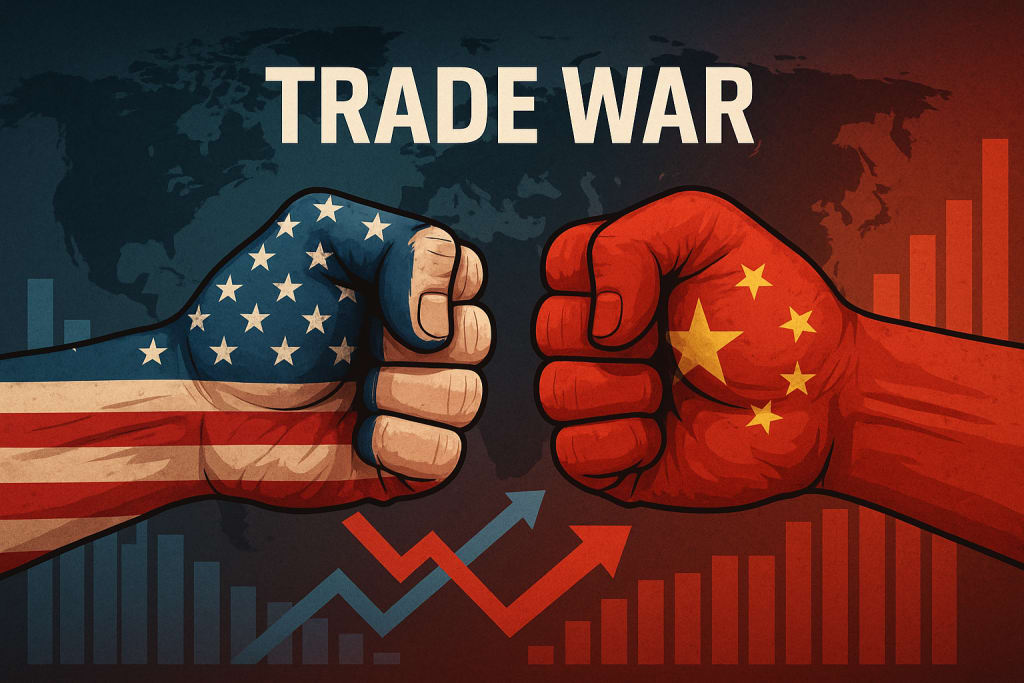
In the modern geopolitical landscape, few rivalries have defined the global stage as significantly as the escalating trade war between the United States and China. What initially began as disputes over trade imbalances and intellectual property rights has since evolved into a complex and multifaceted struggle for global dominance. This rivalry is no longer confined to tariffs and trade deficits—it spans technology, military influence, global alliances, and ideological leadership. As the world's two largest economies, the decisions and confrontations between the U.S. and China reverberate far beyond their borders, affecting markets, politics, and lives worldwide.
Origins of the Conflict
The roots of the U.S.–China trade war trace back decades, rooted in concerns over China’s trade practices, including state subsidies, forced technology transfers, and intellectual property theft. However, tensions intensified sharply in 2018 when the Trump administration imposed a series of tariffs on Chinese goods, citing unfair trade practices and the massive U.S. trade deficit with China. China responded with retaliatory tariffs, and thus began a tit-for-tat escalation that disrupted global markets and supply chains.
Despite efforts to negotiate, including the "Phase One" trade agreement signed in January 2020, the core issues remain unresolved. The Biden administration has maintained many of the previous tariffs while shifting focus toward a broader strategy of strategic competition rather than direct confrontation.
Economic Frontlines: Tariffs, Trade Imbalances, and Supply Chains
At the heart of the trade war lies a fundamental economic competition. The U.S. has long accused China of manipulating its currency, providing unfair subsidies to state-owned enterprises, and flooding the global market with cheap goods. Meanwhile, China views U.S. actions as attempts to contain its rise and preserve American economic hegemony.
Tariffs imposed by both nations have affected billions of dollars in goods. While the U.S. targeted electronics, machinery, and consumer products, China focused on U.S. agriculture, automotive goods, and manufacturing components. The ripple effects of these tariffs have been significant: American farmers lost key export markets, Chinese manufacturers faced uncertainty, and multinational corporations reevaluated their supply chains.
The COVID-19 pandemic further exposed vulnerabilities in global supply chains, prompting both countries to prioritize economic resilience and self-sufficiency. The U.S. has since pushed for reshoring key industries, such as semiconductor manufacturing, while China has emphasized its "dual circulation" strategy—focusing on domestic consumption and technological self-reliance.
Technological Frontlines: The Battle for Innovation and Control
One of the most intense dimensions of the U.S.–China rivalry is the battle for technological supremacy. The U.S. has long been the global leader in innovation, but China has rapidly advanced in areas like 5G, artificial intelligence, and quantum computing.
The U.S. responded with export restrictions on Chinese tech giants like Huawei and ZTE, citing national security risks. Additionally, Chinese firms have been delisted from U.S. stock exchanges and banned from accessing American technology, including advanced semiconductors and software. In return, China has doubled down on its ambition to become technologically independent, investing heavily in R&D and nurturing domestic innovation through state-driven initiatives.
The tech war is not just about economics—it’s about who sets the standards for the future. From controlling rare earth minerals to dominating emerging markets in Africa and Asia, both countries are positioning themselves to shape the next generation of global technology infrastructure.
Political and Ideological Frontlines
Beyond economics and technology, the U.S.–China trade war reflects a deeper ideological clash between two vastly different governance models. The U.S. champions liberal democracy and a free-market economy, while China promotes a state-led model under single-party rule.
This ideological divide has fueled tensions in areas like human rights, particularly concerning China’s policies in Xinjiang, Hong Kong, and its approach to Taiwan. The U.S. has criticized China’s human rights record and worked with allies to push back against what it sees as authoritarian overreach. China, in turn, accuses the U.S. of hypocrisy and interference in its internal affairs.
The trade war has thus evolved into a larger narrative battle. Each nation is striving to influence the international order, with the U.S. promoting a rules-based global system and China advocating for a multipolar world where sovereign choices are respected.
Global Implications and Future Outlook
The repercussions of the U.S.–China trade war are felt across the globe. Developing nations are caught in the crossfire, forced to navigate a delicate balance between the two powers. Allies like the European Union, Japan, and India are reassessing their own economic and security strategies in response to the growing divide.
Global institutions like the World Trade Organization (WTO) face increasing challenges in mediating disputes and enforcing trade rules, as the U.S. and China often sidestep multilateral mechanisms. The war has also reshaped global trade patterns, leading to the emergence of alternative supply chains in Southeast Asia, Latin America, and Africa.
Looking forward, the future of U.S.–China relations remains uncertain. While outright military conflict is unlikely, strategic competition will likely persist for years to come. Both countries are investing heavily in diplomacy, infrastructure, and soft power to shape the post-pandemic world order.
Conclusion
The U.S.–China trade war is more than a conflict over tariffs or trade deficits—it is a battle for global supremacy in a rapidly changing world. As the two powers vie for influence across economic, technological, and ideological arenas, the international community must adapt to a new era defined by strategic competition. Whether this rivalry leads to conflict or cooperation will shape the trajectory of the 21st century.
About the Creator
Muhammad Nadeem Ahmad
I'm a versatile writer with a passion for crafting engaging, research-driven articles across topics like lifestyle, tech, health, business, and culture. I bring fresh perspectives through clear, compelling and storytelling etcetera.
Keep reading
More stories from Muhammad Nadeem Ahmad and writers in Trader and other communities.
The Magnificent Geyser
Nature has a remarkable way of reminding us of its power and beauty, often in sudden and breathtaking displays. One such spectacle is the eruption of a geyser — a rare and extraordinary phenomenon that captures the imagination of travelers, scientists, and artists alike. Among the countless natural wonders scattered across the planet, geysers stand out as some of the most dramatic expressions of Earth's hidden energies.
By Muhammad Nadeem Ahmad9 months ago in Art
Australia Switchgear Market: Power Reliability, Grid Expansion & Industrial Demand
Australia Switchgear Market The Australia switchgear market is experiencing robust growth as the nation expands its power infrastructure, modernises electricity networks and integrates renewable energy sources. Switchgear — electrical equipment used to control, protect and isolate electrical circuits — plays a critical role in ensuring reliable power distribution across residential, commercial, industrial and utility sectors. According to IMARC Group, The Australia switchgear market size reached USD 1.5 Billion in 2025. Looking forward, the market is expected to reach USD 2.4 Billion by 2034, exhibiting a growth rate (CAGR) of 5.29% during 2026-2034.
By Amyra Singh6 days ago in Trader
Australia Faucet Market Flows Toward Strong Growth on Construction, Water Efficiency & Smart Tech Adoption
The Australia faucet market is experiencing a dynamic growth phase as consumer demand, regulatory momentum, and construction activities converge to drive broader adoption of modern plumbing fixtures. According to IMARC Group, the market was valued at USD 661.13 Million in 2025 and is expected to reach USD 1,142.71 Million by 2034, exhibiting a compound annual growth rate (CAGR) of 6.27% over 2026–2034.
By Rashi Sharma2 days ago in Trader



Comments
There are no comments for this story
Be the first to respond and start the conversation.