
The Magnificent Geyser
A Spectacular Eruption of Water and Steam

Nature has a remarkable way of reminding us of its power and beauty, often in sudden and breathtaking displays. One such spectacle is the eruption of a geyser — a rare and extraordinary phenomenon that captures the imagination of travelers, scientists, and artists alike. Among the countless natural wonders scattered across the planet, geysers stand out as some of the most dramatic expressions of Earth's hidden energies.
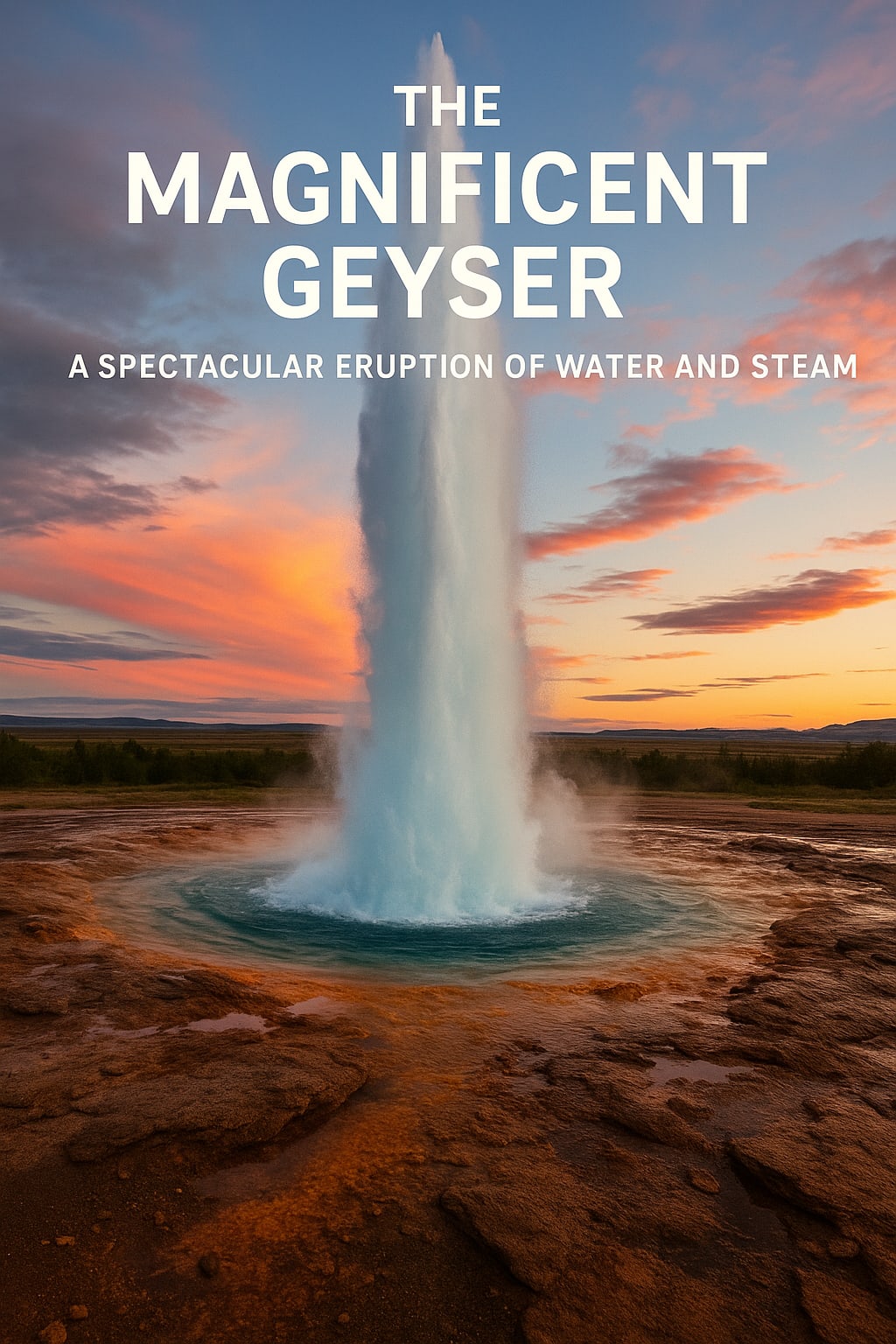
The magnificent geyser captured in this image is a vivid example of nature's grandeur. As plumes of water and steam surge into the sky, the fiery hues of a sunset frame the scene, enhancing the elemental clash between water, earth, and fire. It is a moment frozen in time — one that speaks to the ancient forces at work beneath the surface of our world.
The Science Behind the Spectacle
Geysers are rare geological formations, requiring a delicate balance of heat, water, and underground plumbing to function. They are primarily found in volcanic regions where underground chambers are heated by magma. Water seeps into these chambers through cracks in the Earth’s crust, where it is superheated under pressure. Eventually, the pressure builds to a breaking point, forcing a jet of boiling water and steam through the surface.
There are fewer than a thousand active geysers on Earth today, with the majority located in places like Yellowstone National Park in the United States, Iceland, and parts of Russia and New Zealand. Each geyser has its own unique personality — some erupt like clockwork, while others are unpredictable, lying dormant for years before suddenly roaring back to life.
A Moment of Awe
Watching a geyser erupt is more than just observing a scientific process; it is an emotional experience. The ground rumbles beneath your feet, steam hisses from hidden vents, and then — with a roar — water explodes upwards, sometimes reaching heights of over 100 feet. The air is filled with a mist that carries the scent of minerals and earth.
At sunset, the drama is even more pronounced. The golden and crimson light reflects off the water droplets, creating an ethereal glow. The eruption seems not just a release of geothermal pressure, but a performance — a powerful, natural ballet choreographed by forces deep within the planet.
The surrounding landscape, often barren and rugged, adds to the mystique. The hardened, mineral-stained ground tells stories of countless past eruptions. Pools of steaming, vibrantly colored water hint at the complex chemistry beneath the surface. It is a scene that evokes wonder, respect, and a sense of deep connection to the living Earth.
Cultural and Historical Significance
Throughout history, geysers have fascinated and mystified humans. Early travelers described them with reverence, often attributing their power to the gods or spirits of the Earth. In Iceland, where the word "geyser" originated from the Great Geysir in Haukadalur, these natural phenomena were woven into local legends.
Today, geysers are often protected as part of national parks and reserves, recognized not only for their scientific value but also for their spiritual and cultural importance. They attract millions of visitors annually, inspiring art, literature, and photography. Scientists study them to better understand geothermal systems and the dynamics of Earth’s interior.
Moreover, geysers have practical implications. In regions like Iceland, geothermal energy — harnessed from the same sources that fuel geysers — provides sustainable heating and electricity, demonstrating that the awe-inspiring forces of nature can also benefit human society in meaningful ways.
Environmental Challenges
Despite their rugged appearance, geyser systems are surprisingly delicate. Changes in groundwater levels, pollution, and even the footsteps of careless tourists can disrupt the fragile balance required for geysers to function. In some parts of the world, over-extraction of geothermal energy has led to the decline or disappearance of geysers.
Conservation efforts are crucial to preserving these natural wonders for future generations. National parks have implemented strict rules about staying on marked paths, limiting drilling activities, and monitoring water usage to protect these fragile ecosystems. Educating visitors about the importance of respecting geyser fields is an essential part of these conservation strategies.
A Call to Wonder
In an age where so much of our world is tamed, measured, and managed, geysers serve as a reminder that there are still places where nature holds the upper hand. They are raw, unpredictable, and magnificently beautiful. Witnessing a geyser's eruption is a humbling experience — one that stirs a profound sense of wonder and reverence.
Whether you are a seasoned adventurer, a curious traveler, or simply an admirer of the Earth’s marvels, standing before a geyser at the moment of eruption is unforgettable. It is a spectacle that transcends language and culture, speaking directly to that deep, universal part of us that is drawn to mystery and majesty.
As the sun dips below the horizon and the sky blazes with color, the geyser’s plume becomes a pillar of steam and light — a fleeting but unforgettable testament to the power and beauty of our planet.
About the Creator
Muhammad Nadeem Ahmad
I'm a versatile writer with a passion for crafting engaging, research-driven articles across topics like lifestyle, tech, health, business, and culture. I bring fresh perspectives through clear, compelling and storytelling etcetera.
Keep reading
More stories from Muhammad Nadeem Ahmad and writers in Art and other communities.
City of Minds
In a world constantly shaped by human thought and ambition, few images capture the essence of civilization's intricate bond with identity quite like City of Minds. This surrealistic oil painting—a towering human head made entirely of buildings—evokes profound reflection on the interconnectedness between the self and the environments we construct. It stands as a testament to the idea that cities are not just spaces we inhabit, but extensions of our very consciousness.
By Muhammad Nadeem Ahmad9 months ago in Art
Why 316 stainless steel sculpture is the gold standard for coastal sculptures
If stainless steel sculptures are installed in coastal environments, corrosion caused by sea breezes becomes an important issue to consider. Salt in the air, high humidity, and frequent temperature changes can all accelerate surface deterioration if the material or finish is not suitable.
By Shenzhen Ruiheng Craftsa day ago in Art
How to prevent outdoor sculptures from fading over time
Outdoor sculptures often appear vibrant and impressive when first installed, but after one or two summers, the colors can begin to fade. In some cases, bright surfaces become chalky, while darker tones lose depth and contrast. This fading is not a design flaw, but usually results from environmental exposure and inappropriate material or surface treatment choices during the early stages of the project.
By Shenzhen Ruiheng Crafts7 days ago in Art
Wild Card Weekend Recap: What Happens Now?
I think I figured out why I love Wild Card Weekend so much. It's because it's the first playoff anything of the calendar year. The NFL season starts in the fall, and once upon a time, the champion was crowned either on or slightly before New Year's. The evolution of the NFL schedule has resulted in the playoffs starting just into the New Year, and currently, the final week of the season falls on the first weekend of the New Year, with Wild Card Weekend coming a week after that. So yes, chronologically, the NFL's Wild Card Weekend serves as the first playoff anything of the calendar year.
By Clyde E. Dawkins3 days ago in Unbalanced




Comments
There are no comments for this story
Be the first to respond and start the conversation.