stocks
Stocks made simple; the essentials of stock trading and how stocks are priced, bought and sold.
Trump Media Group denies it’s raising $3B for crypto buys Report
Trump Media and Technology Group has denied reports suggesting that the company is planning to raise three billion dollars for the purpose of purchasing cryptocurrency assets including Bitcoin According to a recent article published by the Financial Times unnamed sources claimed that the media company associated with former President Donald Trump was seeking to generate funding through a combination of equity sales and convertible debt offerings with the intention of investing heavily in digital currencies
By GLOBAL NEWS8 months ago in Trader
Top AI Companies to Invest in 2025
Artificial Intelligence is no longer just a buzzword it's transforming industries and shaping the future of technology. As we step into 2025, AI continues to be one of the most promising sectors for investors looking for long-term growth. Whether you're a seasoned investor or just starting out, knowing which AI companies are leading the way can help you make smarter decisions. In this article, we'll explore some of the top AI companies to consider investing in this year.
By investo mind8 months ago in Trader
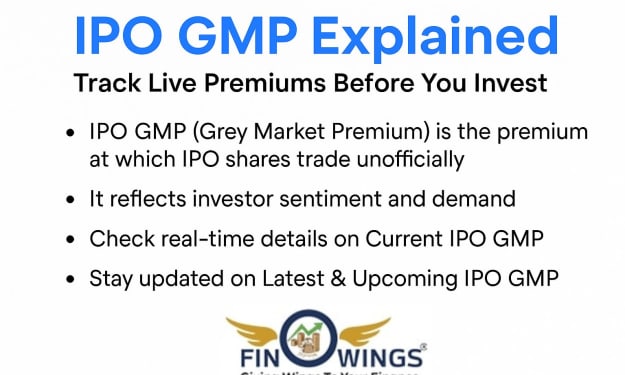
IPO GMP Live Today: Track Latest Grey Market Premiums & Updates
IPO GMP Explained: Track Live Premiums Before You Invest Introduction In recent years, the term IPO GMP has gained immense popularity among retail investors. Whether you're a beginner or a seasoned trader, understanding GMP (Grey Market Premium) is crucial before investing in any upcoming IPO. This provides a quick glimpse in the market spirit and helps predict the potential listing benefits.
By Sharad.finowings8 months ago in Trader
Blue Water Logistics IPO GMP Live: Price, Date, Allotment & Latest Updates 2025
Blue Water Logistics IPO: Price, Dates, GMP & Complete Details Introduction The IPO market is resonating again, and investors are closely watching on Blue Water Logistics IPO. As one of the latest SME IPOs in India, this issue has garnered attention not only for its fundamentals but also for its Blue Water Logistics IPO GMP updates. If you're tracking Blue Water Logistics GMP IPO, Blue Water Logistics IPO GMP Live, or simply want to understand the investment opportunity, here's a full breakdown.
By Sharad.finowings8 months ago in Trader
The stock market is over, and you should get out before Trump triggers
The stock market is over, and you should get out before Trump triggers a full-blown recession—that’s what the mainstream media wants you to think. Headlines are screaming disaster, social media is in a frenzy, and everyone is asking the same question: should I sell now before it gets worse? But there’s more to this than meets the eye. You know I’m a serious investor, obsessed with the stock market, and since many of you have started investing, I feel a responsibility to give you my opinion on this.
By Lomash Dhruv 8 months ago in Trader
Upcoming Dividend Stocks 2025 | Finowings Guide to Top High-Yield Picks
Upcoming Dividend Stocks 2025: Your Finowings Guide to High-Yield Investment Opportunities At Finowings, we believe that building long-term wealth doesn’t always require taking high risks — sometimes, consistency is king. And nothing reflects that better than dividend stocks. As we move deeper into FY 2025, investors are turning to upcoming dividend stocks for stable returns and income generation.
By Sharad.finowings8 months ago in Trader
Golden Cross: Marketplace Crossing in Cross Technical Trading. AI-Generated.
In the trading world, you can make money by opening both short and long positions. However, the number of bull traders is still higher. And why not? The profit potential with bullish trading strategies is greater.
By Beirman Capital8 months ago in Trader
The 90-Day Rush to Get Goods Out of China
**The Rush of 90 Days to Get Things Out of China** The clock is ticking for businesses that rely on manufacturing in China in the global race for supply chain security. Over the next 90 days, businesses around the world are rushing to move goods out of China in response to growing geopolitical tensions, increasing tariffs, and the unpredictable nature of international trade policies. The urgency is a reflection of a larger change in the way multinational corporations manage sourcing, production, and distribution in a global economy that is more volatile. China has been the world's manufacturing hub for decades thanks to its low costs, enormous industrial capacity, and unparalleled logistics network. However, recent developments have accelerated efforts to diversify supply chains. Companies are reevaluating their reliance on Chinese suppliers as a result of trade wars, the COVID-19 pandemic, and now worries about rising tensions between the United States and China. As a result, inventory must be shipped out of China in a frantic 90 days before new restrictions, tariffs, or political developments impede the flow of goods. The anticipation of rising trade barriers is one of the driving forces behind this rush. Many executives are concerned about the imposition of additional export controls or tariffs in light of the escalating rhetoric about China and the approaching elections in the United States. In an effort to stock up before costs rise or supply lines are disrupted, businesses are accelerating shipments to beat potential policy changes. In order to avoid delays and shortages in the near future, some businesses are choosing to overstock right now. Logistics and shipping companies are already feeling the effects. Freight companies report a surge in demand for cargo space, especially on trans-Pacific routes. Container shortages are reemerging, and port congestion is on the rise. Despite remaining lower than their peak during the pandemic, shipping costs are currently trending upward due to the increase in outbound volume from Chinese ports. Last-mile delivery networks, customs brokers, and warehouse operators are also under pressure as a result of this rush. The urgency stems not only from the current demand but also from the strategy for the long term. This window is being utilized by businesses to relocate manufacturing capacity to other nations like Vietnam, India, and Mexico. This process—often called “China +1”—involves building secondary supply chains outside China to mitigate future risk. However, this transition is time-consuming, expensive, and complicated. For many, the 90-day window is more about buying time to implement longer-term solutions than it is about fully moving operations. The automotive, electronics, and apparel industries are among the most affected. Because of their close ties to China, these industries are particularly challenging to decouple from. For instance, China continues to be a significant supplier of semiconductors and battery components in the electronics industry. Although assembly can be moved elsewhere, Chinese factories are still frequently used to obtain advanced components and raw materials. This makes it nearly impossible to exit in the short term, making it even more important to secure goods right away while alternatives are investigated. The uncertainty of policies makes things even more complicated. Export controls, like those that focus on rare earth materials or sensitive technologies, are becoming more common. In parallel, China has enacted new laws to safeguard its own economic interests, which may make it more difficult for foreign businesses to operate or exit without restriction. Global businesses place a high priority on contingency planning as a result of these factors. Inventory management is also being rethought by some businesses. The "just-in-time" model put efficiency and minimal storage first for years. However, the current environment has prompted many to implement a "just-in-case" strategy, which involves maintaining higher inventory levels to safeguard against disruptions. Better forecasting, more warehouse space, and more money invested in logistics infrastructure are all required for this shift. Despite the rush, not all companies are able to move quickly. Particularly, smaller businesses lack the resources necessary to move production or speed up shipments. They see the next 90 days as a test of their resilience in the face of geopolitical uncertainty as well as a logistical challenge. In order to assist smaller businesses in adapting, governments and industry associations may need to intervene with assistance or direction. The frenzied movement of goods out of China may signal a turning point in global trade in the future. It indicates a shift away from an excessive reliance on a single manufacturing hub and toward a supply network that is more diverse and resilient. The current frenzy demonstrates that businesses are no longer willing to place all of their bets on a single nation, despite the fact that China will likely continue to be a significant player in global commerce. The next 90 days could shape the next decade of global supply chain strategy.
By GLOBAL NEWS8 months ago in Trader
Mangui Kamal: The Bitcoin Strategist Who Beat the Cycles
**The Relentless Journey of Mangui Kamal: 8 Years in the Bitcoin Trenches** When Mangui Kamal first heard the word “Bitcoin,” it was late 2016. He was a 26-year-old financial analyst in Casablanca, Morocco, spending his days poring over spreadsheets for a multinational bank. It was a colleague who casually mentioned this “digital gold” while they were having coffee on a rainy afternoon.
By Kamal Mangui8 months ago in Trader
Trading Market Signals: How to Start Forex Trading - A Beginner’s Guide to Entering the Market
Trading Market Signals Understanding the Basics of Forex Trading Forex trading, also known as foreign exchange trading, is the process of buying and selling currencies in the global marketplace. It involves trading currency pairs such as EUR/USD, where traders speculate on whether the value of one currency will rise or fall relative to the other. Unlike traditional stock markets, the forex market operates 24 hours a day, five days a week, across major financial centers worldwide. This round-the-clock access makes it one of the most flexible and attractive markets for new traders.
By Emma Wegenast8 months ago in Trader
How to Manage your Money Like The 1%
How to Manage your Money Like The 1% Let me tell you something that will change your life if you let it sink in. The richest people in the world are 75% entrepreneurs, 15% investors, 7% inheritors of wealth, 3% athletes, entertainers, and artists, 0% employees who just earn a salary. So if you want to know how to manage your money like the 1%, you have to understand what those first four categories have in common. So let's think about it. Entrepreneurs own businesses. Investors own assets. Rich kids own trusts. Finally, athletes, entertainers, and
By Lomash Dhruv 8 months ago in Trader