
Service Robotics Market Trends & Summary: Automation Steps Into Everyday Life
From Hospitals to Hotels, How Intelligent Robots Are Reshaping Global Industries

Introduction: The Rise of Robots Beyond the Factory Floor
Once confined to factory assembly lines and high-security research labs, robots have now stepped into everyday human environments. From hospitals and warehouses to hotels, farms, and shopping centers, service robots are increasingly becoming part of daily operations. These machines are no longer just tools of industrial production—they are assistants, collaborators, and in some cases, frontline service providers.
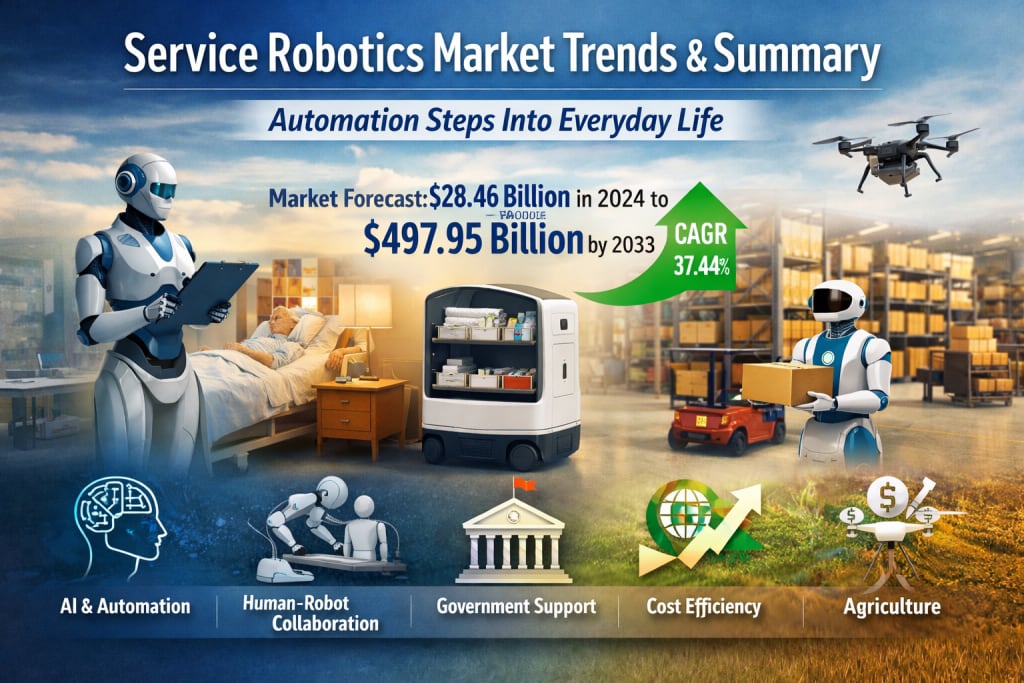
According to Renub Research, the Service Robotics Market is expected to reach US$ 497.95 billion by 2033, up from US$ 28.46 billion in 2024, growing at an impressive CAGR of 37.44% from 2025 to 2033. This extraordinary growth highlights how rapidly automation, artificial intelligence (AI), and robotics are transforming service-based industries worldwide.
The main forces behind this surge include the rising need for automation, cost-effectiveness across regions, and continuous technological advancements. Businesses are under pressure to improve efficiency, reduce labor shortages, and deliver faster, more consistent services—conditions that make service robots an increasingly attractive solution.
What Are Service Robots and Why Do They Matter?
Service robots are designed to perform useful tasks for humans or equipment, excluding industrial automation on factory floors. These robots operate in diverse environments such as hospitals, hotels, warehouses, farms, and even private homes. Their roles range from cleaning floors and delivering goods to assisting in surgeries and monitoring patients.
In healthcare, robots support surgeons with precision procedures, help nurses with routine tasks, and assist elderly patients with daily activities. In hospitality, robots are being deployed for room service delivery, cleaning, and customer interaction. In logistics, autonomous mobile robots (AMRs) handle inventory movement, picking, and sorting with remarkable speed and accuracy.
What makes today’s service robots different from earlier generations is their integration with AI, machine learning, computer vision, and advanced sensors. These technologies allow robots not only to perform tasks, but also to learn, adapt, and operate safely alongside humans.
A Market on Fast-Forward: Global Industry Overview
The global service robotics industry has witnessed rapid expansion over the past few years, driven by breakthroughs in robotics engineering, AI software, and automation systems. Companies across sectors are embracing robots to improve productivity, reduce operational costs, and maintain consistent service quality.
Another major trend is the rise of collaborative robots (cobots)—machines specifically designed to work safely in shared spaces with humans. Unlike traditional industrial robots that require isolation behind safety cages, cobots are equipped with sensors and intelligent control systems that allow them to detect human presence and avoid accidents. This has opened the door for wider adoption in sectors such as healthcare, logistics, retail, and hospitality.
Leading players like iRobot, ABB, SoftBank Robotics, KUKA, and Intuitive Surgical continue to push innovation by launching robots with advanced features such as voice recognition, machine learning capabilities, and cloud-based connectivity.
However, the industry is not without challenges. High initial investment costs, regulatory and safety concerns, and the need for skilled personnel to manage and maintain robotic systems remain key barriers. Despite these obstacles, the long-term outlook remains strongly positive, especially in regions such as North America, Europe, and Asia-Pacific.
Robotics-as-a-Service (RaaS) and the AMR Boom
One of the most transformative trends in the service robotics ecosystem is the rise of Robotics-as-a-Service (RaaS). Instead of purchasing robots outright, businesses can now subscribe to robotic solutions, paying monthly or usage-based fees. This model significantly lowers the entry barrier, especially for small and medium-sized enterprises (SMEs).
At the heart of this shift is the growing adoption of Autonomous Mobile Robots (AMRs), particularly in logistics and warehousing. AMRs are widely used for tasks such as inventory management, order picking, sorting, and internal transportation. They help companies cut operational costs, improve efficiency, and address labor shortages.
The expansion of e-commerce and the demand for faster delivery times have further accelerated AMR adoption. A notable example is Zetes’ acquisition of a 50% stake in Robotize in October 2024, aimed at strengthening logistics automation and tackling workforce challenges through AMR deployment.
With flexible pricing models and rapid return on investment, RaaS and AMRs are becoming major growth engines for the service robotics market.
Key Growth Drivers of the Service Robotics Market
1. Advancements in AI and Automation
Artificial intelligence, machine learning, and automation technologies are at the core of modern service robots. AI enables robots to process vast amounts of data, recognize patterns, and make real-time decisions, while machine learning allows them to improve performance over time.
Automation reduces human error, increases consistency, and allows robots to perform repetitive or labor-intensive tasks with high precision. As these technologies continue to evolve, service robots are becoming more versatile and capable, expanding their use across healthcare, hospitality, retail, logistics, and agriculture.
2. Improved Human-Robot Collaboration
The emergence of collaborative robots (cobots) has changed how robots are integrated into workplaces. Designed to operate safely alongside humans, cobots are equipped with advanced sensors and safety mechanisms that allow close interaction without protective barriers.
This makes them especially valuable in environments where humans and robots must work together, such as hospitals, warehouses, and manufacturing support roles. By taking over physically demanding or repetitive tasks, robots allow human workers to focus on higher-value, more complex activities, boosting overall productivity.
3. Government Support and Investment
Governments around the world are actively promoting robotics and automation to enhance productivity and global competitiveness. Through grants, subsidies, tax incentives, and policy frameworks, public authorities are encouraging companies to adopt service robots and invest in R&D.
Initiatives like Industry 4.0 in Europe and similar digital transformation programs in Asia and North America are accelerating the deployment of robotics in sectors such as manufacturing, logistics, and healthcare. These efforts not only stimulate innovation but also help address labor shortages and demographic challenges, particularly in aging societies.
Challenges Facing the Service Robotics Industry
1. Regulatory and Safety Concerns
As robots increasingly operate in close proximity to humans, safety becomes a critical issue. Regulatory bodies must ensure that robots meet strict standards related to design, operation, and human interaction. This is particularly important in sensitive sectors like healthcare, logistics, and public spaces.
Regulations must continuously evolve to keep pace with technological advancements, ensuring that robots remain safe, reliable, and trustworthy. Compliance with these standards can increase development costs and slow down market entry for new products.
2. Public Perception and Acceptance
Another major challenge is public concern about job displacement. Many workers fear that automation and robotics could replace human labor, leading to economic uncertainty. This perception can slow down adoption, especially in labor-intensive industries.
Overcoming this resistance requires education, transparency, and clear communication about how robots can complement rather than replace human workers. When positioned correctly, service robots can enhance workplace safety, reduce workload stress, and create new opportunities for higher-skilled jobs.
Regional Market Insights
United States
The U.S. service robotics market is expanding rapidly, driven by strong investments in AI, robotics, and automation. Key sectors such as healthcare, logistics, hospitality, and retail are adopting robots for cleaning, delivery, patient care, and inventory management.
An aging population and workforce shortages, especially in healthcare, are major demand drivers. Collaborative robots are also gaining traction, improving human-robot interaction across industries. However, high upfront costs, safety concerns, and public perception still influence the pace of adoption.
Germany
Germany’s strong industrial base and focus on Industry 4.0 have made it a leading market for service robotics in Europe. Robots are increasingly used in healthcare, logistics, agriculture, and hospitality for tasks such as patient assistance, cleaning, delivery, and inventory management.
The country’s aging population and emphasis on automation continue to drive demand. While challenges like high investment costs and regulatory requirements remain, strong government support and technological innovation keep the market on a solid growth path.
India
India’s service robotics market is gaining momentum as businesses seek automation to improve efficiency and address labor shortages. Key application areas include healthcare, hospitality, logistics, and retail, where robots are used for cleaning, delivery, inventory control, and patient monitoring.
Despite strong potential, adoption is slowed by high initial costs, skill gaps, and regulatory hurdles. However, India’s rapidly evolving tech ecosystem and supportive government initiatives are expected to accelerate growth in the coming years.
Saudi Arabia
Saudi Arabia’s Vision 2030 strategy, focused on economic diversification and technological advancement, is fueling the adoption of service robots. The healthcare, hospitality, logistics, and retail sectors are key beneficiaries, using robots for patient care, cleaning, and service delivery.
Investments in smart cities and advanced technologies further support market growth. While challenges such as cost and workforce readiness remain, government-backed initiatives continue to push the industry forward.
Service Robotics Market Segmentation
By Application (Market & Volume):
Transportation & Logistics
Professional Cleaning
Medical Robotics
Hospitality
Agriculture & Field
By Region:
America: United States, Canada, Mexico, Others
Europe: France, Germany, Italy, Spain, Others
Asia Pacific: China, India, Japan, Republic of Korea, Thailand, Others
Rest of the World
Competitive Landscape and Company Analysis
The market features several global leaders, each analyzed across:
Overview
Key Persons
Recent Developments & Strategies
Financial Insights
Key Companies Include:
KUKA
iRobot Corporation
Intuitive Surgical, Inc.
Panasonic Corporation
Fanuc
ABB Ltd
Stryker Corporation
These players are continuously investing in R&D, strategic partnerships, and new product launches to strengthen their positions in a rapidly evolving market.
Final Thoughts: A Robotic Future, Closer Than We Think
The service robotics market is no longer a futuristic concept—it is a present-day reality reshaping industries worldwide. With the market projected to surge from US$ 28.46 billion in 2024 to US$ 497.95 billion by 2033, the scale of transformation is undeniable.
Driven by AI, automation, supportive government policies, and innovative business models like RaaS, service robots are set to become an integral part of modern economies. While challenges around regulation, costs, and public perception remain, the long-term benefits in efficiency, safety, and productivity are simply too compelling to ignore.
About the Creator
Philippines Canned Food Market 2026: Convenience Eating, Shelf-Stable Demand & Product Innovation
Philippines Canned Food Market Overview The Philippines canned food market continues to play a vital role in household food consumption, offering convenient, affordable and long-lasting meal options for millions of consumers. Canned food products include canned meat, seafood, vegetables, fruits, soups, ready meals and sauces that can be stored for extended periods without refrigeration. In a country where busy urban lifestyles coexist with income-sensitive households, canned food provides a reliable solution for quick meal preparation and emergency food stockpiling.
By Manisha Dixit7 days ago in Trader
United Arab Emirates Foodservice Market Size and Forecast 2025–2033
United Arab Emirates Foodservice Market Overview Foodservice refers to the preparation, serving, and sale of food for consumption outside the home. This includes restaurants, cafés, quick-service outlets, catering services, food trucks, and an increasingly important category—cloud kitchens and delivery-only brands. In the UAE, foodservice is not merely a support industry; it is a central pillar of urban lifestyle, tourism, and hospitality.
By shibansh kumar3 days ago in Trader
When True Love Never Questions Your Soul
“And she’s going to learn that this life will hit you, hard, in the face, wait for you to get back up, just so it can kick you in the stomach but getting the wind knocked out of you is the only way to remind your lungs how much they like the taste of air.” — Sarah Kay’s Poem — If I Should Have a Daughter
By Chantal Christie Weiss3 days ago in Humans



Comments
There are no comments for this story
Be the first to respond and start the conversation.