
Industrial Robotics Market Trends & Summary (2025–2033)
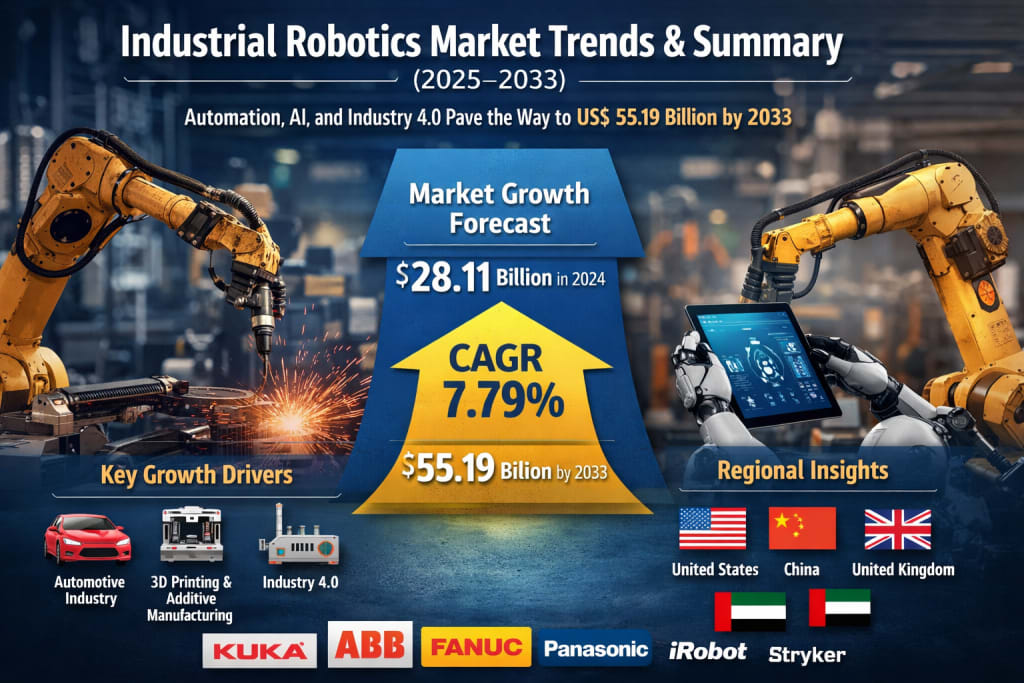
Automation, AI, and Industry 4.0 Push the Global Industrial Robotics Market Toward US$ 55.19 Billion by 2033

Introduction: A New Age of Smart Manufacturing
The global manufacturing landscape is undergoing a profound transformation, and at the heart of this change lies industrial robotics. From automotive assembly lines to food processing plants and electronics factories, robots are no longer a futuristic concept—they are a core pillar of modern production systems. According to Renub Research, the Industrial Robotics Market is expected to reach US$ 55.19 billion by 2033, up from US$ 28.11 billion in 2024, growing at a compound annual growth rate (CAGR) of 7.79% from 2025 to 2033.
This steady expansion reflects the rising need for efficiency, precision, safety, and scalability in manufacturing. Industries across the globe are increasingly turning to automation to address labor shortages, reduce operational costs, improve product quality, and remain competitive in an increasingly globalized market. As technologies such as artificial intelligence (AI), machine learning (ML), the Internet of Things (IoT), and advanced sensors mature, industrial robots are becoming smarter, more flexible, and more collaborative than ever before.
Industrial Robotics Industry Overview
Recent developments in automation technology, artificial intelligence, and machine learning have propelled the industrial robotics sector into a new phase of growth. Today’s industrial robots are widely used for tasks such as assembly, welding, painting, packaging, and material handling across industries including automotive, electronics, consumer goods, food and beverages, and pharmaceuticals.
One of the key advantages of industrial robots is their ability to deliver high precision, consistent quality, and operational efficiency while working in environments that may be hazardous for human workers. Robots can operate continuously with minimal downtime, helping manufacturers increase output and stabilize production quality. At the same time, automation reduces dependency on manual labor, which is becoming increasingly scarce and expensive in many parts of the world.
The growing adoption of smart factories is another major force shaping the industry. By integrating robots with IoT platforms, cloud computing, and data analytics, manufacturers can monitor performance in real time, predict maintenance needs, and optimize production workflows. Collaborative robots, or cobots, are also gaining traction, as they are designed to work safely alongside human operators, combining human judgment with robotic precision.
The industrial robotics sector is no longer limited to large automotive plants. Its footprint is expanding into logistics, food processing, life sciences, semiconductors, and even construction, proving that robotics is becoming a universal productivity tool rather than a niche industrial asset.
Market Momentum Driven by Global Policy and Industry 4.0
The market’s expansion has been strongly supported by regional investments in automation and the rapid adoption of Industry 4.0 principles. For example, China’s “Made in China 2025” initiative aims to modernize the country’s manufacturing base by emphasizing innovation, quality, and advanced technologies such as robotics and AI. Similar strategies can be seen across Europe, North America, and parts of Asia-Pacific, where governments and industries are actively promoting digital transformation in manufacturing.
Industry 4.0 has introduced a new era of connected, intelligent production systems. In this environment, robots are not just standalone machines—they are integrated components of digital ecosystems that include sensors, software platforms, and data-driven decision tools. This shift allows manufacturers to reduce errors, streamline operations, and significantly boost productivity.
The International Federation of Robots (IFR) estimates that collaborative robots could account for around 34% of all robot sales by 2025, highlighting how human-robot collaboration is reshaping factory floors. Meanwhile, major technology-driven manufacturers, including those in the semiconductor and electronics sectors, are increasingly relying on advanced robotics to meet the demands of precision, speed, and scale.
Key Growth Drivers in the Industrial Robotics Market
1. Increasing Use in the Automobile Industry
The automotive sector remains one of the largest and most influential adopters of industrial robotics. Robots play a crucial role in welding, painting, assembly, and material handling—tasks that require extreme precision and repeatability. In welding operations, for example, robots ensure consistent quality in spot, arc, and laser welding, which is essential for vehicle safety and structural integrity.
In December 2023, Volvo Cars deployed more than 1,300 ABB robots across its plants in China and Sweden to perform tasks such as riveting and spot welding. These modular robots, including models like the IRB 6710, 6720, and 6730, offer flexible payload capacities and sizes, making them suitable for diverse automotive applications.
Similarly, in May 2023, BMW introduced an AI-controlled robotic system to process and inspect painted car surfaces, improving quality control while reducing lead times. Such developments highlight how automotive manufacturers continue to push the boundaries of automation, directly boosting demand in the industrial robotics market.
2. Growing Integration of 3D Printing and Additive Manufacturing
The convergence of industrial robotics with 3D printing and additive manufacturing (AM) is opening up new growth avenues. Robots equipped with extrusion or deposition heads can precisely lay down materials such as metals, ceramics, and thermoplastics layer by layer, enabling the production of complex geometries and customized components.
In November 2023, ADDitec introduced the AMDroid laser-wire DED deployable robotic system, designed for high deposition rates in mass production, particularly for titanium applications. This innovation demonstrates how robotics is becoming central to advanced manufacturing techniques that go beyond traditional subtractive processes.
Construction is another emerging area. In January 2024, RIC Technology launched the RIC-M1 PRO robotic printer for construction, offering time-saving and cost-effective solutions for building large structures such as panels and walls on-site. These applications show that industrial robotics is no longer confined to factory floors—it is becoming a key enabler across multiple sectors, further strengthening market growth prospects.
3. Rising Adoption of Industry 4.0
Industry 4.0 is fundamentally reshaping how factories operate, and industrial robots are at the core of this transformation. Connected, data-driven, and increasingly autonomous, modern robots are designed to integrate seamlessly with other machines, software platforms, and control systems.
For instance, in February 2024, KUKA AG launched the KR FORTEC robot, featuring a reach of 145 inches and a payload capacity of 529 pounds, making it suitable for energy-efficient operations such as welding and heavy material handling. At the same time, human-robot collaboration is gaining momentum, particularly with cobots that assist workers in repetitive or physically demanding tasks while humans focus on more complex responsibilities.
In another notable development, Figure and BMW partnered in February 2024 to deploy humanoid robots, further underlining how advanced robotics is moving closer to mainstream industrial use. These trends collectively reinforce the role of robotics as a cornerstone of smart manufacturing.
Challenges Facing the Industrial Robotics Market
High Initial Costs
Despite the long-term benefits, the high upfront cost of industrial robots remains a significant barrier, especially for small and medium-sized enterprises (SMEs). Beyond the purchase price, companies must also account for installation, calibration, integration, and ongoing maintenance expenses.
For many SMEs, these financial requirements can be difficult to justify, even if automation promises productivity gains over time. The need for specialized expertise to integrate robots into existing systems further increases the total cost of ownership. As a result, cost concerns continue to slow the broader adoption of industrial robotics in certain segments of the market.
Skilled Labor Shortage
Another major challenge is the shortage of skilled professionals capable of programming, operating, and maintaining advanced robotic systems. As robotics technology becomes more sophisticated, the demand for expertise in automation, software, and systems integration is rising faster than the supply of trained workers.
This skills gap creates operational bottlenecks for companies looking to fully leverage their investments in robotics. To address this issue, many organizations are investing in specialized training programs or partnering with educational institutions. However, bridging this gap will take time and coordinated effort across industry and academia.
Regional Market Insights
United States Industrial Robotics Market
The United States industrial robotics market is experiencing strong growth, driven by the adoption of Industry 4.0 technologies, rising demand for efficiency, and ongoing automation across sectors such as automotive, electronics, and consumer goods. Robots are widely used for material handling, welding, and assembly, while cobots are gaining popularity for enabling safer human-robot collaboration.
Key growth drivers include labor shortages, pressure to reduce manufacturing costs, and the need for higher productivity. Government support for innovation and manufacturing modernization is also encouraging investment in robotics. However, high initial costs and the need for skilled personnel remain notable challenges to widespread adoption.
United Kingdom Industrial Robotics Market
In the UK, the demand for industrial robots is increasing across industries such as automotive, electronics, and pharmaceuticals. Companies are adopting robotics to improve efficiency, cut labor costs, and boost productivity. Collaborative robots are particularly popular, as they allow safe and flexible interaction between humans and machines.
Labor shortages and the need for greater speed and precision in production are key factors driving market growth. Government initiatives promoting advanced manufacturing and digital transformation further support this trend. Still, high upfront costs, training requirements, and concerns about job displacement continue to influence the pace of adoption.
China Industrial Robotics Market
China represents one of the largest and fastest-growing industrial robotics markets in the world. As a global manufacturing hub, the country is rapidly adopting robots in automotive, electronics, and consumer goods industries to enhance efficiency, reduce labor costs, and improve product quality.
Strong government support, including initiatives like “Made in China 2025,” has accelerated innovation and deployment of robotics technologies. Collaborative robots are also gaining traction due to their flexibility and ability to work alongside human employees. Nevertheless, challenges such as high costs, skill shortages, and system integration issues still need to be addressed for broader adoption.
United Arab Emirates Industrial Robotics Market
In the UAE, the push for economic diversification and technological innovation is driving rapid growth in the industrial robotics market. The country is investing heavily in sectors such as construction, logistics, and automotive, where robotics can significantly improve productivity and reduce reliance on manual labor.
Government programs like UAE Vision 2021 emphasize advanced manufacturing technologies, including robotics. The growing use of cobots is also enhancing workplace safety and efficiency. However, high initial costs, the need for specialized labor, and integration challenges remain key hurdles for the market.
Market Segmentation Overview
By Industry & Volume
The Industrial Robotics Market & Volume is analyzed across the following segments:
Automotive Industry and Forecast
Electrical and Electronics Industry and Forecast
Metal and Machinery Industry and Forecast
Plastic and Chemical Products
Food Industry and Forecast
Others
By Region and Countries
America:
United States
Canada
Mexico
Others
Europe:
France
Germany
Italy
Spain
Others
Asia Pacific:
China
India
Japan
Republic of Korea
Thailand
Others
Rest of the World
Competitive Landscape and Company Analysis
Key players in the industrial robotics market are analyzed across four dimensions:
Overview
Key Persons
Recent Developments & Strategies
Financial Insights
Major companies covered include:
KUKA
iRobot Corporation
Intuitive Surgical, Inc.
Panasonic Corporation
Fanuc
ABB Ltd
Stryker Corporation
These companies are actively investing in R&D, expanding their product portfolios, and forming strategic partnerships to strengthen their market positions and meet the evolving needs of global manufacturers.
Final Thoughts
The industrial robotics market is entering a decisive decade. With the market projected to grow from US$ 28.11 billion in 2024 to US$ 55.19 billion by 2033, at a CAGR of 7.79%, robotics is set to become an even more integral part of global manufacturing. Driven by Industry 4.0, AI integration, automotive demand, and the rise of additive manufacturing, industrial robots are no longer just tools for efficiency—they are strategic assets for competitiveness and innovation.
While challenges such as high initial costs and skilled labor shortages persist, the long-term trajectory remains firmly positive. As technology continues to evolve and adoption spreads across more industries and regions, industrial robotics will play a central role in shaping the future of smart, connected, and resilient manufacturing worldwide.
About the Creator
United States Diabetes Market Size, Trends, Growth & Forecast 2034
United States Diabetes Market Overview The United States diabetes market is expanding steadily due to the rising prevalence of diabetes, increasing awareness about early diagnosis, and continuous advancements in treatment and monitoring technologies. Diabetes remains one of the most common chronic diseases in the country, affecting millions of individuals across different age groups. Sedentary lifestyles, unhealthy dietary habits, obesity, and genetic predisposition are major factors contributing to the growing patient population.
By Kim Soo hyunabout 12 hours ago in Trader
Compressor Rental Market Expands with Rising Industrial and Infrastructure Demand
Compressor Rental Market Overview The Compressor Rental Market involves the temporary leasing of air compressors used across various industrial and commercial applications. These compressors play a crucial role in powering equipment, supporting construction activities, and maintaining operations in sectors such as oil and gas, mining, power generation, and manufacturing. Rental services provide businesses with cost-effective and flexible solutions, eliminating the need for large capital investments and long-term maintenance responsibilities. The market is gaining traction due to increasing infrastructure development, industrial expansion, and growing demand for energy-efficient equipment. Additionally, companies are focusing on providing customized rental solutions, advanced compressor technologies, and improved service support to meet diverse industry requirements.
By James Smith2 days ago in Trader



Comments
There are no comments for this story
Be the first to respond and start the conversation.