
Saudi Arabia Smart Hospital Market Size and Forecast 2025–2033
How Vision 2030, AI, IoT, and Digital Health Are Transforming the Kingdom’s Healthcare Landscape

Introduction
Saudi Arabia is undergoing one of the most ambitious healthcare transformations in the Middle East, driven by the Kingdom’s Vision 2030 agenda and a strong commitment to digital innovation. At the center of this change is the rapid rise of smart hospitals—technology-enabled healthcare facilities that integrate artificial intelligence (AI), the Internet of Things (IoT), electronic health records (EHRs), robotics, telemedicine, and advanced connectivity to improve patient outcomes and operational efficiency.
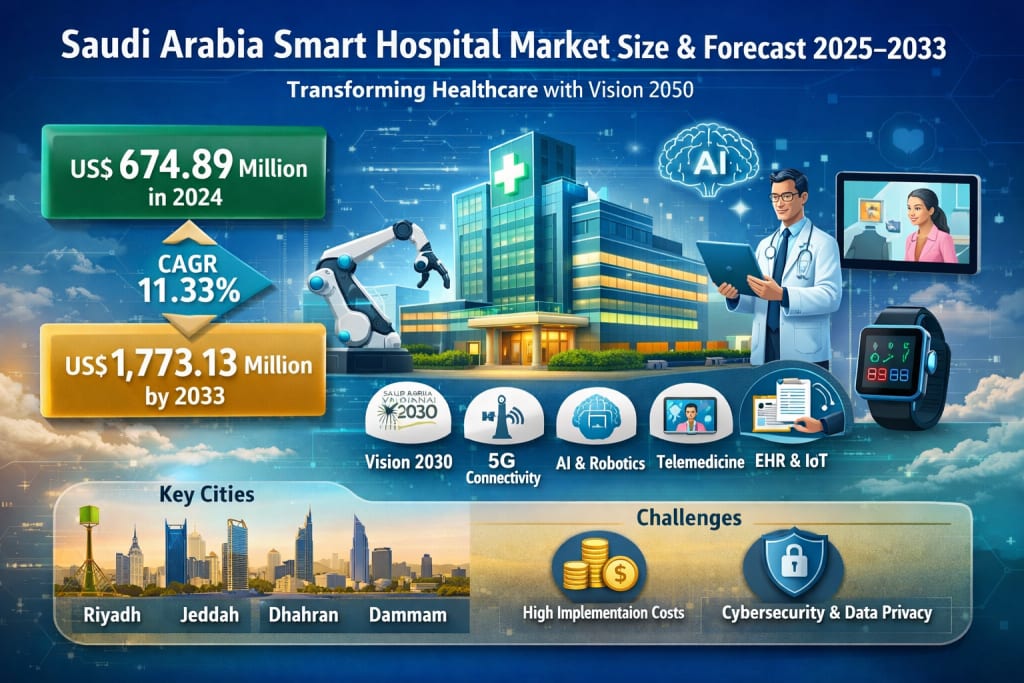
According to Renub Research, the Saudi Arabia Smart Hospital Market is expected to grow from US$ 674.89 million in 2024 to US$ 1,773.13 million by 2033, registering a strong compound annual growth rate (CAGR) of 11.33% during 2025–2033. This impressive expansion is being fueled by government-backed digital health initiatives, rising chronic disease prevalence, growing adoption of EHRs and connected devices, the rollout of 5G, and increasing reliance on AI-assisted diagnostics, robotic surgery, telemedicine, and remote patient monitoring.
As healthcare systems worldwide move toward more data-driven and patient-centric models, Saudi Arabia is positioning itself as a regional leader in smart healthcare infrastructure. The smart hospital market is no longer a futuristic concept in the Kingdom—it is rapidly becoming the new standard of care.
Saudi Arabia Smart Hospital Market Overview
Smart hospitals represent a fundamental shift in how healthcare services are delivered. Instead of relying solely on traditional clinical workflows, these hospitals leverage interconnected digital systems to enhance diagnosis, treatment, monitoring, and administration. In Saudi Arabia, this shift is closely aligned with the government’s broader goal of building a technology-driven, efficient, and sustainable healthcare system.
The adoption of smart technologies is visible across both public and private healthcare facilities. Hospitals are increasingly implementing EHR platforms, AI-based diagnostic tools, smart imaging systems, automated pharmacy solutions, robotic surgery platforms, and IoT-enabled patient monitoring devices. These tools not only improve clinical accuracy and speed but also reduce administrative burdens on healthcare professionals.
Another important aspect of Saudi Arabia’s smart hospital strategy is sustainability and resource optimization. New healthcare facilities are being designed with energy-efficient systems, smart building management technologies, and data-driven resource planning. This ensures that digital transformation goes hand in hand with long-term operational efficiency and environmental responsibility.
With continuous investments in healthcare infrastructure and digital platforms, the Saudi Arabia smart hospital industry is expected to play a critical role in improving access to care, enhancing patient safety, and supporting the Kingdom’s ambition to become a global hub for healthcare innovation.
Key Factors Driving the Saudi Arabia Smart Hospital Market
Government Support and Vision 2030
One of the strongest growth drivers of the smart hospital market in Saudi Arabia is the government’s Vision 2030 reform agenda. Healthcare transformation is a core pillar of this strategy, with the Health Sector Transformation Program focusing on building an integrated, high-quality, and sustainable healthcare system.
Through targeted funding, regulatory reforms, and public-private partnerships, the government is actively encouraging hospitals to adopt digital technologies. Initiatives include the expansion of digital health platforms, promotion of telemedicine services, nationwide implementation of EHR systems, and investment in advanced medical technologies such as AI and robotics.
In addition, the government is focusing on workforce training and capacity building to ensure that healthcare professionals are equipped to work in digitally advanced environments. These coordinated efforts are accelerating the transition toward smart hospitals and strengthening Saudi Arabia’s position as a regional leader in digital healthcare.
Modernization of Healthcare Infrastructure
Saudi Arabia is investing heavily in modernizing its healthcare infrastructure, which is a key enabler of smart hospital development. Existing hospitals are being upgraded with advanced medical equipment, digital information systems, and automated workflows, while new facilities are being designed from the ground up as fully integrated smart hospitals.
This modernization includes the deployment of cloud-based hospital management systems, AI-powered diagnostic tools, robotic surgical systems, smart imaging solutions, and IoT-connected devices for real-time patient monitoring. The introduction of 5G connectivity further enhances the ability of hospitals to transmit large volumes of medical data quickly and securely.
The primary objectives of these upgrades are to reduce operational inefficiencies, improve patient safety, enhance clinical decision-making, and optimize resource utilization. As healthcare demand continues to rise due to population growth and urbanization, modern smart hospital infrastructure is becoming essential for maintaining high standards of care across the Kingdom.
Growing Adoption of Digital Health Solutions
Digital health is playing a transformative role in Saudi Arabia’s healthcare ecosystem. The widespread adoption of electronic health records (EHRs) has significantly improved data accessibility, care coordination, and continuity of treatment across healthcare facilities.
Telemedicine platforms have also gained strong momentum, especially for remote consultations, chronic disease management, and follow-up care. These services are particularly valuable in improving access to healthcare for patients in remote or underserved regions.
In addition, mobile health applications now allow patients to book appointments, access medical records, monitor health metrics, and receive personalized health guidance. Artificial intelligence is increasingly being used for clinical decision support, diagnostic imaging analysis, predictive analytics, and risk assessment, enabling a shift from reactive to proactive healthcare delivery.
Together, these digital health solutions are creating a more connected, efficient, and patient-centric healthcare system—one that forms the backbone of the smart hospital model in Saudi Arabia.
Challenges in the Saudi Arabia Smart Hospital Market
High Costs of Implementation
Despite strong growth prospects, the transition to smart hospitals requires substantial financial investment. The costs associated with deploying advanced medical technologies, digital infrastructure, automation systems, and cybersecurity frameworks can be significant.
Implementing AI platforms, EHR systems, telemedicine solutions, and IoT devices also involves ongoing expenses related to software upgrades, system maintenance, staff training, and technical support. For smaller hospitals or private healthcare providers with limited budgets, these costs can be a major barrier.
Although smart hospital investments typically deliver long-term benefits in terms of efficiency and quality of care, the return on investment is often gradual, which can slow down adoption in certain segments of the market.
Cybersecurity and Data Privacy Risks
As healthcare becomes increasingly digitized, cybersecurity and data privacy have emerged as critical concerns. Smart hospitals rely on interconnected systems, cloud platforms, and networked medical devices, all of which can become potential targets for cyberattacks.
Protecting sensitive patient data requires continuous investment in encryption technologies, firewalls, multi-factor authentication, and real-time threat detection systems. The evolving nature of cyber threats and the lack of uniform security standards across healthcare facilities further increase vulnerability.
Any breach of patient data can lead to legal consequences, financial losses, and erosion of public trust. Addressing these risks is essential to ensuring the long-term success and credibility of smart hospital initiatives in Saudi Arabia.
Saudi Arabia Smart Hospital Market Regional Analysis
The adoption of smart hospital technologies is strongest in major urban centers such as Riyadh, Jeddah, Dammam, and Dhahran, where government investment, advanced infrastructure, and leading healthcare institutions are driving innovation.
Dhahran Smart Hospital Market
Dhahran’s smart healthcare ecosystem is anchored by Johns Hopkins Aramco Healthcare (JHAH), a leading multispecialty hospital serving Saudi Aramco employees and their families. JHAH has been at the forefront of digital transformation, introducing initiatives such as Epic Dorothy to streamline home healthcare workflows and reduce administrative burdens.
The hospital has also pioneered AI-supported medical imaging for early detection of cardiac risks in cancer patients and has been a regional leader in robotic-assisted surgeries, including minimally invasive colorectal and advanced urological procedures. With international accreditations and continuous technology upgrades, JHAH sets a strong benchmark for smart hospital adoption in the Eastern Province.
Riyadh Smart Hospital Market
Riyadh stands out as one of the Kingdom’s most important smart hospital hubs. King Faisal Specialist Hospital & Research Centre (KFSHRC) has gained global recognition, being named among Newsweek’s “World’s Best Smart Hospitals 2025.”
KFSHRC has implemented more than 20 AI applications through its Centre for Healthcare Intelligence, established an AI-powered Patient Flow & Capacity Command Centre, and introduced advanced digital imaging, robotics, and immersive simulation training. Riyadh is also home to the Seha Virtual Hospital, the world’s largest virtual hospital, which connects over 224 hospitals and delivers dozens of specialized services through remote care platforms.
Jeddah Smart Hospital Market
Jeddah is rapidly emerging as a major smart healthcare center. The International Medical Center (IMC) has led digital transformation through its “Digital Door” strategy, introducing AI-powered applications to enhance patient engagement and streamline clinical workflows.
In addition, King Faisal Specialist Hospital & Research Centre (Jeddah) has achieved notable milestones, including performing the first fully robotic liver transplant in the western region. New facilities such as Andalusia New Hospital are also integrating robotic surgery and smart room technologies, reinforcing Jeddah’s role in the Kingdom’s digital health revolution.
Market Segmentation
By Artificial Intelligence:
Offering
Technology
Applications
By Components:
Hardware
System and Software
Services
By Connectivity:
Wired
Wireless
By Application:
Outpatient Vigilance
Electronic Health Record & Clinical Workflow
Remote Medicine Management
Medical Connection Imaging
By States:
Dhahran
Riyadh
Khobar
Jeddah
Dammam
Others
Competitive Landscape and Company Analysis
The Saudi Arabia smart hospital market features several leading global and regional players focusing on innovation, partnerships, and technology integration. Key companies covered include:
Koninklijke Philips N.V.
Medtronic Plc
SAP SE
Cerner Corporation
Schneider Electric Healthcare
These companies are actively involved in product development, digital platform expansion, AI integration, and strategic collaborations with healthcare providers across the Kingdom. Their offerings span medical imaging, hospital information systems, connected devices, data analytics platforms, and smart infrastructure solutions, all of which are critical to the growth of the smart hospital ecosystem.
Final Thoughts
The Saudi Arabia Smart Hospital Market is on a strong growth trajectory, expanding from US$ 674.89 million in 2024 to an expected US$ 1,773.13 million by 2033, driven by a robust CAGR of 11.33%. Backed by Vision 2030, rapid digitalization, AI adoption, 5G connectivity, and increasing demand for efficient, patient-centered care, smart hospitals are reshaping the future of healthcare in the Kingdom.
While challenges such as high implementation costs and cybersecurity risks remain, the long-term benefits of improved efficiency, better clinical outcomes, and enhanced patient experiences far outweigh these hurdles. As investments continue and technologies mature, Saudi Arabia is well on its way to becoming a regional and global leader in smart healthcare innovation.
About the Creator
Tom Shane
Tom Shane is a content writer specializing in SEO-driven blogs, product descriptions, and thought leadership. He crafts engaging, research-backed content that connects with audiences and drives results.
Dow Jones Industrial Average Insight: Quiet Market Pressure Building Beneath the Surface
Dow Jones Industrial Average activity often looks calm before major change appears. Right now, the Dow Jones Industrial Average is moving without strong direction, but hidden pressure is building. Many investors overlook these quiet signals and only react when prices move fast. Understanding what the Dow Jones Industrial Average is showing today can help investors stay one step ahead.
By John.doe7984 days ago in Trader
Blessed 33
So I woke up on the morning of February 5, 2026 and guess what and you know what I realized? It’s my 33rd birthday. Do you know what that means? Yes, technically I’m getting old, but what I couldn’t have guessed was this would be one of the best days of my life.
By Joe Pattersonabout 24 hours ago in Confessions


Comments
There are no comments for this story
Be the first to respond and start the conversation.