
Respiratory Care Devices Market Size and Forecast 2026–2034
Rising Respiratory Disorders, Home Healthcare Adoption, and Smart Medical Technologies Drive the Next Phase of Global Market Expansion

Introduction: Breathing Life into a Growing Global Market
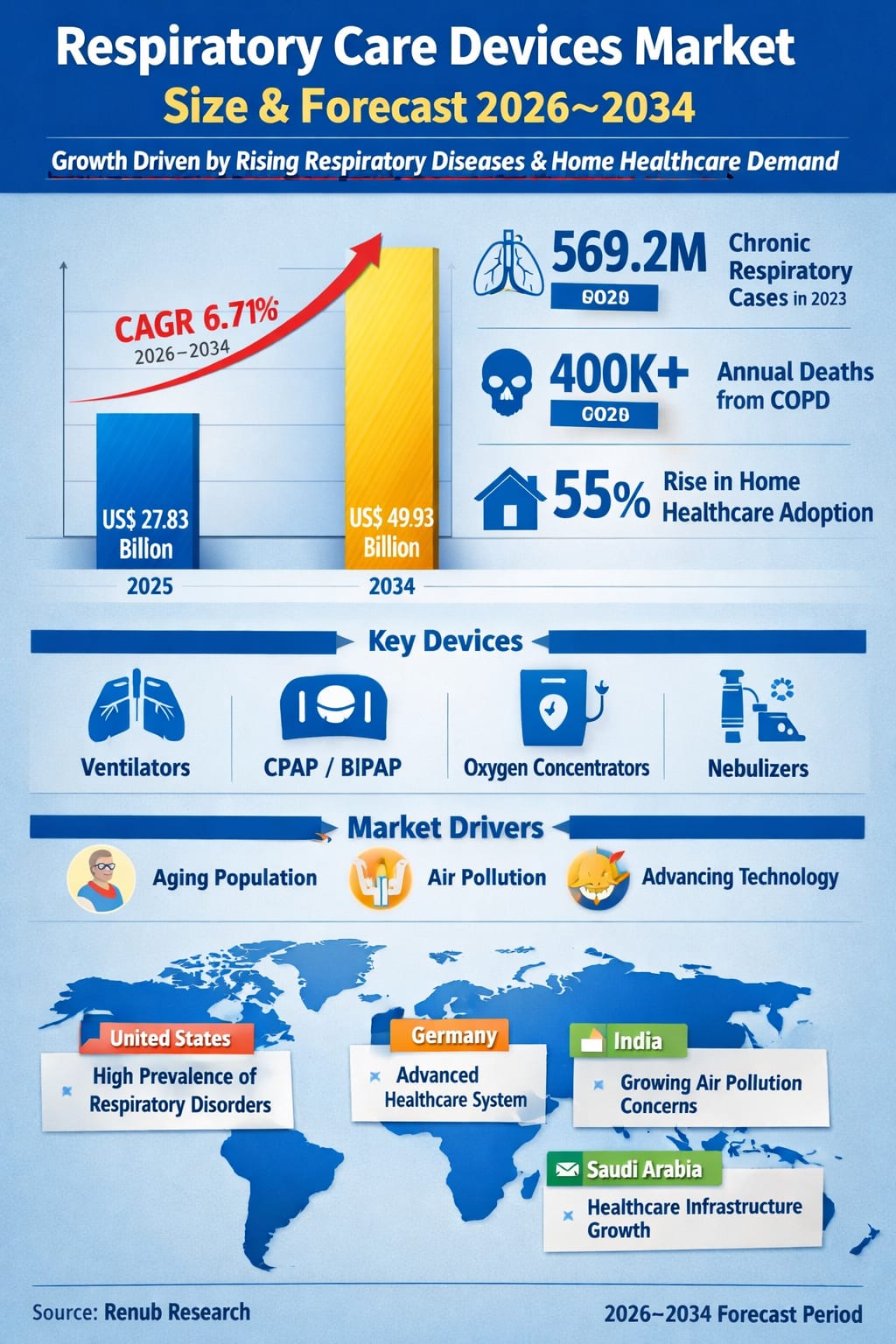
The global healthcare industry is witnessing a powerful shift toward technology-driven, patient-centric solutions, and respiratory care devices stand at the center of this transformation. According to Renub Research, the Respiratory Care Devices Market is expected to grow from US$ 27.83 billion in 2025 to US$ 49.93 billion by 2034, registering a CAGR of 6.71% during the forecast period from 2026 to 2034. This impressive growth trajectory reflects not only the rising burden of respiratory diseases worldwide but also the rapid adoption of advanced medical technologies and home-based care models.
Respiratory care devices play a critical role in supporting, monitoring, and improving breathing functions in patients suffering from acute and chronic respiratory conditions. From asthma and chronic obstructive pulmonary disease (COPD) to sleep apnea, pneumonia, and respiratory distress syndromes, these devices have become indispensable across hospitals, clinics, and increasingly, in home care settings.
The COVID-19 pandemic further underscored the strategic importance of respiratory support technologies, accelerating investments, innovation, and awareness globally. Today, with aging populations, rising air pollution, lifestyle-related health risks, and better access to healthcare in emerging economies, the demand for reliable and efficient respiratory care solutions continues to surge.
Respiratory Care Devices Market Overview
The respiratory care devices market serves a wide spectrum of healthcare environments, including hospitals, ambulatory care centers, and home healthcare settings. These devices are designed to assist, monitor, or enhance breathing in patients with respiratory disorders. Their functions range from oxygen delivery and airflow regulation to airway clearance and continuous respiratory monitoring.
Commonly used respiratory care devices include ventilators, oxygen concentrators, CPAP and BiPAP machines, nebulizers, inhalers, and respiratory monitoring systems. These tools are essential in managing both chronic conditions like asthma, COPD, and sleep apnea, as well as acute conditions such as respiratory distress and pneumonia.
Globally, the popularity of respiratory care devices has grown due to a combination of factors: increasing disease prevalence, rising pollution levels, smoking habits, and demographic shifts toward older populations. Moreover, growing awareness around early diagnosis and long-term disease management has encouraged both patients and healthcare providers to adopt respiratory support technologies more proactively.
The shift toward home-based care, supported by compact, portable, and user-friendly devices, has further expanded the market’s reach. Developing countries, in particular, are seeing increased adoption as healthcare infrastructure improves and access to essential medical devices becomes more widespread.
Key Market Drivers Shaping the Industry
Rising Prevalence of Chronic Respiratory Diseases
Chronic respiratory diseases remain one of the leading global health challenges. In 2023 alone, these conditions accounted for 569.2 million cases and 4.2 million deaths worldwide. Diseases such as COPD, asthma, sleep apnea, and pulmonary fibrosis are increasingly common due to factors like longer life expectancy, higher smoking rates, occupational exposure, and worsening air quality.
These conditions often require long-term management, making devices such as inhalers, nebulizers, oxygen therapy systems, and non-invasive ventilators essential components of treatment. Improved survival rates and better disease management strategies are also expanding the patient pool that depends on ongoing respiratory support.
In the WHO European Region, chronic respiratory diseases rank as the sixth leading cause of death, claiming nearly 400,000 lives annually, with around 80% of these deaths attributed to COPD. Such statistics highlight the enormous and sustained demand for respiratory care solutions worldwide.
Increasing Demand for Home-Based Respiratory Care
One of the most significant shifts in modern healthcare is the move from hospital-centered treatment to home-based care models. Patients and healthcare systems alike prefer home care due to its cost-effectiveness, convenience, and positive impact on quality of life.
Advancements in portable, lightweight, and easy-to-use respiratory devices have made home treatment more feasible than ever. Products such as home ventilators, oxygen concentrators, CPAP, and BiPAP machines allow patients to manage chronic conditions outside traditional hospital environments.
This trend is particularly strong among elderly populations and individuals with long-term respiratory conditions. Home-based care also reduces hospital readmissions and eases the burden on healthcare infrastructure. In May 2025, ABM Respiratory Care announced the initiation of a multicenter home care study with Delve Health to evaluate its BiWaze® Clear System in patients with bronchiectasis, reflecting the growing clinical and commercial focus on home respiratory therapies.
Technological Advancements and Innovation
Continuous technological innovation is a cornerstone of growth in the respiratory care devices market. The industry is witnessing the emergence of smart ventilators, connected inhalers, digital monitoring platforms, and wearable respiratory devices that significantly enhance patient outcomes and usability.
Battery-powered and portable solutions are improving patient mobility, while noise reduction, improved comfort, and intuitive interfaces are making devices more patient-friendly. Digital integration allows for remote monitoring, better data tracking, and more personalized treatment plans.
In April 2024, Getinge introduced the Servo-c mechanical ventilator, a major innovation designed to meet the needs of both pediatric and adult patients, demonstrating how manufacturers are responding to diverse clinical requirements with advanced engineering solutions.
Key Challenges Facing the Market
High Cost of Advanced Respiratory Devices
Despite strong demand, the high cost of advanced respiratory care equipment remains a major barrier, especially in low- and middle-income countries. Sophisticated ventilators, monitoring systems, and home care devices require significant upfront investment. Additional costs for maintenance, consumables, and replacement parts further increase the financial burden.
In many regions, limited or inconsistent reimbursement policies restrict patient access to premium technologies. As a result, healthcare providers and patients may opt for lower-cost alternatives, potentially limiting the adoption of cutting-edge solutions. Balancing affordability with performance and quality remains a critical challenge for manufacturers and healthcare systems alike.
Regulatory Complexity and Skilled Workforce Requirements
Respiratory care devices are subject to strict regulatory standards related to safety, performance, and quality. While necessary, these regulations often increase development timelines and costs for manufacturers. Navigating complex approval pathways across different countries can slow down market entry for new technologies.
Additionally, many respiratory devices require skilled professionals for proper operation and patient training. Shortages of trained respiratory therapists and technicians in certain regions limit effective device utilization. Although training and support programs help address this issue, they also add to overall operational costs and complexity.
Segment Insights: A Closer Look at Key Categories
Respiratory Care Monitoring Devices Market
This segment focuses on devices that continuously track patients’ respiratory functions, including pulse oximeters, capnography monitors, spirometers, and respiratory rate monitors. These tools are vital in intensive care units and increasingly in home care environments for early detection of complications.
Rising respiratory disease prevalence and growing use of continuous monitoring in critical care settings are major growth drivers. Advances in sensor technology, wireless connectivity, and wearable monitoring solutions are expected to sustain long-term expansion in this segment.
Respiratory Care Diagnostic Devices Market
Diagnostic devices such as spirometers, peak flow meters, polysomnography systems, and imaging-based tools are essential for detecting and evaluating conditions like asthma, COPD, and sleep apnea. Growing awareness of early diagnosis and preventive healthcare is boosting demand for accurate, minimally invasive diagnostic technologies.
Modern devices now offer improved portability, simplified operation, and better data connectivity, supporting wider adoption in outpatient clinics and diagnostic laboratories. As respiratory disease incidence continues to rise, the need for advanced diagnostic solutions will remain strong.
Nebulizers Respiratory Care Devices Market
Nebulizers are widely used to deliver medication directly into the lungs, particularly for patients with asthma, COPD, cystic fibrosis, and other chronic respiratory conditions. They are especially valuable for children and elderly patients who may struggle with inhalers.
Technological advancements such as mesh and ultrasonic nebulizers have improved treatment efficiency, reduced therapy time, and enhanced portability. The growing preference for home-based respiratory care is further accelerating demand in this segment.
OSA Respiratory Care Devices Market
Obstructive sleep apnea (OSA) represents a rapidly expanding segment within the respiratory care devices market. CPAP, BiPAP, and oral appliances are commonly used to keep airways open during sleep and prevent breathing interruptions.
Rising awareness of the link between sleep apnea and cardiovascular or metabolic disorders, along with increasing obesity rates and aging populations, is driving demand. Ongoing improvements in comfort, noise reduction, and digital monitoring are making these devices more acceptable and effective for long-term home use.
Respiratory Care Devices in Hospitals
Hospitals remain one of the largest end-user segments due to the high demand for ventilators, oxygen delivery systems, and advanced monitoring equipment. Rising hospital admissions for respiratory illnesses and surgical procedures requiring respiratory support continue to fuel this segment.
Increased investment in critical care infrastructure and emergency preparedness further strengthens hospital demand for advanced respiratory technologies.
Regional Market Highlights
United States
The U.S. represents one of the largest and most advanced markets for respiratory care devices. High prevalence of COPD, asthma, and sleep apnea, along with an aging population and rising obesity rates, continues to drive demand. Strong healthcare infrastructure and reimbursement systems support widespread adoption across hospitals and home care settings.
Home care and telemedicine trends are particularly influential, boosting sales of oxygen concentrators, CPAP machines, and home ventilators. In October 2025, Synchrony Medical launched its LibAirty™ Airway Clearance System in the U.S., signaling a new wave of innovation focused on improving daily breathing and quality of life for chronic patients.
Germany
Germany’s market benefits from a highly developed healthcare system, strong reimbursement frameworks, and a focus on early diagnosis and disease management. Demand is strong for ventilators, oxygen therapy devices, and CPAP systems across both hospitals and home care settings.
Innovation and high-quality manufacturing in medical technology continue to support market growth. In February 2022, AstraZeneca and Honeywell partnered to develop next-generation inhalers using near-zero global-warming-potential propellants, highlighting Germany’s commitment to both medical innovation and sustainability.
India
India’s respiratory care devices market is expanding rapidly due to rising air pollution, smoking rates, and growing awareness of respiratory health. Government healthcare initiatives and the expansion of private healthcare services are boosting demand for affordable solutions such as nebulizers, oxygen concentrators, and basic monitoring devices.
In August 2022, AstraZeneca India partnered with Alveofit to provide IoT-enabled handheld spirometers to hospitals nationwide, aiming to modernize diagnosis and management of lung diseases like asthma, COPD, and pulmonary fibrosis.
Saudi Arabia
Saudi Arabia’s market growth is driven by significant government investment in healthcare infrastructure and the development of modern hospitals and medical cities. The rising focus on critical care services is increasing demand for advanced ventilators and monitoring systems.
At the Arab Health exhibition in February 2025, Respircare Company showcased its latest respiratory therapy products, reflecting the region’s growing interest in advanced respiratory care technologies.
Market Segmentation Snapshot
By Device Type:
Therapeutic Devices
Monitoring Devices
Diagnostic Devices
Consumables & Accessories
By Products:
Respiratory Consumables
Nebulizers
Oxygen Concentrators
Polysomnography Devices
Pulse Oximeters
Mechanical Ventilators
Spirometers
Others
By Application:
COPD
Obstructive Sleep Apnea
Asthma
Respiratory Distress Syndrome
Cystic Fibrosis
Others
By End Users:
Hospitals
Home Care
Ambulatory Care
By Geography:
North America (U.S., Canada)
Europe (France, Germany, Italy, Spain, U.K., Belgium, Netherlands, Turkey)
Asia Pacific (China, Japan, India, Australia, South Korea, Thailand, Malaysia, Indonesia, New Zealand)
Latin America (Brazil, Mexico, Argentina)
Middle East & Africa (South Africa, Saudi Arabia, UAE)
Competitive Landscape
Key companies profiled in the market include:
Medtronic Plc
Koninklijke Philips
General Electric Company
Masimo Corporation
ResMed Inc.
Becton Dickinson
Chart Industries Inc.
Getinge AB
Inogen Inc.
Each company is analyzed across five viewpoints: Overview, Key Persons, Recent Developments & Strategies, Product Portfolio, and Financial Insights, providing a comprehensive understanding of the competitive environment.
Final Thoughts
The global respiratory care devices market is entering a decade of sustained growth, driven by rising disease prevalence, rapid technological innovation, and the accelerating shift toward home-based healthcare. With the market projected to nearly double from US$ 27.83 billion in 2025 to US$ 49.93 billion by 2034, opportunities abound for manufacturers, healthcare providers, and technology innovators alike.
While challenges such as high costs, regulatory complexity, and workforce constraints remain, continued investment in smart, affordable, and patient-friendly solutions is expected to reshape respiratory care worldwide. As healthcare systems increasingly prioritize early diagnosis, long-term management, and remote monitoring, respiratory care devices will remain a critical pillar of modern medicine in the years ahead.
About the Creator
Tom Shane
Tom Shane is a content writer specializing in SEO-driven blogs, product descriptions, and thought leadership. He crafts engaging, research-backed content that connects with audiences and drives results.
Large Cap Equity Fund: A Beginner’s Guide to Safe and Steady Growth
Investing in a Large Cap Equity Fund is one of the smartest ways to grow your money while keeping risk low. These funds focus on big, well-established companies with strong performance histories. By understanding how they work and following simple strategies, even beginners can build wealth steadily over time. To learn more about starting smart investments, check out our guide on Top Mutual Fund Tips for New Investors.
By John.doe7985 days ago in Trader




Comments
There are no comments for this story
Be the first to respond and start the conversation.