
S&P BSE Sensex vs Nifty 50: Key Differences Every Investor Should Know
A Simple Guide to Understanding India’s Benchmark Index, Market Performance, and Investor Impact

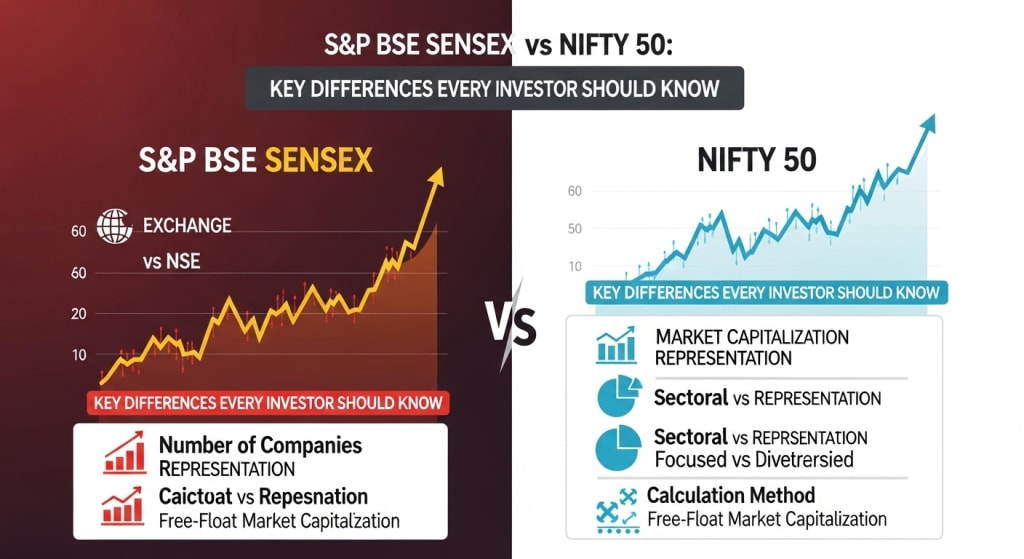
If you follow the Indian stock market, you have likely heard about the Sensex and Nifty 50 many times.
When people check the market news, they often look at the Sensex current value to understand how the market is behaving and what investors are feeling today.
This article focuses mainly on the S&P BSE Sensex, while also explaining how it differs from the Nifty 50 in a simple and friendly way.
By the end, you will clearly know what the Sensex is, how it works, and why it matters for everyday investors.
What the Sensex Represents in Simple Terms?
The S&P BSE Sensex is one of India’s oldest and most trusted stock market indicators. It shows the overall health of the Indian stock market using a small group of leading companies.
Think of it like a report card for big businesses in India.
When these companies perform well, the Sensex usually moves up.
A Quick Look at How the Sensex Started
The Sensex was launched in 1986 by the Bombay Stock Exchange. At that time, India needed a clear way to track market performance.
It started with a base value and slowly grew into a key market guide.
Today, millions of investors watch the Sensex current value daily to understand market direction.
Companies That Shape the Sensex
The Sensex includes 30 large and well-known companies from different sectors. These companies are leaders in areas like banking, technology, and manufacturing.
Examples include major banks, IT firms, and consumer brands.
Their combined performance decides whether the Sensex rises or falls.
How the Sensex Is Calculated?
The Sensex is calculated using a free-float market method. This means only shares available for public trading are counted.
Companies with higher market value have more impact.
That is why a single stock can move the Sensex current value up or down quickly.
Why Investors Track the Sensex Daily?
Investors track the Sensex to understand market mood. A rising Sensex usually means confidence, while a falling one signals caution.
Many people use it to decide when to buy or sell stocks.
It also helps new investors learn how markets react to news.
Sensex Current Value and What It Tells You
The Sensex current value reflects real-time market conditions and investor emotions. It reacts fast to news like policy changes, global markets, or company results.
When the Sensex current value moves sharply, it often signals big changes ahead.
Long-term investors use this data to stay calm and focused.
The Nifty 50 in Brief
The Nifty 50 is another major Indian stock index. It tracks 50 top companies listed on the National Stock Exchange.
It covers more companies than the Sensex.
Because of this, it may show a slightly wider market view.
Key Differences Between Sensex and Nifty 50
The main difference is the number of companies. Sensex tracks 30, while Nifty tracks 50.
They also belong to different exchanges.
Still, both often move in the same direction on most days.
How Global Events Affect These Indexes?
Global news plays a big role in market movement. Events like interest rate changes or global conflicts can impact both indexes.
A sudden global shock may drop the Sensex current value quickly.
Positive global signals often lift market confidence.
Which Index Is Better for Beginners?
For beginners, the Sensex is easier to understand. It tracks fewer companies and gives a clear picture.
The Nifty 50 offers broader exposure.
Many investors follow both for balanced insight.
Real-Life Example of Sensex Movement
During major economic announcements, the Sensex often reacts first. For example, a positive budget speech can push markets up.
In such cases, the Sensex current value may rise sharply within minutes.
This shows how closely it follows national news.
Using the Sensex for Long-Term Planning
Long-term investors use the Sensex as a trend guide. Instead of daily moves, they focus on growth over years.
Tracking the Sensex current value over time helps spot patterns.
It also builds patience and discipline in investing.
Common Myths About the Sensex
Some people think a falling Sensex means the economy is failing. This is not always true.
Markets move due to many short-term factors.
Smart investors look beyond daily numbers.
How Sensex Impacts Mutual Funds?
Many mutual funds are linked to the Sensex. When it performs well, these funds often grow too.
Fund managers watch the Sensex current value closely.
It helps them adjust their strategies.
Final Thoughts
The S&P BSE Sensex is more than just a number on a screen. It reflects investor confidence, business strength, and economic direction, all in one place. By understanding how it works and watching the Sensex current value, you can make smarter and calmer investment choices.
About the Creator
Faster Growth with Intraday Trading or More Loss?
You've seen the posts. The sleek laptops, the exotic backdrops, the claims of "unlimited income" from "just a few clicks a day." It's the day trading dream: the ultimate shortcut to wealth, freedom, and endless financial swagger.
By Daniel Reida day ago in Trader




Comments
There are no comments for this story
Be the first to respond and start the conversation.