
Philippines Real Estate Market 2026: Set to Expand to USD 135.9 Billion by 2034 on Urbanization & Investment Growth
Strong demand in residential, commercial and industrial properties drives steady growth with a 4.12 % CAGR through 2034.

Philippines Real Estate Market Overview
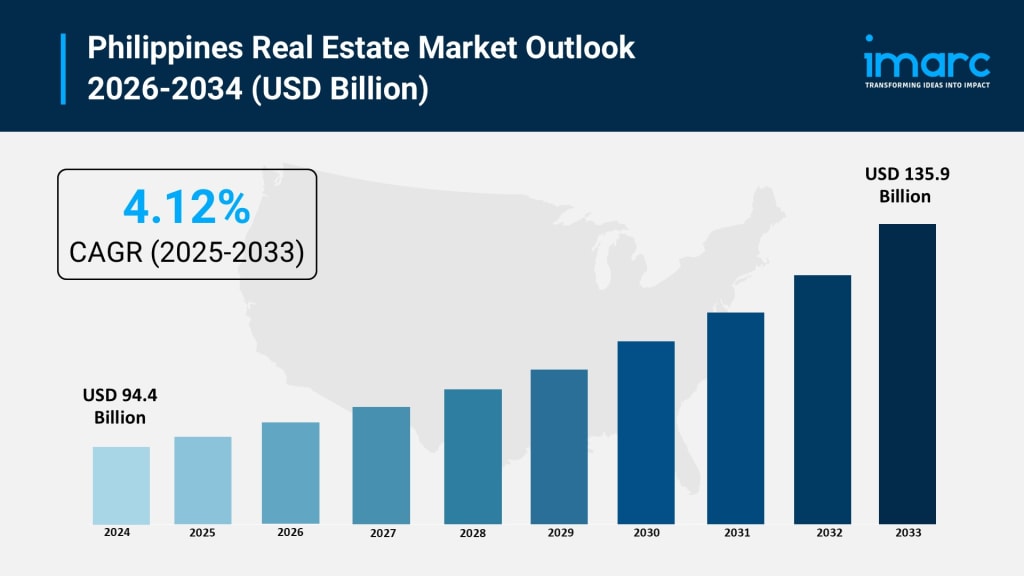
The Philippines real estate market growth is on a trajectory of sustained expansion as the nation continues to urbanize and attract domestic and foreign investment. According to IMARC Group, the market reached a size of USD 94.4 billion in 2025 and is projected to grow to USD 135.9 billion by 2034, exhibiting a compound annual growth rate (CAGR) of 4.12 % between 2026 and 2034.
This growth reflects broader economic trends in the Philippines, from rapid urban migration and infrastructure spending to rising household incomes and strong real estate demand across property types. As real estate becomes a vehicle for capital appreciation and rental income, investors and developers are increasingly positioning themselves to benefit from these long-term tailwinds.
Why the Market Is Growing So Rapidly
One of the primary growth drivers is rapid urbanization and a burgeoning middle class. As cities like Metro Manila, Cebu, and Davao continue to attract workers and families seeking better opportunities, demand for residential housing — from affordable units to mid-range condominiums — has risen sharply. This shift in population dynamics has pushed developers to build upwards and outwards, accommodating the evolving needs of urban residents.
Closely linked to urbanization is infrastructure development. Projects under the government’s flagship infrastructure programs have improved connectivity between metropolitan centers and surrounding regions, making peripheral areas increasingly attractive for housing and commercial development. Improved transportation networks and utilities reduce commute times and support new real estate clusters, fueling investor confidence.
Another significant factor is foreign and domestic investment growth in property assets. With the Philippines seen as a stable Southeast Asian economy, investors are channeling capital into commercial office spaces, industrial parks, and retail centers, alongside residential properties. This influx not only supports construction activity but also underpins long-term demand fundamentals across real estate subsectors.
The diversification of property types — including land, industrial facilities, and logistics hubs — is also broadening the market’s base. E-commerce growth and logistics demand have boosted interest in industrial real estate, while retail and office sectors evolve amid changing work and consumer patterns. This diversification enhances the market’s resilience and investment appeal.
Finally, financial inclusion and mortgage accessibility improvements have made homeownership more attainable for a broader swath of the population. As credit markets deepen and financial products become more tailored to property buyers, more Filipinos are entering the housing market, generating demand for both purchase and rental units.
Request a Sample Report with the Latest 2026 Data & Forecasts
What the Opportunities Are
1. Residential Real Estate Development
The ongoing housing demand in urban and suburban areas offers opportunities for developers and investors to tap into both affordable and mid-range segments. Rising household incomes and employment growth make residential real estate a cornerstone investment thesis.
2. Infrastructure-Linked Urban Expansion
Properties near major infrastructure projects — such as transit corridors and expressway links — are likely to appreciate faster, offering strategic positioning for developers and land investors alike.
3. Commercial Office Space Growth
With continued expansion of business process outsourcing (BPO) and corporate operations in Philippine cities, quality office space remains a long-term investment play, especially in well-connected business districts.
4. Industrial & Logistics Parks
The rise of e-commerce and manufacturing reshoring creates demand for logistics hubs and light industrial spaces, presenting niche opportunities beyond traditional residential and commercial real estate.
5. Regional City Development
Secondary cities like Iloilo, Bacolod, and Cagayan de Oro are emerging as alternative hubs for real estate activity, offering lower entry costs and high growth potential compared to saturated primary markets.
6. Mixed-Use and Transit-Oriented Projects
Developments combining residential, retail, and office spaces near transit nodes are attracting both occupiers and investors seeking convenience-based lifestyles.
7. Foreign Investment Structures
Innovative investment vehicles such as REITs and joint ventures allow foreign capital to flow into local real estate projects while navigating land ownership restrictions, expanding access to global institutional funds.
Recent News & Developments
• January 2025: Government Affordable Housing Initiative Launched: The Philippine Department of Human Settlements and Urban Development announced a public-private partnership aimed at accelerating the construction of affordable housing units in Metro Manila and key provincial cities. The initiative sets a target to deliver over 50,000 units by end-2025, improving access to homeownership and boosting construction activity in the lower-cost segment.
• June 2025: Ayala Land Announces Mixed-Use Expansion: One of the country’s largest developers unveiled plans for a new mixed-use township project in Cebu, integrating residential towers, office space, and retail amenities. With an estimated project value exceeding PHP 10 billion (~USD 175 million), the development underscores investor confidence and demand for integrated community living.
• September 2025: New Real Estate Funding Milestone: Local property markets reported a 20 % year-on-year increase in mortgage originations, driven by higher lending volumes from digital mortgage platforms. Enhanced accessibility to home loans is broadening buyer participation, particularly among first-time homeowners and young professionals.
Why Should You Know About the Philippines Real Estate Market?
For investors, the Philippines real estate sector presents a blend of stability and growth. With a nearly 50 % urban population share and favorable demographic trends, property investments offer both income potential and capital appreciation over the long term.
For developers, the diversification of demand — from residential to logistics and mixed-use properties — creates multiple avenues to innovate and capture market share across segments. Strategic positioning near infrastructure hubs offers enhanced return prospects.
For policy makers, the sector’s expansion underscores the importance of continued reforms in land titling, housing policy, and infrastructure planning to sustain investment and ensure equitable access to affordable housing.
About the Creator
Keep reading
More stories from Manisha Dixit and writers in Trader and other communities.
Philippines Digital Asset Management Market 2026: Set for Rapid Expansion Amid Digital Transformation Trends
Philippines Digital Asset Management Market Overview The Philippines digital asset management market growth stands at a pivotal point of expansion as organizations across sectors embrace digital transformation and content-driven strategies. According to IMARC Group data, the market was valued at USD 39.64 million in 2025 and is projected to reach USD 122.86 million by 2034, representing a compound annual growth rate (CAGR) of 13.39 % between 2026 and 2034.
By Manisha Dixita day ago in Trader
Neonatal Intensive Care Market Size and Forecast 2026–2034
Neonatal Intensive Care Market: A Decade of Critical Growth The global Neonatal Intensive Care Market is entering a decisive growth phase as healthcare systems across the world intensify their focus on infant survival and long-term health outcomes. According to Renub Research, the market is expected to expand from US$ 4.27 billion in 2025 to US$ 7.87 billion by 2034, growing at a CAGR of 7.03% during the forecast period 2026–2034.
By shibansh kumar5 days ago in Trader
Australia Eco Friendly Bricks Market: Sustainable Construction on the Rise
The Australia eco friendly bricks market reached USD 24.0 Million in 2025 and is anticipated to grow to USD 42.6 Million by 2034, exhibiting a compound annual growth rate (CAGR) of 6.56% between 2026 and 2034.
By Amélie Bellea day ago in Trader



Comments
There are no comments for this story
Be the first to respond and start the conversation.