
Neonatal Intensive Care Market Size and Forecast 2026–2034
How technology, rising preterm births, and healthcare investment are reshaping critical care for newborns worldwide

Neonatal Intensive Care Market: A Decade of Critical Growth
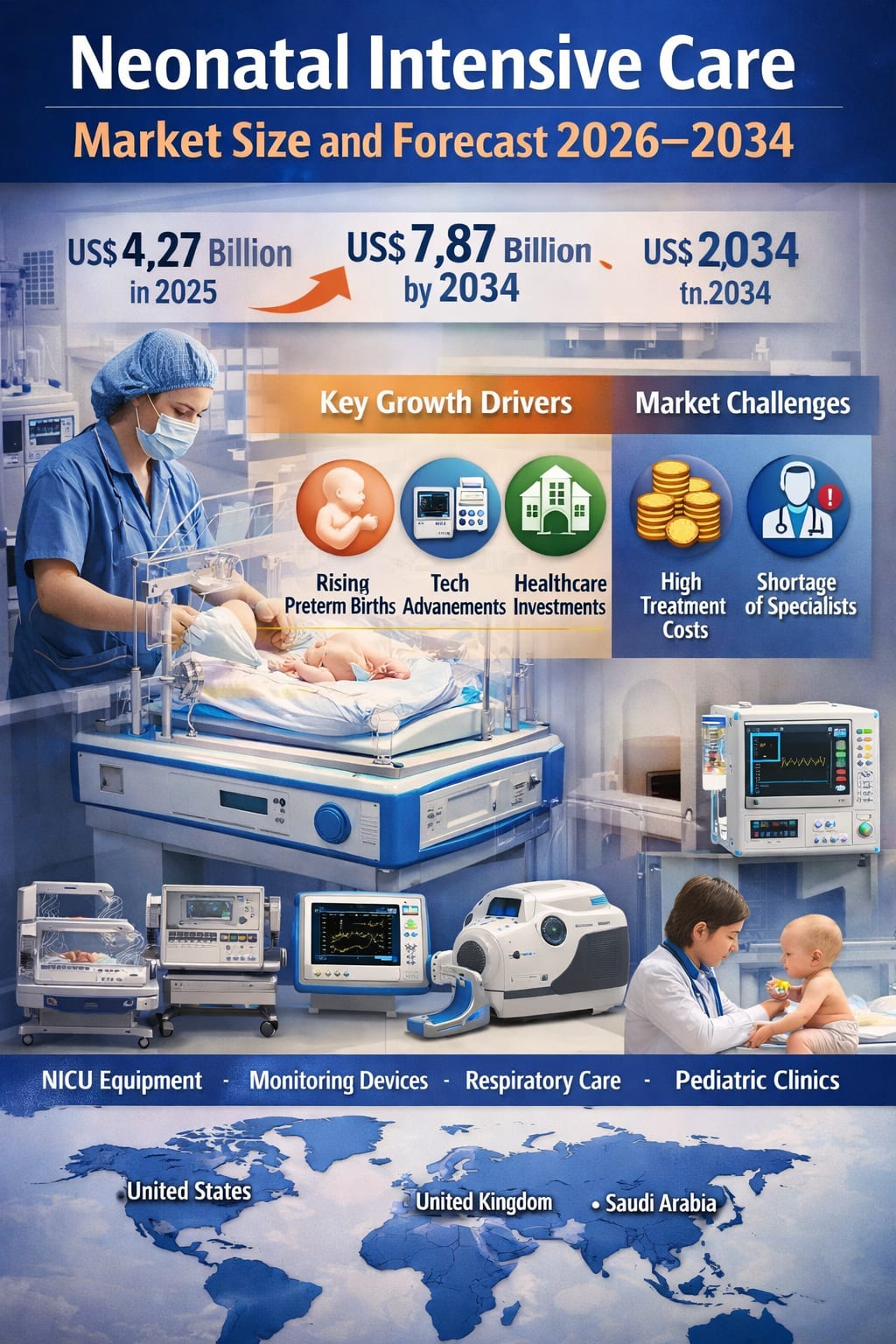
The global Neonatal Intensive Care Market is entering a decisive growth phase as healthcare systems across the world intensify their focus on infant survival and long-term health outcomes. According to Renub Research, the market is expected to expand from US$ 4.27 billion in 2025 to US$ 7.87 billion by 2034, growing at a CAGR of 7.03% during the forecast period 2026–2034.
This steady rise reflects more than just numbers on a balance sheet. It mirrors deeper structural changes in global healthcare: increasing preterm birth rates, higher healthcare spending on maternal and child health, and rapid technological progress in neonatal monitoring, respiratory care, and incubator systems. In both developed and developing regions, governments and private healthcare providers are scaling up Neonatal Intensive Care Units (NICUs) to ensure that the most vulnerable patients—newborns in critical condition—receive timely and specialized care.
Neonatal Intensive Care, often abbreviated as NIC care, refers to advanced medical interventions provided to premature infants, low-birth-weight babies, and newborns suffering from congenital conditions, infections, or other life-threatening complications. These services are delivered in NICUs equipped with incubators, life-support and ventilation systems, cardiac and respiratory monitors, infusion pumps, and a range of diagnostic tools. Just as important as the equipment is the human expertise behind it: neonatologists, neonatal nurses, respiratory therapists, and specialized caregivers who operate in high-pressure, high-stakes environments every day.
Over the past two decades, neonatal care has witnessed remarkable improvements in survival rates and clinical outcomes. Today, babies born at much earlier gestational ages than ever before have a fighting chance, thanks to advances in medical technology, better clinical protocols, and greater awareness among parents and healthcare providers. This combination of medical progress and social awareness continues to fuel the expansion of the neonatal intensive care market worldwide.
Key Market Drivers Shaping the Neonatal Intensive Care Landscape
Rising Preterm Birth Rates and Neonatal Complications
One of the strongest drivers behind the growth of the neonatal intensive care market is the rising incidence of preterm births and high-risk deliveries. Several factors contribute to this trend, including higher maternal age, lifestyle-related health issues, the growing use of assisted reproductive technologies, and the increasing prevalence of chronic conditions such as diabetes and hypertension among pregnant women.
Globally, it is estimated that around 15 million babies are born prematurely each year, meaning before 37 weeks of gestation. Complications arising from preterm birth remain one of the leading causes of death among children under five years of age. These vulnerable newborns often require respiratory support, temperature regulation, nutritional assistance, and continuous monitoring—services that can only be reliably delivered in well-equipped NICUs.
At the same time, awareness about the benefits of early and high-quality neonatal intervention is rising among both healthcare professionals and parents. More high-risk deliveries are now being planned in hospitals with advanced neonatal facilities, further increasing demand for NICU infrastructure, equipment, and specialized staff.
Technological Advancements in Neonatal Care Equipment
Technology is playing a transformative role in neonatal intensive care. Continuous innovation in incubators, ventilators, monitoring systems, and infusion devices has significantly improved both the safety and effectiveness of neonatal treatments. Modern NICU equipment allows for more precise control, gentler ventilation strategies, and real-time monitoring of vital parameters such as heart rate, oxygen saturation, blood pressure, and temperature.
These advancements not only improve survival rates but also reduce the risk of long-term complications by minimizing stress and injury to fragile organs, particularly the lungs and brain. The integration of digital health solutions, data management systems, and connectivity with electronic medical records is further enhancing clinical decision-making and workflow efficiency inside NICUs.
The industry is also seeing a push toward locally manufactured, patient-first solutions in several regions, reflecting both cost considerations and strategic healthcare priorities. Such innovations are helping hospitals expand access to advanced neonatal care while maintaining quality and safety standards.
Increasing Healthcare Investments and NICU Infrastructure Expansion
Another major growth engine for the neonatal intensive care market is rising investment in healthcare infrastructure, especially in maternal and child health services. Governments, public health agencies, and private hospital groups are all placing greater emphasis on improving neonatal outcomes, which has led to the establishment of new NICUs and the modernization of existing ones.
In many emerging economies, expanding access to specialized neonatal care is now seen as a critical public health priority. Insurance coverage and public health funding are also playing a growing role in making NICU services more accessible to a broader segment of the population. Alongside infrastructure, investments in training programs for neonatologists, nurses, and allied healthcare professionals are helping to build the skilled workforce required to support this expansion.
Challenges in the Neonatal Intensive Care Market
High Cost of Neonatal Intensive Care Services
Despite strong growth prospects, the neonatal intensive care market faces a significant barrier in the form of high treatment costs. NICU care requires sophisticated medical equipment, highly trained staff, and often prolonged hospital stays, all of which contribute to substantial healthcare expenses. For families without adequate insurance coverage or public healthcare support, these costs can be financially overwhelming.
From a hospital perspective, the initial investment required to set up and maintain a fully functional NICU is also considerable. This includes not only equipment and infrastructure, but also ongoing costs related to staffing, maintenance, and compliance with strict regulatory and safety standards.
Shortage of Skilled Neonatal Healthcare Professionals
Another critical challenge is the shortage of qualified neonatal healthcare professionals, including neonatologists, specialized nurses, and respiratory therapists. Neonatal intensive care is a highly specialized field that demands extensive training and experience. In many regions, the limited availability of skilled personnel restricts the capacity of NICUs and slows the adoption of advanced neonatal care services.
Addressing this gap through education, training, and retention programs will be essential for sustaining long-term growth in the neonatal intensive care market.
Key Segments Within the Neonatal Intensive Care Market
Neonatal Warmers Market
Neonatal warmers play a vital role in maintaining the body temperature of newborns, especially preterm and low-birth-weight infants who are highly susceptible to hypothermia. Modern warmers use advanced temperature regulation technologies, infrared heating, and integrated monitoring systems to ensure stable and safe thermal environments. As awareness of thermal management in neonatal care grows, demand for advanced neonatal warmers continues to rise across hospitals and specialized care centers.
Neonatal Intensive Care Monitoring Devices Market
Monitoring devices are the backbone of any NICU, providing continuous real-time data on a newborn’s vital signs. These systems track heart rate, respiratory rate, oxygen saturation, blood pressure, and temperature, enabling clinicians to detect complications early and intervene promptly. Advances in sensor technology, wireless monitoring, and data visualization are making these devices more accurate, less invasive, and easier to integrate into digital hospital systems.
Neonatal Intensive Care Respiratory Devices Market
Respiratory distress is one of the most common and serious challenges faced by premature and critically ill newborns. The respiratory devices segment includes ventilators, CPAP systems, and oxygen delivery tools designed specifically for neonatal use. Innovations in this area are focused on gentler ventilation techniques that reduce the risk of lung injury while improving survival outcomes. Given the strong link between preterm birth and respiratory complications, this segment is expected to see sustained demand.
Pediatric Clinics and Childcare in Neonatal Care
Beyond the hospital stay, specialized pediatric clinics and childcare centers play an increasingly important role in post-NICU follow-up and long-term care. These facilities support developmental monitoring, immunization, early intervention programs, and family-centered care approaches. With greater recognition of the long-term impacts of neonatal complications, the importance of continuous and coordinated care is growing across healthcare systems.
Regional Market Insights
United States Neonatal Intensive Care Market
The United States represents one of the most advanced neonatal intensive care markets globally, supported by strong healthcare infrastructure, high awareness levels, and widespread access to advanced medical technologies. A large network of dedicated NICUs, favorable reimbursement systems, and ongoing investments in medical innovation continue to drive market growth. The country also benefits from extensive training programs that ensure a steady supply of specialized neonatal healthcare professionals.
United Kingdom Neonatal Intensive Care Market
In the United Kingdom, the neonatal intensive care market is shaped by the National Health Service (NHS) and its structured approach to maternal and child health. Standardized care protocols, a strong emphasis on family-centered care, and continuous investment in neonatal facilities support steady market development. While budget constraints remain a challenge, neonatal care continues to be a priority area within the public healthcare system.
India Neonatal Intensive Care Market
India’s neonatal intensive care market is expanding rapidly due to the country’s high birth rate, rising incidence of preterm births, and growing awareness of infant health. Government initiatives aimed at reducing infant mortality, along with increased private sector investment in healthcare infrastructure, are strengthening NICU capacity across the country. The demand for cost-effective and scalable neonatal care solutions is particularly strong in this market.
Saudi Arabia Neonatal Intensive Care Market
Saudi Arabia’s market is driven by significant government spending on healthcare and a strong focus on improving maternal and child health outcomes. Modern hospitals equipped with advanced neonatal technologies are becoming more common, and public healthcare services play a major role in ensuring access to specialized care for newborns. Growing awareness and continued investment are expected to support market growth in the coming years.
Market Segmentation Overview
By Product:
Warmers
Incubators
Monitoring Devices
Respiratory Devices
Phototherapy Equipment
Others
By End User:
Hospitals & Neonatal Pediatric Hospitals
Pediatric Clinics & Childcare
Others
By Region:
North America (United States, Canada)
Europe (France, Germany, Italy, Spain, United Kingdom, Belgium, Netherlands, Turkey)
Asia Pacific (China, Japan, India, Australia, South Korea, Thailand, Malaysia, Indonesia, New Zealand)
Latin America (Brazil, Mexico, Argentina)
Middle East & Africa (South Africa, Saudi Arabia, United Arab Emirates)
Competitive Landscape
Leading companies operating in the neonatal intensive care market include:
Masimo Corporation, 3M Company, Medtronic PLC, Koninklijke Philips N.V., Siemens Healthcare GmbH, Terumo Corporation, Angio Dynamics, and Drägerwerk AG & Co. KGaA.
These companies compete through product innovation, strategic partnerships, portfolio expansion, and investments in research and development, with a strong focus on improving clinical outcomes and operational efficiency in NICUs.
Final Thoughts
The global neonatal intensive care market is on a clear upward trajectory, driven by rising preterm birth rates, continuous technological innovation, and growing investment in healthcare infrastructure. With the market projected to grow from US$ 4.27 billion in 2025 to US$ 7.87 billion by 2034 at a CAGR of 7.03%, the coming decade will be critical in shaping how neonatal care is delivered worldwide.
While challenges such as high treatment costs and workforce shortages remain, the overall outlook is strongly positive. As healthcare systems place increasing emphasis on early-life interventions and long-term health outcomes, neonatal intensive care will continue to stand at the center of one of modern medicine’s most important missions: giving the world’s smallest and most vulnerable patients the best possible start in life.
About the Creator
Keep reading
More stories from shibansh kumar and writers in Trader and other communities.
United Kingdom Diabetes Devices Market Size and Forecast 2026–2034
Introduction: A Market Shaped by Urgency and Innovation Diabetes has quietly become one of the most pressing long-term healthcare challenges in the United Kingdom. With millions of people already diagnosed and many more at risk, the need for accurate, reliable, and user-friendly diabetes management tools has never been greater. This growing clinical burden is now reshaping the medical device landscape, pushing innovation beyond traditional glucose meters into the era of continuous monitoring, smart insulin delivery, and digitally connected care.
By shibansh kumar4 days ago in Trader
MCX Gold Rate Today: Market Updates and Investment Insights
The MCX gold rate today is closely monitored by traders, investors, and market analysts across India. Gold remains one of the most preferred safe-haven assets, protecting wealth during economic uncertainty, inflation, and global market fluctuations. Understanding current gold rates, as well as the factors affecting them, is essential for informed investment decisions.
By Hammad Nawaz4 days ago in Trader
United States Free-From Food Market Size and Forecast 2026–2034
Introduction The Free-From Foods industry in the United States is entering a powerful phase of long-term expansion, evolving from a niche dietary solution into a mainstream food movement. According to Renub Research, the U.S. Free-From Food Market is projected to grow from US$ 30.41 billion in 2025 to US$ 74.33 billion by 2034, registering a robust CAGR of 10.44% between 2026 and 2034.
By Sakshi Sharma5 days ago in Trader




Comments
There are no comments for this story
Be the first to respond and start the conversation.