
Mass Spectrometry Market Size, Technology Trends & Forecast 2025–2033 | Renub Research
From Drug Discovery to Food Safety: Why Mass Spectrometry Is Becoming the Backbone of Modern Analytical Science

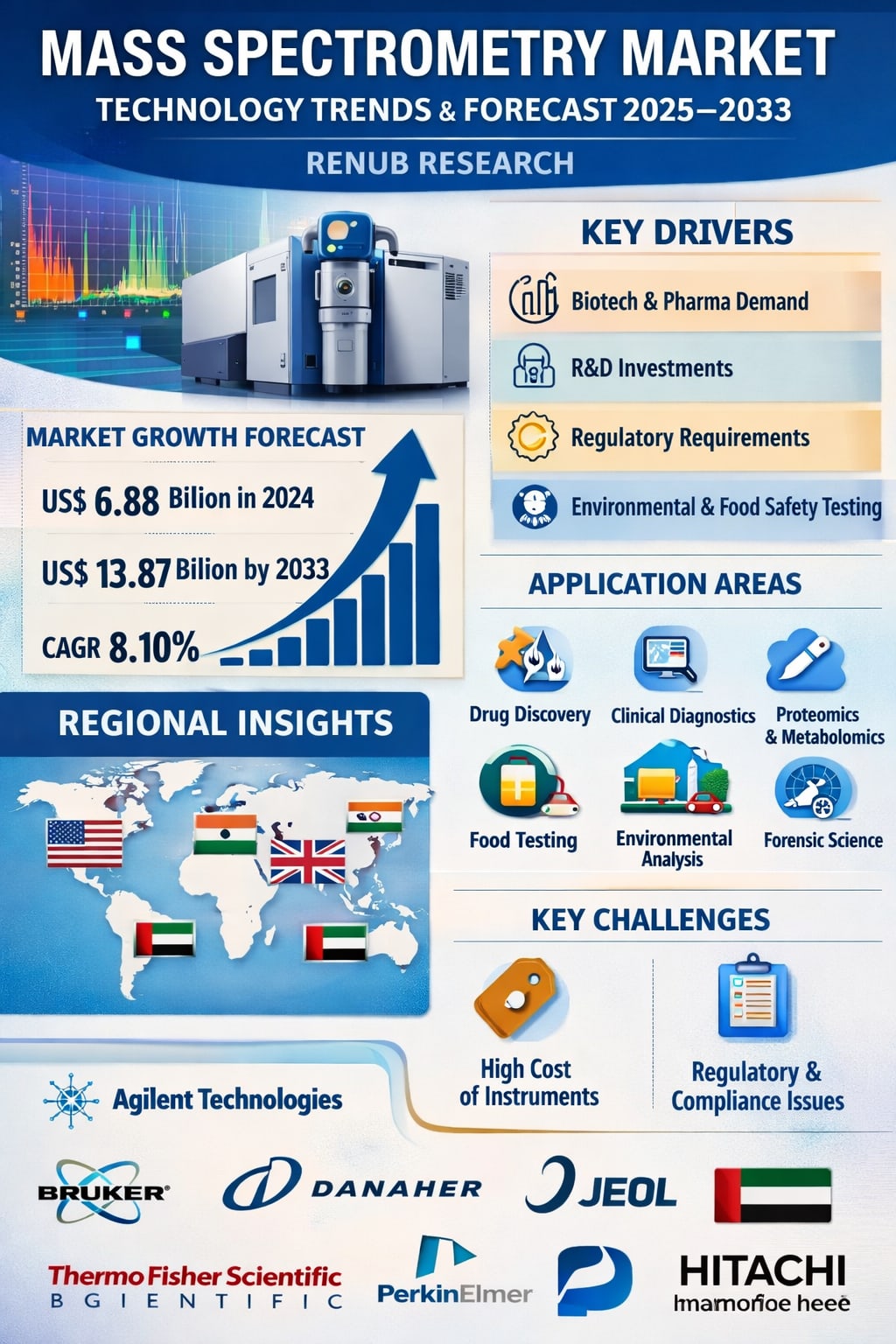
Mass Spectrometry Market: A Rapidly Evolving Analytical Powerhouse
The global Mass Spectrometry Market is entering a decisive growth phase, driven by accelerating demand across pharmaceuticals, biotechnology, clinical diagnostics, environmental testing, and food safety. According to Renub Research, the market is expected to expand from US$ 6.88 billion in 2024 to US$ 13.87 billion by 2033, registering a strong compound annual growth rate (CAGR) of 8.10% from 2025 to 2033.
This impressive growth trajectory reflects how mass spectrometry has moved beyond being a niche laboratory tool to becoming a core technology in modern scientific research and industrial quality control. Its ability to deliver highly precise, sensitive, and reliable molecular analysis makes it indispensable in an era where accuracy, speed, and data-driven decisions are critical.
From identifying complex proteins in life sciences to detecting contaminants in food and the environment, mass spectrometry is now at the center of global analytical workflows.
Global Mass Spectrometry Industry Overview
Mass spectrometry is an advanced analytical technique used to identify, quantify, and characterize molecules by measuring their mass-to-charge ratio. The process typically involves ionizing chemical compounds, separating the resulting ions using electric or magnetic fields, and detecting them to generate highly detailed molecular information.
What makes mass spectrometry especially valuable is its exceptional sensitivity and accuracy. It can analyze extremely small sample quantities, detect trace-level impurities, and provide detailed structural information about complex compounds. Because of these capabilities, it has become a cornerstone technology in industries such as:
Pharmaceuticals and biotechnology
Clinical diagnostics and healthcare
Environmental monitoring
Food and beverage testing
Proteomics and metabolomics research
Forensic and applied industrial sciences
Today, mass spectrometry is routinely used to analyze complex biological samples such as proteins, peptides, metabolites, and nucleic acids, as well as to identify unknown substances and verify the composition of mixtures.
The growing emphasis on precision medicine, chronic disease research, and advanced therapeutics has further elevated the importance of mass spectrometry, making it a critical tool for both research laboratories and industrial production environments.
Key Growth Drivers Shaping the Market
1. Rapid Technological Advancements
One of the strongest forces behind the expansion of the mass spectrometry market is continuous technological innovation. Modern instruments offer dramatically improved sensitivity, resolution, speed, and accuracy, allowing scientists to perform more complex and reliable analyses than ever before.
The integration of automation, artificial intelligence (AI), and advanced data analytics has further transformed mass spectrometry workflows. These advancements reduce analysis time, improve data interpretation, and enhance reproducibility—critical factors in high-throughput research and industrial quality control.
A notable example is the launch of next-generation mass spectrometry systems designed for translational omics research, which emphasize faster throughput, easier operation, and higher analytical performance. Such innovations highlight how technology is not only expanding the application range of mass spectrometry but also making it more accessible and efficient for both academic and commercial users.
As instruments become more compact, user-friendly, and digitally integrated, adoption is expected to accelerate across multiple sectors.
2. Increasing Investment in Research and Development
Rising R&D expenditure across pharmaceuticals, biotechnology, and clinical research is another major growth driver. Drug discovery, biomarker identification, and personalized medicine all rely heavily on advanced analytical tools, with mass spectrometry playing a central role.
The growing complexity of modern therapeutics—such as biologics, cell and gene therapies—requires highly precise and reliable analytical techniques. Mass spectrometry meets this need by enabling detailed molecular characterization, impurity profiling, and quantitative analysis.
In parallel, the adoption of AI-driven data processing and machine learning tools is improving how researchers handle large and complex datasets generated by mass spectrometry. These innovations increase productivity, reduce manual workloads, and help scientists extract more meaningful insights from their experiments, further strengthening the technology’s value proposition.
3. Stringent Regulations and Quality Control Requirements
Regulatory pressure in industries such as pharmaceuticals, food safety, and environmental monitoring is also fueling demand for mass spectrometry. Governments and regulatory agencies worldwide are enforcing stricter standards for product quality, safety, and compliance.
Mass spectrometry is widely regarded as one of the most reliable techniques for:
Detecting impurities and contaminants
Verifying compound identity and purity
Ensuring consistency in manufacturing processes
Monitoring trace-level substances in complex samples
In the food industry, for example, mass spectrometry is increasingly used to detect pesticides, toxins, and chemical residues. In pharmaceuticals, it is essential for ensuring drug safety, efficacy, and regulatory compliance. As regulations become more rigorous, mass spectrometry is no longer optional—it is becoming a necessity for quality assurance and compliance.
Challenges Facing the Mass Spectrometry Market
High Cost of Instruments
Despite its advantages, the high cost of mass spectrometry systems remains a significant barrier, particularly for smaller laboratories, academic institutions, and facilities in developing regions. The expense is not limited to the initial purchase; it also includes:
Installation and infrastructure requirements
Ongoing maintenance and calibration
Costly consumables
The need for highly skilled personnel
These financial constraints can slow adoption, even in sectors where advanced analytical capabilities are urgently needed.
Regulatory and Compliance Complexities
While regulations drive demand, they also create challenges. Achieving and maintaining compliance often requires extensive documentation, method validation, audits, and standardization, all of which consume time and resources.
For smaller organizations with limited regulatory expertise, these requirements can delay the adoption of new technologies and reduce flexibility in implementing innovative analytical methods.
Regional Market Insights
United States
The United States remains one of the most significant markets for mass spectrometry, driven by strong demand from pharmaceutical companies, biotechnology firms, and clinical research institutions. The country’s advanced healthcare infrastructure, robust R&D funding, and focus on innovation support widespread adoption.
Mass spectrometry plays a critical role in drug development, quality assurance, and biomedical research. The integration of automation and AI is further improving efficiency and expanding application areas, keeping the U.S. at the forefront of technological adoption.
India
India’s mass spectrometry market is growing steadily, supported by rising activity in pharmaceutical manufacturing, biotechnology research, clinical diagnostics, and environmental testing. Increased focus on food safety, personalized medicine, and drug development is boosting demand for advanced analytical tools.
While challenges such as high equipment costs and a shortage of skilled professionals remain, expanding research infrastructure and healthcare investments position India as a high-potential growth market over the forecast period.
United Kingdom
The UK market benefits from a strong research ecosystem and high demand from pharmaceutical, biotechnology, environmental, and forensic sectors. The country’s emphasis on innovation, coupled with stricter regulatory standards and growing interest in personalized medicine, continues to drive adoption.
The use of advanced data analysis tools and high-performance instruments is also improving operational efficiency across both academic and industrial laboratories.
United Arab Emirates
In the UAE, the mass spectrometry market is expanding due to rising demand in clinical diagnostics, pharmaceuticals, and environmental analysis. Investments in healthcare and research infrastructure, along with stricter quality and safety standards, are encouraging wider adoption.
The growing availability of compact and portable mass spectrometry systems is further enhancing the technology’s appeal, especially for on-site and real-time analysis applications.
Market Segmentation Overview
By Product:
Instruments
Consumables & Services
By Technology:
Hybrid Mass Spectrometry
Single Mass Spectrometry
Inductively Coupled Plasma Mass Spectrometry (ICP-MS)
By End Use:
Pharmaceutical & Biotechnology Companies
Government & Academic Institutions
Others
By Application:
Drug Discovery
Life Science Research
Clinical Diagnostics
Food Testing
Applied Industries
Environmental Testing
Other Applications
By Country (25 Market Viewpoints):
North America (United States, Canada)
Europe (France, Germany, Italy, Spain, United Kingdom, Belgium, Netherlands, Turkey)
Asia Pacific (China, Japan, India, Australia, South Korea, Thailand, Malaysia, Indonesia, New Zealand)
Latin America (Brazil, Mexico, Argentina)
Middle East & Africa (South Africa, Saudi Arabia, United Arab Emirates)
Competitive Landscape
Key players covered in the market include:
Agilent Technologies
Bruker Corporation
Danaher Corporation
Hitachi Ltd
JEOL Ltd
LECO Corporation
PerkinElmer Inc.
Thermo Fisher Scientific
These companies are analyzed across four key dimensions: company overview, key personnel, recent developments and strategies, and sales analysis, reflecting a highly competitive and innovation-driven market environment.
Final Thoughts
The global mass spectrometry market is on a clear upward trajectory, supported by technological progress, rising R&D investments, and stricter regulatory requirements across multiple industries. With the market projected to grow from US$ 6.88 billion in 2024 to US$ 13.87 billion by 2033, mass spectrometry is set to remain a cornerstone of modern analytical science.
While challenges such as high costs and regulatory complexity persist, ongoing innovation, digital integration, and expanding application areas are steadily strengthening the market’s long-term outlook. As healthcare, life sciences, and industrial quality standards continue to rise, mass spectrometry will play an increasingly vital role in shaping the future of research, diagnostics, and global safety standards.
About the Creator
Philippines Retail Market 2026: Set for Rapid Expansion on Digital, Urban & Consumer Trends
Philippines Retail Market Overview The Philippines retail market is experiencing significant expansion as rising consumer spending, omnichannel retailing, and modern retail innovations reshape how Filipinos shop. According to the latest IMARC Group report, the market size reached USD 648.2 billion in 2025 and is expected to grow to USD 1,223.1 billion by 2034, exhibiting a compound annual growth rate (CAGR) of 7.31% during 2026–2034 — reflecting robust demand across product segments and distribution channels.
By Manisha Dixit2 days ago in Trader




Comments
There are no comments for this story
Be the first to respond and start the conversation.