
India Biometrics Market Size and Forecast 2025–2033 | Renub Research
India’s Digital Identity Revolution: How Biometrics Is Reshaping Security, Governance, and Everyday Life

India Biometrics Market: A Market on the Fast Track
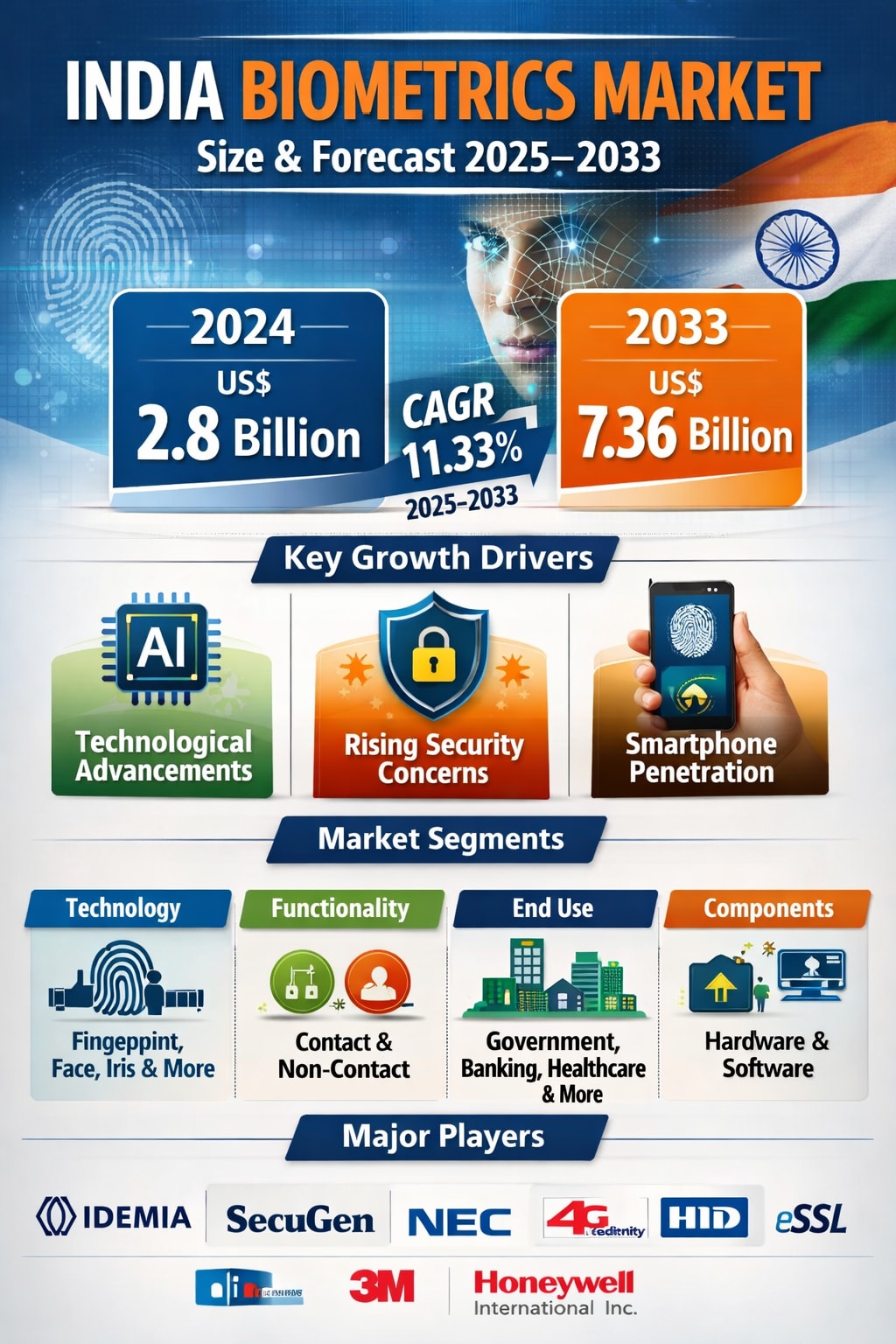
India’s biometrics market is entering a decisive growth phase, powered by rapid digitalization, rising security concerns, and the country’s expanding digital infrastructure. According to Renub Research, the India Biometrics Market is expected to reach US$ 7.36 billion by 2033, up from US$ 2.8 billion in 2024, growing at a CAGR of 11.33% from 2025 to 2033. This strong growth trajectory reflects how deeply biometric technologies are becoming embedded in India’s governance systems, financial services, consumer electronics, healthcare, and security frameworks.
Biometrics, once limited to niche government or forensic applications, has now become a mainstream authentication method. From unlocking smartphones and authorizing digital payments to securing airports and government facilities, biometric systems are steadily replacing traditional passwords, PINs, and physical ID cards. The shift is not just about convenience—it is also about building a more secure, fraud-resistant, and efficient digital ecosystem.
India’s unique scale and diversity make it one of the most dynamic biometrics markets in the world. With a population exceeding 1.4 billion and a rapidly growing digital user base, the country presents both massive opportunities and complex challenges for biometric adoption.
India Biometrics Industry Overview
The Indian biometrics industry is expanding rapidly due to the increasing demand for secure and reliable identity verification across multiple sectors. One of the biggest catalysts for this growth has been the government’s push toward digitization, especially through large-scale initiatives such as Aadhaar, which has created one of the world’s largest biometric identity databases.
Biometric technologies—such as fingerprint, facial, iris, and voice recognition—are now widely used for access control, identity verification, and fraud prevention. Their adoption has accelerated in sectors like banking and finance, consumer electronics, healthcare, defense, and government services. As online services, mobile banking, and digital payments continue to grow, biometric authentication offers a secure and user-friendly way to verify identities without relying on easily compromised passwords.
In consumer electronics, biometric features have become almost standard. Smartphones, laptops, and smart devices increasingly come equipped with fingerprint sensors and facial recognition systems. This has normalized biometric usage in everyday life, making users more comfortable with the technology and, in turn, boosting overall market demand.
Another important trend shaping the industry is the rise of multi-modal or hybrid biometric systems. These systems combine two or more biometric traits—such as fingerprint and facial recognition—to improve accuracy, speed, and reliability. Multi-modal biometrics are especially useful in high-security environments and large-scale deployments where accuracy and robustness are critical.
Key Factors Driving the India Biometrics Market Growth
1. Rising Technological Advancements
Technological innovation is one of the strongest growth engines for the biometrics market in India. Recent advancements in artificial intelligence (AI), machine learning, and sensor technology have significantly improved the accuracy, speed, and reliability of biometric systems. Modern facial, iris, and fingerprint recognition solutions can now operate effectively even in challenging conditions, reducing error rates and improving user experience.
Improved algorithms have made biometric systems more resilient to variations in lighting, facial expressions, or minor physical changes. At the same time, hardware costs have been gradually decreasing, making these solutions more accessible to a wider range of industries and organizations.
The integration of multiple biometric modalities—such as combining fingerprint and facial recognition—has further strengthened security while maintaining user convenience. This multi-factor approach is increasingly being adopted in sectors like banking, government services, and corporate security, where both accuracy and reliability are non-negotiable.
2. Growing Security Concerns
India’s rapid digital transformation has brought enormous benefits, but it has also increased exposure to cyber threats, identity theft, and online fraud. As more sensitive data moves online, organizations are under growing pressure to strengthen their authentication systems.
Biometric authentication provides a powerful solution because biometric traits are unique to each individual and difficult to replicate or steal. Unlike passwords or PINs, biometric identifiers cannot be easily forgotten, guessed, or shared. This makes them especially attractive for high-risk sectors such as banking, healthcare, defense, and government services.
With concerns around terrorism, data breaches, and financial fraud continuing to rise, biometrics is increasingly seen as a critical layer of defense in both digital and physical security systems. This heightened focus on security is expected to remain a major driver of market growth over the forecast period.
3. Increased Smartphone Penetration
The explosive growth of smartphones in India has played a major role in popularizing biometric technology. Today, millions of users rely on fingerprint scanners and facial recognition to unlock their devices, access apps, and authorize digital payments.
Smartphones have effectively become the most widespread biometric platforms in the country, familiarizing users with the technology and building trust in its reliability. As mobile devices continue to dominate personal and professional life, biometric authentication is becoming a default feature rather than a premium add-on.
This widespread adoption in consumer electronics is also creating spillover effects in other sectors, such as banking, retail, healthcare, and e-governance, where users now expect fast, secure, and password-free authentication methods.
Challenges in the India Biometrics Market
1. Privacy and Data Security Concerns
Despite its many advantages, biometrics also raises serious privacy and data protection concerns. Biometric data—such as fingerprints, facial images, and iris scans—is highly sensitive and permanent. If such data is compromised, it cannot be “changed” like a password.
In India, concerns about data breaches, unauthorized access, and misuse of personal information have made privacy a central issue in the biometrics debate. Public trust can be easily undermined if users feel that their biometric data is not being handled responsibly or securely.
To sustain long-term growth, the industry must invest heavily in strong encryption, secure storage, transparent data practices, and robust regulatory compliance. Building trust will be just as important as improving technology.
2. Accuracy and Reliability Issues
While biometric technology has improved significantly, accuracy and reliability remain important challenges. Factors such as aging, manual labor, injuries, or health conditions can affect fingerprint quality. Similarly, facial recognition systems can struggle with poor lighting, changes in appearance, or improper positioning.
False positives (incorrect matches) and false negatives (failure to recognize a valid user) can undermine both security and user confidence. In high-stakes environments—such as airports, banking systems, or government services—even small error rates can have serious consequences.
Ongoing research, better sensors, improved algorithms, and context-aware systems will be essential to address these limitations and ensure consistent performance across diverse real-world conditions.
Market Segmentation: A Diverse and Expanding Landscape
By Technology
Face Recognition
Fingerprint Recognition
Voice Recognition
Hand Geometry
Iris Recognition
Others
Among these, fingerprint and facial recognition currently dominate due to their widespread use in smartphones, banking, and government systems. However, iris and voice recognition are gaining traction in high-security and specialized applications.
By Functionality
Non-Contact
Contact
Combined
The demand for non-contact biometric systems has increased significantly, especially after the pandemic, as organizations look for hygienic and touch-free authentication methods.
By Component
Hardware
Software
While hardware forms the physical backbone of biometric systems, software and algorithms are becoming increasingly critical in determining accuracy, speed, and scalability.
By End Use
Government
Defense Services
Banking and Finance
Consumer Electronics
Healthcare
Commercial Safety and Security
Transport/Visa/Logistics
Others
The government and banking sectors remain the largest adopters, but consumer electronics and healthcare are rapidly emerging as high-growth segments.
Competitive Landscape: Key Players Shaping the Market
The India biometrics market features a mix of global giants and strong domestic players. Some of the key companies operating in this space include:
IDEMIA
SecuGen India Pvt. Ltd
NEC Technologies India Pvt. Ltd
4G Identity Solutions Pvt. Ltd
HID Corporation
eSSL Security
3M India Ltd
Honeywell International Inc.
These companies are actively investing in product innovation, strategic partnerships, and large-scale deployments to strengthen their market positions. Competition is increasingly focused on improving accuracy, reducing costs, and offering scalable solutions tailored to India’s vast and diverse market.
The Road Ahead: What the Future Holds
Looking ahead, the India biometrics market is set to play a central role in the country’s digital future. With a projected market size of US$ 7.36 billion by 2033, the industry is moving well beyond its early adoption phase and into a period of widespread, multi-sector integration.
Emerging technologies such as AI-powered recognition systems, cloud-based biometric platforms, and advanced multi-modal authentication will further expand the scope of applications. At the same time, increasing regulatory focus on data protection and privacy will shape how these technologies are deployed and managed.
The success of the market will depend not only on technological progress but also on how effectively stakeholders address concerns around privacy, security, and ethical use. If these challenges are handled responsibly, biometrics could become the backbone of India’s digital identity and security infrastructure.
Final Thoughts
The India biometrics market stands at the intersection of technology, security, and digital transformation. Driven by strong government initiatives, rising security needs, and the everyday adoption of biometric features in consumer devices, the market is poised for sustained growth through 2033.
While challenges related to privacy and accuracy cannot be ignored, continuous innovation and stronger regulatory frameworks are likely to build greater trust and wider acceptance. As India continues its journey toward a more connected and digital-first economy, biometrics will play an increasingly vital role in shaping how identities are verified, services are delivered, and security is maintained.
In many ways, biometrics is no longer just a technology trend in India—it is becoming a foundational pillar of the country’s digital future.
About the Creator
Shopify Stock Analysis: Can Shopify Continue Dominating the E-Commerce Platform Market?
Introduction Shopify stock has become synonymous with the growth of online commerce. Shopify provides a cloud-based platform that enables businesses of all sizes to create online stores, manage inventory, and process payments. With small businesses, entrepreneurs, and large brands increasingly shifting to e-commerce, Shopify stock is closely watched by investors seeking exposure to the digital retail revolution. The central question is whether Shopify can sustain its growth amid rising competition and market saturation.
By Hammad Nawaz2 days ago in Trader
Small Molecule API Market: Driving Innovation in Modern Pharmaceutical Manufacturing
Overview – Small Molecule API Market Small molecule APIs are chemically synthesized compounds that form the active components of most conventional pharmaceutical drugs. They dominate the drug development pipeline due to their stability, oral bioavailability, and well-established regulatory pathways. The market includes both innovative and generic small molecule APIs, serving branded pharmaceutical manufacturers, generic drug producers, and contract manufacturing organizations (CMOs). With the growing aging population and increasing healthcare expenditure worldwide, demand for therapeutic drugs continues to rise, strengthening the need for high-quality APIs. Emerging technologies such as artificial intelligence and advanced chemical synthesis methods are also enhancing drug discovery processes and improving production efficiency, contributing to overall market growth.
By James Smith7 days ago in Trader



Comments
There are no comments for this story
Be the first to respond and start the conversation.