
Malaysia Agriculture Equipment Market Size and Forecast 2025–2033
How Mechanization, Government Support, and Smart Farming Are Reshaping Malaysian Agriculture

Introduction: A Market Moving from Tradition to Technology
Malaysia’s agricultural sector is undergoing a quiet but powerful transformation. Long associated with labor-intensive practices and smallholder farming, the country is now steadily embracing mechanization, automation, and smart farming technologies. This shift is not just a matter of convenience—it is becoming a necessity in the face of rising labor shortages, increasing demand for food security, and the pressure to improve productivity across key crops such as palm oil, rice, rubber, and horticulture.
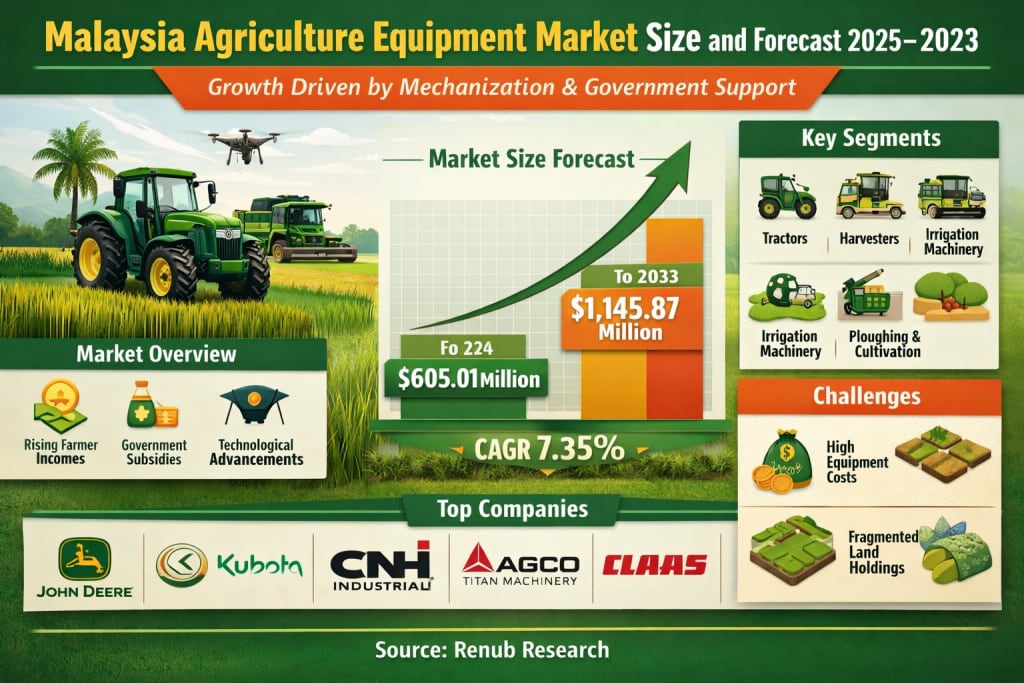
According to Renub Research, the Malaysia Agriculture Equipment Market is expected to reach US$ 1,145.87 million by 2033, up from US$ 605.01 million in 2024, growing at a compound annual growth rate (CAGR) of 7.35% from 2025 to 2033. This growth reflects a broader structural change in Malaysian agriculture, where farmers, agribusinesses, and policymakers are increasingly aligned around one goal: making farming more efficient, resilient, and sustainable through modern equipment.
At the heart of this evolution lies a mix of economic, technological, and policy-driven factors. Rising farmer incomes, supportive government programs, favorable weather conditions for food production, and initiatives such as loan waivers and subsidies are all helping to lower the barriers to mechanization. At the same time, manufacturers are tailoring their equipment to suit Malaysia’s diverse terrain and crop patterns, making technology more accessible even for smaller farms.
Malaysia Agriculture Equipment Industry Overview
Malaysia’s agriculture equipment market is developing gradually but steadily as the country prioritizes the modernization of its farming ecosystem. Historically, agriculture in Malaysia has relied heavily on manual labor, particularly among smallholder farmers who dominate the sector. However, demographic shifts—such as an aging farming population and a shrinking rural workforce—have made this model increasingly unsustainable.
To address these challenges, the government has actively promoted the adoption of mechanized and semi-automated solutions. Tractors, harvesters, irrigation systems, sprayers, and planting machinery are now becoming more common sights across both commercial plantations and smaller farms. This transition is not only about replacing labor but also about improving consistency, reducing crop losses, and optimizing the use of resources such as water, fuel, and fertilizers.
Another notable trend is the growing demand for equipment designed specifically for smaller landholdings and mixed terrain. Unlike large-scale farming regions where massive machinery dominates, Malaysia’s fragmented land structure requires more compact, versatile, and cost-effective solutions. Manufacturers and suppliers are increasingly responding to this need by offering machinery that is easier to operate, maintain, and adapt to local conditions.
Despite this progress, the industry still faces structural challenges. High upfront costs, limited access to affordable financing, and gaps in technical knowledge continue to slow down adoption among small and medium farmers. Fragmented land ownership further complicates the economics of large equipment purchases. As a result, the next phase of growth will depend not only on technology itself but also on policy support, financing innovation, and stronger after-sales and training ecosystems.
Market Size and Forecast: Strong Growth Ahead
Renub Research estimates that the Malaysia Agriculture Equipment Market will grow from US$ 605.01 million in 2024 to US$ 1,145.87 million by 2033, registering a CAGR of 7.35% during the 2025–2033 period. This growth trajectory highlights the increasing importance of mechanization in ensuring the long-term competitiveness of Malaysian agriculture.
Several factors underpin this outlook. First, the push for higher productivity in staple crops and export-oriented commodities is intensifying. Second, labor constraints are making automation less of a choice and more of a necessity. Third, government-backed financial support programs are gradually improving farmers’ ability to invest in modern equipment. Finally, technological advancements are making machinery more efficient, more precise, and, over time, more affordable.
Together, these forces are reshaping the investment landscape of Malaysian agriculture, turning equipment from a luxury into a strategic asset for farmers and agribusinesses alike.
Growth Drivers for the Malaysia Agriculture Equipment Market
Government Support and Policies
The Malaysian government has been a central driver of mechanization through a range of policies and development programs. Initiatives such as the Agrofood Policy 2021–2030 aim to enhance productivity, strengthen food security, and reduce dependence on manual labor. Under these frameworks, farmers are encouraged to adopt modern equipment through subsidies, grants, and financing assistance.
Loan waiver programs and targeted financial incentives further reduce the burden of investment, particularly for smallholders and medium-scale farmers. Beyond direct financial support, the government also promotes training programs and knowledge-sharing initiatives to ensure that farmers can effectively use and maintain new machinery. This combination of policy support and capacity building is helping create a more technology-ready agricultural sector.
Technological Advancements in Equipment
Technology is redefining what agricultural equipment can do. GPS-guided tractors, automated harvesters, precision sprayers, and smart irrigation systems are no longer futuristic concepts—they are increasingly practical tools for improving farm performance. These innovations allow farmers to plant, irrigate, fertilize, and harvest with greater accuracy, reducing waste and improving yields.
In Malaysia, the growing availability of such technologies is making precision agriculture more achievable, even for mid-sized farms. Smart irrigation systems, for example, help conserve water while ensuring optimal crop growth, an important advantage in a region where climate variability can impact production cycles. As technology continues to mature and costs gradually decline, adoption rates are expected to rise further.
Rising Demand for Productivity and Efficiency
With population growth, urbanization, and export commitments putting pressure on food production systems, productivity has become a top priority. Mechanization offers a clear path to achieving higher output with fewer labor inputs. Tractors, harvesters, and planting machinery significantly reduce the time and effort required for core farming activities while improving consistency and scale.
Sectors such as rice cultivation, palm oil, and rubber—key pillars of Malaysian agriculture—are increasingly relying on mechanized solutions to remain competitive. By adopting modern equipment, farmers can not only increase yields but also improve operational efficiency, reduce post-harvest losses, and better manage input costs.
Challenges in the Malaysia Agriculture Equipment Market
High Initial Costs and Financial Accessibility
One of the most persistent barriers to adoption is the high upfront cost of modern agricultural equipment. Tractors, combine harvesters, and advanced irrigation systems require significant capital investment, which many smallholder farmers find difficult to afford. Even with subsidies and financial aid, access to affordable credit remains uneven, particularly in rural areas.
In addition to purchase costs, farmers must also consider maintenance, fuel, spare parts, and operational expenses. These ongoing costs can further discourage investment, especially for those operating on thin profit margins. Without more innovative financing models—such as leasing, equipment sharing, or cooperative ownership—this challenge is likely to remain a constraint on market growth.
Fragmented Land Holdings and Small-Scale Farming
Malaysia’s agricultural landscape is characterized by small, fragmented landholdings. This structure limits the economic viability of large-scale machinery and reduces the potential benefits of economies of scale. For many farmers, investing in high-capacity equipment simply does not make financial sense given the size of their plots.
Moreover, certain types of machinery are not well-suited to smaller or irregularly shaped fields, further restricting their usefulness. As a result, many farmers continue to rely on traditional, labor-intensive methods, slowing the overall pace of mechanization. Addressing this issue will require more flexible equipment designs and stronger models for shared ownership or community-based machinery pools.
Market Segmentation: Understanding the Equipment Landscape
By Machinery Type
The Malaysia agriculture equipment market includes a wide range of machinery categories, each serving a specific function in the farming cycle:
Irrigation Machinery
Tractors
Ploughing and Cultivation Machinery
Harvesting Machinery
Haying and Forage Machinery
Planting Machinery
Sprayer
Among these, tractors and harvesting machinery play a central role in mechanization, while irrigation equipment is becoming increasingly important as farmers focus on water efficiency and climate resilience.
Irrigation Machinery
Irrigation systems are segmented into:
Gravity Irrigation
Micro-Irrigation
Sprinkler Systems
Micro-irrigation and sprinkler systems are gaining traction due to their ability to conserve water and improve crop yields through precise water delivery.
Tractors by Engine Power
Tractors are categorized by engine power into:
Less than 40 HP
41 to 100 HP
More than 100 HP
In Malaysia, demand is particularly strong for low to mid-range horsepower tractors, which are better suited to small and medium-sized farms and diverse terrain conditions.
Ploughing and Cultivation Machinery
This segment includes:
Cultivators and Tillers
Harrows
Ploughs
Others
These tools remain essential for land preparation and soil management, forming the backbone of pre-planting operations.
Harvesting Machinery
Harvesting equipment is segmented into:
Combine Harvesters
Harvesting Robots
Self-Propelled Forage Harvesters
While traditional combine harvesters dominate, interest in automated and robotic solutions is gradually increasing, particularly among larger and more technology-oriented operations.
Haying and Forage Machinery
This category includes:
Mowers
Balers
Tedders and Rakes
Forage Harvesters
These machines are especially important for livestock farming and fodder management, supporting the broader agricultural value chain.
Competitive Landscape: Key Companies Shaping the Market
The Malaysian agriculture equipment market features a mix of global and regional players. Key companies covered from multiple viewpoints—overview, leadership, product portfolio, recent developments and strategies, and revenue analysis—include:
John Deere
CNH Industrial
AGCO Corporation
Kubota Corporation
Titan Machinery Inc.
CLAAS
Lindsay Corporation
Alamo Group Inc.
These companies compete on factors such as product reliability, technological innovation, after-sales service, and adaptability to local farming conditions. Partnerships with local distributors, investment in service networks, and customization of equipment for regional needs are becoming increasingly important competitive strategies.
The Road Ahead: What Will Define the Next Decade?
Looking ahead to 2033, the Malaysia agriculture equipment market is poised for steady and meaningful expansion. The projected growth to US$ 1,145.87 million reflects not just rising sales but a deeper structural shift in how farming is done in the country. Mechanization, once seen as optional or limited to large plantations, is becoming a central pillar of agricultural development.
However, sustaining this momentum will require continued policy support, more inclusive financing models, and stronger efforts to build technical skills among farmers. The future of the market will also depend on how effectively manufacturers can design affordable, flexible, and user-friendly equipment tailored to Malaysia’s unique agricultural landscape.
Final Thoughts
The Malaysia Agriculture Equipment Market is at a pivotal moment. With strong growth projected at a CAGR of 7.35% from 2025 to 2033, the sector is clearly moving toward a more modern, efficient, and technology-driven future. Supported by government policies, rising productivity needs, and ongoing technological innovation, agricultural equipment is becoming a strategic investment rather than a luxury.
Yet, challenges such as high initial costs and fragmented landholdings remain real and pressing. Overcoming these hurdles will be crucial to ensuring that mechanization benefits not just large agribusinesses, but also the millions of smallholder farmers who form the backbone of Malaysian agriculture.
If the right balance between policy, technology, and accessibility can be achieved, Malaysia’s agriculture equipment market will not only grow in size but also play a transformative role in securing the country’s food future and strengthening its position in the regional and global agricultural economy.


Comments
There are no comments for this story
Be the first to respond and start the conversation.