
India Gas Genset Market Size & Forecast 2025–2033: Powering India’s Shift to Cleaner Backup Energy
Rising demand for clean power, expanding gas infrastructure, and industrial growth push India’s gas genset market toward a US$ 714 million future

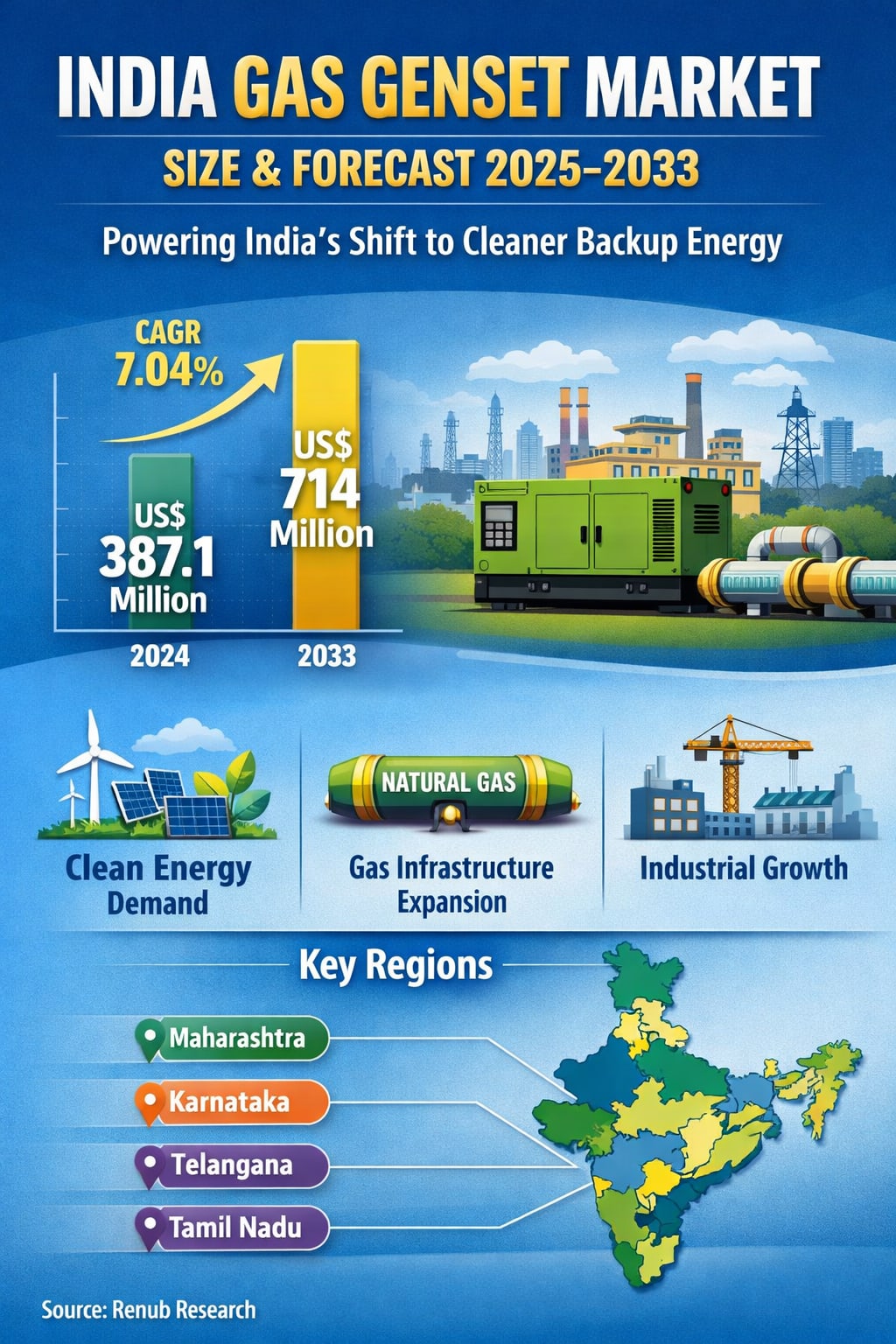
India Gas Genset Market Overview
The India gas genset market is entering a strong growth phase, driven by the country’s urgent need for reliable, cleaner, and more efficient power backup solutions. According to Renub Research, the market is expected to grow from US$ 387.1 million in 2024 to around US$ 714 million by 2033, registering a compound annual growth rate (CAGR) of 7.04% during the period 2025 to 2033.
This impressive expansion is being fueled by several converging factors: the growing demand for dependable power supply, stricter environmental regulations, government policies promoting clean energy, rapid industrialization, and the expansion of natural gas infrastructure across India. As power reliability continues to be a challenge in many regions, gas gensets are increasingly being seen as a practical, sustainable alternative to traditional diesel generators.
A gas genset (gas generator set) is a power generation system that uses natural gas, biogas, or LPG to produce electricity. It typically consists of an engine, alternator, and control systems that convert the chemical energy of gas into electrical power. Compared to diesel gensets, gas gensets are known for lower emissions, quieter operation, and better fuel efficiency, making them especially attractive in urban, commercial, and environmentally sensitive areas.
In India’s evolving energy landscape, gas gensets are no longer just a backup option—they are becoming a strategic component of cleaner, more resilient power infrastructure.
Why Gas Gensets Are Gaining Popularity in India
India’s power ecosystem is changing rapidly. While grid capacity has improved, power outages, voltage fluctuations, and peak load shortages still affect many industrial, commercial, and even residential users. For businesses, even a short power interruption can mean production losses, data risks, and operational disruptions.
At the same time, environmental awareness and regulatory pressure are pushing industries to move away from high-emission diesel generators. Gas gensets offer a compelling solution: they provide reliable backup power while significantly reducing carbon emissions, particulate matter, and noise pollution.
Government initiatives to promote clean fuels, city gas distribution (CGD) networks, and a higher share of natural gas in the energy mix are further strengthening the case for gas-based power generation. As a result, sectors such as manufacturing, healthcare, IT & data centers, commercial real estate, and infrastructure development are increasingly adopting gas gensets for both standby and continuous power needs.
Key Growth Drivers in the India Gas Genset Market
1. Rising Demand for Clean and Environment-Friendly Power Solutions
One of the strongest drivers of the gas genset market in India is the growing emphasis on sustainability and emission reduction. With stricter pollution norms such as CPCB IV+, many industries are actively shifting away from diesel gensets toward cleaner alternatives.
Gas gensets running on natural gas, LPG, or biogas emit significantly lower levels of carbon dioxide, nitrogen oxides, and particulate matter compared to diesel generators. This makes them more compliant with environmental regulations and more attractive for companies focused on ESG (Environmental, Social, and Governance) goals.
A notable development in this space came in July 2025, when a collaboration led to the launch of the ‘Daimon Genset,’ India’s first CPCB IV+ certified 10 kVA LPG genset, manufactured by Cooper Corporation. This product set a new benchmark for cost-effective and sustainable power generation and highlighted how innovation is accelerating the shift toward cleaner genset technologies in India.
As environmental compliance becomes non-negotiable and corporate sustainability targets become stricter, the demand for gas gensets is expected to rise steadily across industries.
2. Expansion of Natural Gas Infrastructure and City Gas Distribution Networks
Another major growth catalyst is the rapid expansion of India’s natural gas infrastructure. The government aims to increase the share of natural gas in the country’s primary energy mix from around 6% to 15% by 2030. To support this goal, significant investments are being made in pipelines, LNG terminals, and city gas distribution (CGD) networks.
As CGD networks expand into more cities, industrial hubs, and even smaller towns, access to reliable and affordable gas supply is improving. This directly boosts the feasibility of gas gensets, as users can reduce fuel logistics costs and ensure more consistent operations.
In a related move, the Indian government commissioned a Smart Gas Meter Manufacturing Unit established by IGL in partnership with Genesis Gas Solutions. The facility, expected to start production in October 2025, will have the capacity to produce around one million gas meters annually, supporting India’s push toward modern, efficient, and self-reliant gas infrastructure.
With better gas availability and infrastructure support, gas gensets are becoming a more practical and attractive choice for a wider range of users.
3. Rapid Industrialization and Infrastructure Development
India’s ongoing industrial and infrastructure boom is another powerful engine driving the gas genset market. Initiatives such as “Make in India,” smart city projects, industrial corridors, logistics parks, and large-scale infrastructure construction are significantly increasing the demand for reliable power backup.
Industries such as manufacturing, healthcare, IT services, data centers, cement, steel, and automotive require uninterrupted power to maintain productivity and protect sensitive equipment. Gas gensets offer a cost-effective, cleaner, and efficient alternative to diesel, especially for facilities located near CGD networks.
The expansion of commercial real estate in Tier 2 and Tier 3 cities, including shopping malls, office complexes, hospitals, and educational institutions, is further adding to the demand for medium and high KVA gas gensets. As India continues to build and industrialize, the need for dependable on-site power solutions will only grow stronger.
Challenges Facing the India Gas Genset Market
1. Gas Availability and Infrastructure Constraints
Despite strong policy support, uneven gas availability remains a key challenge. Many rural and remote areas still lack access to piped natural gas, making it difficult to operate gas gensets reliably. In such regions, diesel remains the default choice due to easier fuel availability.
Additionally, high initial costs for gas storage, pipelines, and related infrastructure can discourage smaller users. Delays in CGD network expansion and volatility in LNG import prices also create uncertainty around long-term fuel supply and costs. These factors continue to limit the wider adoption of gas gensets in certain parts of the country.
2. High Upfront Costs and Limited Awareness
Gas gensets generally have a higher upfront purchase and installation cost compared to diesel gensets, mainly due to advanced engine technology and additional gas-related infrastructure requirements. While they offer lower operating and maintenance costs over the long term, the initial investment can be a barrier for small and medium enterprises.
Moreover, in many regions, there is still limited awareness about the long-term economic and environmental benefits of gas gensets. Some users also perceive them as more complex to install and maintain. Without better financing options, incentives, and awareness campaigns, this challenge may continue to slow market penetration.
Segment Insights
India Medium KVA Gas Genset Market
The medium KVA segment (75–375 KVA) primarily serves small and medium industries, commercial complexes, and residential communities. Growth in the IT sector, rising urbanization, and the increasing number of mid-sized manufacturing units are key demand drivers.
These gensets strike a balance between performance, cost-effectiveness, and environmental compliance, making them ideal for hospitals, malls, educational institutions, and office buildings. Their lower noise and emission levels compared to diesel gensets also make them suitable for urban and environmentally sensitive zones.
India High KVA Gas Genset Market
The high KVA segment (above 375 KVA) caters to large industrial facilities, data centers, infrastructure projects, and major commercial complexes. The rapid growth of data centers and heavy industries such as cement, steel, and automotive manufacturing is significantly boosting demand in this segment.
As emission norms tighten and corporate sustainability goals become more ambitious, large enterprises are increasingly opting for high-capacity gas gensets to ensure reliable, cleaner backup power for mission-critical operations.
India Industrial Gas Genset Market
Industrial users represent the largest share of gas genset demand in India. Manufacturing plants, process industries, and factories require continuous and stable power to avoid production losses and equipment damage.
With lower operating costs, reduced emissions, and better suitability for continuous operation, gas gensets are steadily replacing diesel gensets in many industrial settings—especially those located near CGD networks.
Regional Market Highlights
Jharkhand
Jharkhand’s gas genset market is supported by its strong base in metallurgy, mining, and heavy engineering. Industrial centers around Jamshedpur, Bokaro, and Ranchi face power reliability issues, driving demand for dependable backup solutions. As gas connectivity improves and sustainability regulations tighten, the shift from diesel to gas gensets is expected to continue.
Karnataka
Karnataka, especially cities like Bengaluru, Mysuru, and Mangaluru, is seeing rising adoption of gas gensets in IT parks, data centers, hospitals, and commercial buildings. The state’s focus on clean energy and the expansion of CGD networks are supporting steady market growth.
Telangana
Hyderabad’s rapid expansion as an IT, pharma, and logistics hub is boosting demand for medium and high KVA gas gensets. Improved gas infrastructure and government support for energy efficiency are making gas gensets an increasingly attractive choice for businesses in the region.
Maharashtra
With its vast industrial base and strong CGD infrastructure, Maharashtra is one of the largest markets for gas gensets in India. Cities like Mumbai and Pune—also major data center hubs—are driving strong demand for high-capacity, low-emission gensets.
Tamil Nadu
Tamil Nadu’s strong presence in textiles, automotive, electronics, and manufacturing is fueling steady growth in the gas genset market. Cities such as Chennai, Coimbatore, and Hosur are emerging as key demand centers, supported by industrial expansion and clean energy policies.
Competitive Landscape
Key companies active in the broader genset ecosystem include:
Kirloskar Oil Engine
Mahindra & Mahindra Ltd
Ashok Leyland
Cummins India Ltd
Greaves Cotton Ltd
Caterpillar Inc.
Escorts Limited
Powerica Ltd.
These players are focusing on technology upgrades, cleaner fuel compliance, and product innovation to stay competitive in a market that is increasingly shaped by environmental regulations and efficiency demands.
Final Thoughts
The India gas genset market is clearly on a strong growth trajectory. With the market projected to rise from US$ 387.1 million in 2024 to US$ 714 million by 2033 at a CAGR of 7.04%, gas gensets are set to become a crucial pillar of India’s cleaner and more reliable power ecosystem.
While challenges such as infrastructure gaps and high upfront costs remain, the long-term outlook is highly positive. Driven by clean energy policies, industrial expansion, infrastructure development, and stricter emission norms, gas gensets are steadily moving from a niche solution to a mainstream power backup choice.
About the Creator
The Devil's Triangle
The sails ruffled in the breeze as we cruised along. The Sea Breeze was a mid-size catamaran that sailed out of Royal Naval Dockyard in Bermuda. We had booked this trip weeks in advance and were now looking at our Captain, Spike and two boat hands. Paddy and Wilson seemed like nice guys, joking around with the passengers and telling us some stories about Bermuda that only locals would know. Their island accents sounded almost British but they were pleasant to listen to.
By Barbara Gode Wiles6 days ago in Fiction




Comments
There are no comments for this story
Be the first to respond and start the conversation.